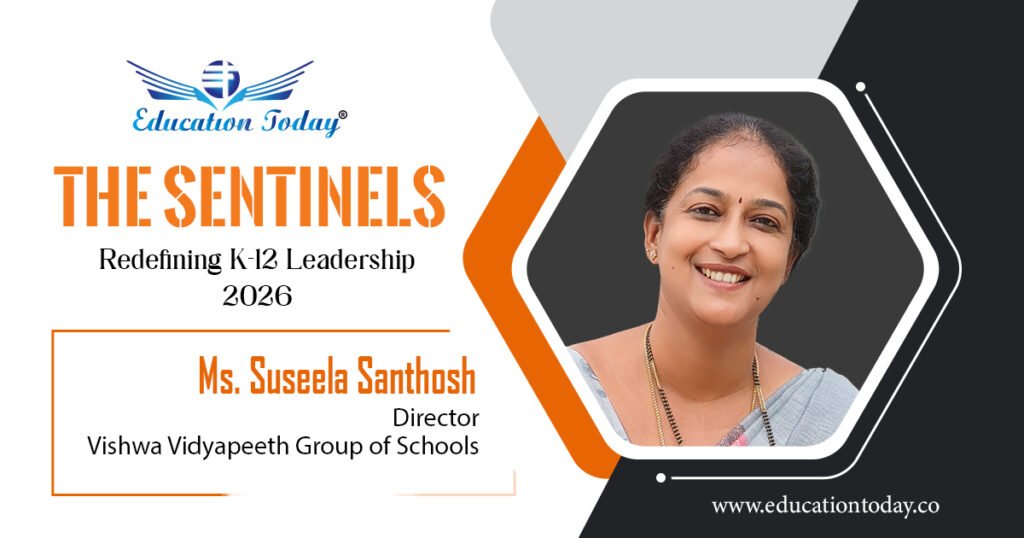
In an era where global education is frequently reduced to a frantic pursuit of quantifiable metrics, true leadership is found in the quieter, enduring spaces of human growth. This philosophy sits at the heart of the Vishwa Vidyapeeth Group of Schools, steered by the visionary hand of its Director, Suseela Santosh. Her approach represents a definitive departure from the rigid blueprints of traditional pedagogy, opting instead for a leadership style rooted in profound purpose and purpose-led education shaped by the very people it serves. To understand her impact is to recognise a fundamental shift in the “why” of schooling, moving from an assembly line of information toward a garden of human flourishing.
A Journey Defined by Moments, Not Milestones
For Ms. Suseela Santosh, the path to educational distinction was never a pre-ordained route. It was an organic evolution forged through years of attentive listening within the classroom. Early in her career, she rejected the notion that schooling should be a linear race toward examination scores or sterile benchmarks. She recognised that the true essence of education lies in how a child experiences the act of learning and, crucially, how educators respond to that unique, unpredictable journey. This rejection of a “metrics-first” mentality allowed her to cultivate a space where the child is the protagonist rather than the product.
Progress, in her estimation, often arrives without spectacle. It manifests in a hesitant child finally finding their voice, a teacher rediscovering professional confidence through shared inquiry, or a community of parents aligning around deeply held values. At Vishwa Vidyapeeth, these moments are intentionally nurtured through a culture of patience. By viewing childhood as an expansive phase of exploration rather than a competitive sprint, Ms. Suseela Santosh has created a cadence of learning that balances intellectual rigour with deep-seated empathy and holistic learning. Experiential initiatives, ranging from mathematical festivals like Ganitha Mela to immersive “Back to Gurukula” visits, are designed to linger in the memory long after formal assessment fades, ensuring that the joy of discovery remains the primary driver of the academic experience.
The Evolution of a Philosophy: From Instruction to Inquiry
The hallmark of Ms. Suseela Santosh’s leadership is the shift from constant explanation to a more nuanced, sophisticated restraint. She champions a pedagogical tradition where mentorship supersedes mere instruction and understanding grows through relationship rather than rote repetition, reflecting the principles of inquiry based education. In this environment, questions carry as much weight as answers. Students are invited to explore ideas and test assumptions, often losing their way before finding clarity. This intentional embrace of uncertainty echoes older, more profound pedagogical traditions where mentorship replaced rigid instruction and understanding grew through the steady, collaborative pursuit of truth.
Translating this ethos into the modern classroom demands immense discernment. Structure is maintained only where it supports growth and is gently loosened when it threatens to inhibit the natural, messy inquisitiveness of the learner. By focusing on how children see themselves and engage with others, the curriculum at Vishwa Vidyapeeth shapes character as much as cognition. This ensures that education informs how students respond to complexity, providing them with the internal tools to navigate an increasingly convoluted world. It is a philosophy that trusts the learner’s process, allowing for a “productive struggle” that builds genuine intellectual stamina and self-assurance, reinforcing student development.
Beyond the Screen: A Thoughtful Integration of Technology
In a digital-first world, Ms. Suseela Santosh maintains a sophisticated stance on technology, viewing it as neither an adversary to be feared nor a universal saviour to be blindly adopted. Under her guidance, digital tools are introduced with profound intention, framed by dialogue rather than dependence, aligning with the evolving demands of digital learning. Students are encouraged to pause and interrogate their digital encounters, questioning sources of information and being mindful of the emotional responses triggered by the screen. This is not about technological literacy in the technical sense, but about technological wisdom, the ability to remain human in a digital landscape.
This gradual cultivation of agency ensures that technology becomes a genuine aid rather than a distraction that erodes attention or inner stillness. The goal is for learners to regulate their own engagement, recognising when technology serves a specific purpose and when distance is required to restore focus. By prioritising “thoughtful use” over “constant use,” Ms. Suseela Santosh ensures that digital tools enhance human connection rather than replacing it. It is a commitment to ensuring that the internal world of the child remains as vast and vibrant as the digital world they frequent.
Leadership as Connection: The Power of Mentorship
The leadership model practised by Ms. Suseela Santosh is inherently anti-hierarchical. It is a practice grounded in reflection rather than command, where the Director walks alongside her staff rather than standing above them, exemplifying progressive education leadership. She believes that the most transformative moments in a school occur when administrators and educators step back to examine their intent and impact. Mentorship, in this context, is an exercise in listening. By asking the right questions and withholding immediate solutions, space is created for genuine insight and professional growth to occur organically.
When teachers feel secure enough to experiment without the fear of judgment, reflection becomes a habit rather than a procedural requirement. This collective responsibility ensures that education does not thrive in isolation; it becomes a sustained ecosystem involving teachers, families, and the wider community. Leadership then evolves from direction into connection, quietly sustaining the ecosystem of learning through a shared commitment to the child’s well-being. This model of leadership is understated and deeply reflective, proving that true influence is often found in the ability to empower others to lead within their own spheres.
Educating for an Unwritten Future
The world today is marked by unprecedented volatility. Recognising this, Ms. Suseela Santosh advocates for an education that prepares children not for known outcomes, but for uncertainty itself, aligning with the principles of future-ready education. Since the future defies precise forecasting, she identifies adaptability and resilience as the essential currencies of the next generation. Rather than training students to follow predetermined paths, schools must equip them to think independently, collaborate meaningfully, and remain grounded amid the inevitable ambiguity of the 21st century. These capabilities are forged gradually through moments of doubt, reflection, and courageous trial.
In her view, education is no longer about delivering definitive answers. It is about helping children stand firm when clarity is absent, guided by curiosity and a robust ethical compass. This vision for the future is resolute: schools must extend beyond academic excellence to prepare children for real-world complexities. This involves fostering a readiness that includes emotional intelligence, ethical discernment, and the ability to pivot in the face of unforeseen challenges.
Looking Forward: A Vision of Belonging
For Ms. Suseela Santosh, accolades and honours, such as the institution being guided to national prominence among leading ICSE schools in India and recognition by EducationToday, are merely mirrors reflecting a shared, communal effort. They represent teachers extending themselves beyond the limits of their job descriptions, students asking questions that transcend the boundaries of the syllabi, and parents sustaining the learning environment within the home. Her leadership is defined not by standing apart, but by the relentless pursuit of a vision where every stakeholder feels a deep sense of ownership.
Ultimately, her vision is one where campuses remain spaces of true belonging. In these spaces, teachers continue to evolve with purpose, and children arrive with anticipation, anchored in the steady belief that every child carries unrealised potential. It is a devotion to the work that shapes lives long after the final lessons end. By maintaining this focus on the profoundly relational nature of education, Ms. Suseela Santosh ensures that the Vishwa Vidyapeeth Group of Schools remains a beacon of compassion and inquiry in an increasingly automated world. Education, for her, remains a pursuit anchored in the belief that when we invest in the person, the performance naturally follows, redefining the essence of modern schooling.
Ms. Suseela Santosh is an education leader associated with Vishwa Vidyapeeth Group of Schools, dedicated to promoting quality and student-focused education.
Her vision emphasizes academic excellence, holistic development, innovation, and nurturing students with the skills needed for lifelong success.
The school group is recognized for its commitment to quality education, modern teaching methods, and fostering all-round student development.
The schools focus on critical thinking, leadership, technology integration, and experiential learning to prepare students for higher education and global opportunities.
Holistic education helps students develop intellectually, emotionally, socially, and ethically, creating confident and responsible global citizens.