
Table of Contents
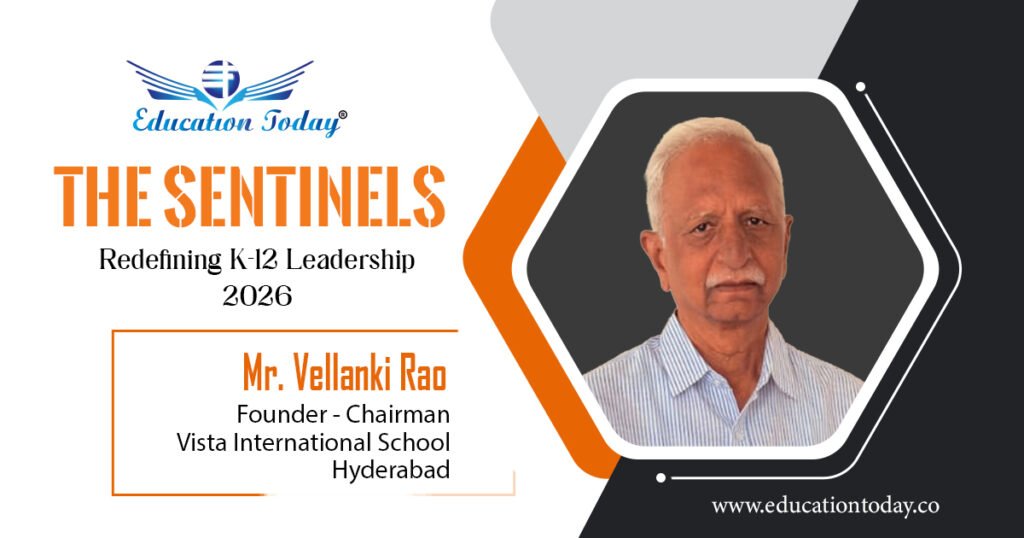
In the contemporary educational landscape, where institutional success is often erroneously conflated with architectural grandeur or the sheer volume of annual enrolments, a profounder paradigm exists. It is one where leadership is not viewed as a static position of authority, but as a dynamic, moral responsibility. At the helm of this philosophical shift stands Vellanki Rao, the Founder-Chairman of Vista International School. His stewardship, recognised by EducationToday for its commitment to purposeful educational leadership offers a masterclass in how a clear conviction, anchored in mentorship, reflective practice, and values-driven education, can transform a school from a mere building into a living, breathing community of learners.
Leadership as a Moral Imperative
For Mr. Vellanki Rao, leadership within the educational sphere is neither a title to be flaunted nor a mechanism for control. Instead, it is a profound responsibility to children, to educators, to parents, and to the larger society we serve. This conviction forms the bedrock of Vista International School. In his view, a school’s enduring impact is not shaped by infrastructure or transient accolades, but by the strength of its human relationships and the ethical integrity of its leaders.
This perspective challenges the prevailing corporate model of education that often prioritises administrative efficiency over individual growth. Mr. Rao’s approach suggests that true excellence is an emergent property of a supportive environment. When leadership is rooted in service rather than ego, it creates a ripple effect that extends from the boardroom to the classroom, ultimately shaping the lives and characters of the students. It is a commitment to the “long game” of education, where the success of an institution is measured by the quality of the citizens it produces decades after they have left the campus, reinforcing the importance of education leadership India.
Mentorship: The Institutional Ethos
At Vista, mentorship is not a sporadic initiative or a formal periodic programme; it is woven into the very fabric of the institution. Mr. Vellanki Rao envisioned a culture where growth flows in every direction from senior leadership to faculty, and from teachers to students, embodying the essence of mentorship in education. This continuity ensures that learning is never an isolated event but a collective, sustained endeavour that defines the school’s identity.
Senior leaders at Vista do not merely manage; they mentor. Experienced educators guide younger faculty members, ensuring that pedagogical wisdom is shared and institutional memory is preserved. This culture of support trickles down to the students. When teachers feel trusted and supported by their chairman, they transform classrooms into spaces of curiosity and confidence. Students, in turn, evolve from passive recipients of instruction into capable, reflective learners. By embedding mentorship into its DNA, the school has achieved a rare balance: it evolves with changing educational demands while remaining firmly anchored to its founding values. This creates a stable environment that paradoxically encourages constant, incremental innovation.
Reflection: The Discipline of Thoughtful Leadership
In an era that celebrates speed and visible, often superficial metrics, Mr. Vellanki Rao champions the discipline of reflection. Under his guidance, reflection is treated as a compass that keeps the institution aligned with its core purpose, exemplifying reflective leadership. It is a practice that demands courage, as it requires leaders and educators to move beyond self-congratulation and engage in rigorous self-interrogation.
Reflective practice at Vista compels the community to ask difficult but necessary questions. Are students being prepared only for examinations, or for life beyond the school gates? Are the systems in place truly empowering educators to excel? Is the parent community meaningfully and authentically engaged in the educational journey? This introspective habit prevents the complacency that often follows success. It ensures that achievements do not dull ambition and that challenges are approached as opportunities for refinement rather than occasions for blame. When reflection becomes habitual, institutional leadership shifts from reactive crisis management to intentional, long-term vision. It allows the school to maintain a steady course even when the external educational environment becomes turbulent.
The Three Pillars of the Vista Philosophy
The leadership philosophy of Mr. Vellanki Rao rests on three enduring pillars that guide the daily operations and long-term strategy of the school. These are not merely abstract concepts but are practiced with a rigour that permeates every level of the organisation.
The first is Clarity of Purpose. This is a steadfast commitment to what the school stands for, ensuring every decision aligns with the holistic learning and development of the child. Second is Consistency in Action. This stems from the understanding that excellence is not an act but a habit, requiring a steady and predictable hand at the helm to provide students with a sense of security. Finally, Compassion in Execution is the recognition that education is fundamentally a human endeavour, requiring empathy and heart in every interaction. These principles are particularly vital in a rapidly evolving global context. Mr. Rao recognises that students today require more than academic proficiency; they must cultivate adaptability, ethical reasoning, collaboration, and emotional intelligence. Consequently, his leadership prioritises safeguarding holistic development alongside scholastic excellence, strengthening overall student development.
Building Community, Not Merely an Institution
A recurring theme in Mr. Vellanki Rao’s discourse is the distinction between an institution and a community. Vista was conceived as the latter. He posits that education flourishes only when parents are treated as partners, teachers as collaborators, and students as the central reason for the community’s existence. This sense of community is built on a foundation of transparency and mutual respect, reflecting progressive school leadership practices. When stakeholders feel heard, alignment follows naturally, and the friction of administrative hurdles is replaced by the momentum of shared goals.
Inclusivity further strengthens this ecosystem. By respecting diversity of thought and background, the school prepares students to engage meaningfully with a complex, globalised world. In his estimation, a school must mirror the society it hopes to nurture, one defined by responsibility, respect, and a shared commitment to the common good. This involves fostering an environment where different perspectives are not just tolerated but are seen as essential to the learning process. Under Mr. Rao’s stewardship, the school becomes a microcosm of a functional, respectful society.
Leadership Rooted in Service and Humanity
Education is fundamentally a moral undertaking. Leadership within a school must therefore be grounded in service. For Mr. Vellanki Rao, influence has always mattered more than authority. Leadership is about creating clarity during periods of uncertainty and nurturing trust during moments of doubt. Every academic and administrative decision carries a ripple effect that extends directly into students’ lives. This requires a leader who is as decisive as they are empathetic.
Mr. Rao believes that a leader must combine empathy in execution with decisiveness in vision. This duality allows Vista to remain a sanctuary of learning while pursuing the highest standards of excellence. It is about understanding the human cost of policy and the human potential within every administrative shift. By viewing the school as a moral entity, he ensures that the education provided is not just about the accumulation of facts, but about the formation of a robust, ethical character within the modern education system.
The Continuing Commitment to Enduring Impact
The journey of Vista International School is not about immediate triumph or transient glory; it is about enduring impact. Mr. Vellanki Rao’s commitment remains clear: to mentor with intent, to reflect with honesty, and to lead with unwavering integrity. While infrastructure may expand and external recognition may follow, he maintains that the true strength of the institution lies in its people. He frequently reminds his team that buildings are static, but people are the dynamic force that drives change and inspires growth.
Education, at its core, is profoundly human. When mentorship guides progress and reflection grounds decisions, schools do more than merely educate; they inspire generations. Mr. Rao’s stewardship serves as a poignant reminder that leadership with purpose has the power to shape futures that extend far beyond the school walls. His legacy is not found in the bricks and mortar of the campus, but in the reflective learners and ethical leaders who graduate from Vista, carrying with them the values of a chairman who walked alongside them. He remains devoted to the work that shapes lives long after the lessons end, ensuring that Vista remains a beacon of excellence anchored in ethics.
Mr. Vellanki Rao is an education leader recognized for his purpose-driven approach to leadership, innovation, and holistic student development.
His philosophy centers on purposeful leadership, continuous reflection, educational innovation, and creating meaningful learning experiences.
Reflective leadership helps educators evaluate practices, improve teaching strategies, and foster continuous growth for students and institutions.
It creates a positive learning culture, strengthens collaboration, encourages innovation, and supports long-term academic excellence.
His vision nurtures confident, responsible, and future-ready learners equipped with critical thinking, leadership, and lifelong learning skills.