Table of Contents
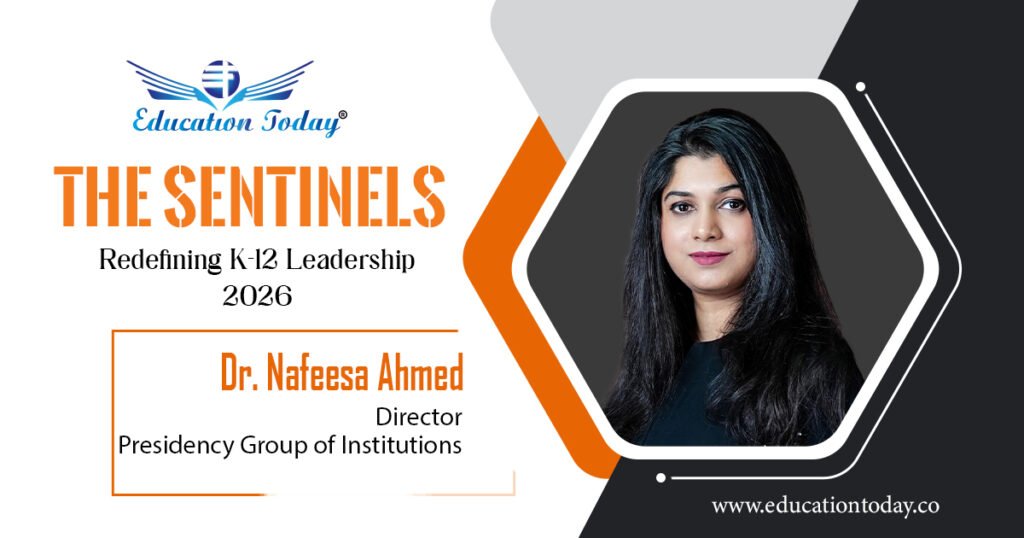
In the contemporary educational landscape, where the sheer velocity of technological change often threatens to decouple learning from its humanistic moorings, leadership requires more than administrative prowess; it demands a profound philosophical anchor. At the vanguard of this institutional renaissance is Nafeesa Ahmed, Director of the Presidency Group of Institutions. Building upon a storied legacy initiated in 1976, Dr. Ahmed has spent over a decade transmuting a traditional academic inheritance into a sophisticated, multi-tiered ecosystem of innovation rooted in modern pedagogy. Her stewardship across K-12, pre-collegiate, and university sectors is defined by a singular, overarching conviction: that education is not merely a mechanism for the transmission of data, but a sacred duty to cultivate human flourishing in an unwritten future.
A Journey Defined by Intentionality and Scholarly Rigour
The professional trajectory of Dr. Nafeesa Ahmed is marked by a rare synthesis of global academic exposure and a granular understanding of local educational exigencies. Her intellectual foundation, a Master’s in International Management complemented by advanced qualifications in Education and English, was refined at world-renowned crucibles of thought, including University College London, Harvard University, and the Wharton School. This extensive academic pedigree has birthed a leadership style that is simultaneously strategic and deeply empathetic, rooted in the belief that an institution’s strength is measured by the intellectual independence of its youngest members.
Dr. Ahmed’s evolution from a practitioner to a systemic visionary was catalysed by a deliberate shift away from conventional, outcome-heavy instruction toward a learner-oriented framework grounded in inquiry-based learning. This transition was not merely a change in methodology but a profound moral realignment. She recognised early in her tenure that academic proficiency, while necessary, is insufficient for the complexities of modern life. True leadership, she posits, is found in the responsibility to create sustainable impact, ensuring that every pedagogical shift aligns with a core set of values that include integrity, reflection, and a steadfast commitment to the individual potential of every student. This focus on long-term human value ensures that the institutions under her care do not merely produce graduates, but resilient, ethical citizens, strengthening overall student development.
Reimagining the Pedagogical Blueprint: From Instruction to Inquiry
The cornerstone of Dr. Nafeesa Ahmed’s philosophy is the reimagining of the classroom as a laboratory of inquiry rather than a theatre of instruction. Under her guidance, the Presidency Group has pivoted toward a learner-centred model where students are active participants in their own cognitive development. In this paradigm, teaching is viewed as a form of academic leadership, where the educator’s role is to curate environments that stimulate curiosity and demand rigorous analytical reasoning. This shift represents a move away from the “banking model” of education, where information is simply deposited into students, toward a model of active construction of knowledge.
This shift has profound implications for how growth is measured. Dr. Ahmed has moved the institutional focus away from structured, static outcomes toward a framework that values emotional security and inclusion as the prerequisites for intellectual risk-taking. Assessment, in this context, is no longer a terminal verdict on a student’s ability but a diagnostic tool for self-awareness and iterative growth. By balancing intellectual challenge with relevance, she ensures that the academic experience resonates with the real-world readiness required for the 21st century, reinforcing the principles of holistic learning. It is an approach that prepares students to handle ambiguity and complexity with confidence.
Digital Wisdom: Navigating the Technocratic Epoch
In an era of ubiquitous connectivity, Dr. Ahmed’s stance on technology is both sophisticated and healthily sceptical. She champions “Digital Wisdom” over mere digital literacy, advocating for a principled integration of technology that reflects digital wisdom education, preserving the sanctity of human reflection. For Dr. Ahmed, the objective is to develop discerning thinkers rather than digitally reliant learners. This requires a curriculum that treats technology as a tool for extension rather than a replacement for cognitive effort.
In the Presidency institutions, technology is utilised as a strategic aid to enhance inquiry, creativity, and collaborative problem-solving. However, she remains vigilant against the erosion of focus that often accompanies unmediated screen time.
Independent Judgement: Students are trained to interrogate information, assessing its provenance and credibility with a critical eye.
Ethical Conduct: Digital responsibility is treated as a core competency, involving self-regulation and a balanced approach to virtual engagement.
Experiential Vitality: Dr. Ahmed maintains that the most profound learning still occurs through face-to-face discussion, physical experimentation, and reflective engagement, activities that technology can support but never replace.
This disciplined approach ensures that as students navigate increasingly complex digital spaces, they do so with a steady moral compass and an undiminished capacity for deep, sustained concentration.
The Mentorship Ecosystem: Leadership as Service
Central to the sustainability of the Presidency Group is Dr. Ahmed’s commitment to collective accountability. She views the school not as a hierarchy, but as a collaborative ecosystem built on the pillars of mentorship and reflective practice, embodying the essence of mentorship in education. By investing deliberately in the professional capacity of educators, she ensures that institutional growth is organic and continuous.
Mentorship, in her view, is the conduit through which institutional values are preserved and evolved. When educators feel valued and empowered, they become the primary models of the integrity and mutual respect they seek to instill in their students. This unified vision creates a sense of collective ownership over student outcomes, where leadership is decentralised, and excellence becomes a shared habit. Dr. Ahmed’s focus on building cohesive teams ensures that the institutional culture remains resilient, even in the face of broader societal or educational shifts, reinforcing her role in education leadership in India.
Navigating Tomorrow: Roots and Wings
As students prepare to enter a world defined by volatility and rapid transformation, Dr. Nafeesa Ahmed emphasises the necessity of adaptability as the primary currency of the future. She argues that education must prioritise problem-solving, ethical judgement, and effective communication over the mastery of fixed academic endpoints. Disciplinary knowledge remains the foundation, but it is the ability to apply that knowledge in novel, unforeseen contexts that will define the leaders of tomorrow.
Values-based education serves as the steady moral foundation in these uncertain times. By modelling lifelong learning and a relentless capacity for adaptation, Dr. Ahmed empowers her students to do more than just navigate the future, she equips them to shape it. Her vision is aligned with the principles of future-ready education, providing students with both grounding and global readiness.
Conclusion: A Legacy of Transformative Stewardship
Ultimately, the impact of Dr. Nafeesa Ahmed is best observed in the calibre of graduates the Presidency Group of Institutions produces, individuals who possess not just the grades to enter elite universities, but the resilience, intellectual independence, and ethical awareness to thrive within them. Her stewardship is a testament to the power of a vision that is both legacy-driven and future-focused.
In a world often preoccupied with transient metrics and league table standings, Dr. Ahmed remains a sentinel of purposeful education. She understands that the true measure of success is found in the character of the community she has built and the enduring curiosity of the minds she has shaped. Under her leadership, the Presidency Group continues to be a beacon of excellence, earning recognition from EducationToday while proving that when education is anchored in integrity and reflection, it has the power to transform not just individual lives, but the very fabric of society.
Dr. Nafeesa Ahmed is an education leader dedicated to empowering learners through visionary leadership, innovation, and values-driven education.
Her philosophy focuses on combining vision, values, and innovation to create engaging, inclusive, and future-ready learning environments.
Innovation encourages creativity, critical thinking, collaboration, and problem-solving, helping students excel academically and personally.
Values-based education develops integrity, empathy, responsibility, and resilience, preparing students to become ethical global citizens.
She promotes holistic development, technology-enabled learning, leadership, and lifelong learning skills to help students thrive in a changing world.