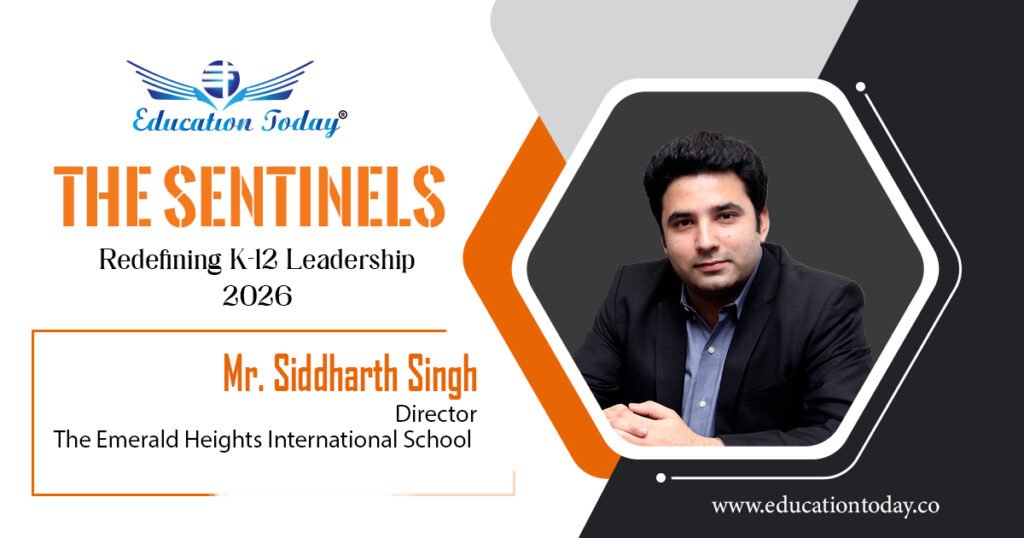
In the contemporary educational landscape, where the tides of technological disruption often clash with the bedrock of traditional academic rigour, the role of a school leader has shifted from administrative overseer to visionary strategist within the framework of modern education. At the forefront of this evolution stands Mr. Siddharth Singh, the Director of Emerald Heights International School, Indore, a benchmark institution in education in India. An alumnus of Stony Brook University with a background in Economics, Finance, and an MBA, Mr. Singh’s leadership is defined by a rare synthesis of systems thinking and humanistic values rooted in school leadership. His professional journey, enriched by strategic leadership programmes at the Harvard Graduate School of Education and IIM Kozhikode, reflects a profound commitment to redefining the purpose of schooling for a globalised, unpredictable era through K-12 leadership and global pedagogy.
From Systems Thinking to Scholastic Excellence
Mr. Siddharth Singh’s entry into the educational sector was neither accidental nor purely conventional within the domain of education innovation. His early professional life was rooted in the high-stakes worlds of economics and finance, where he developed an acute appreciation for operational efficiency and institutional structure. A formative tenure in China, focused on streamlining industrial operations, provided him with a unique lens through which to view organisational growth. When he transitioned these insights into the realm of education, he did not merely bring a business mindset; he brought a “systems thinking” approach that views a school as a dynamic, interconnected ecosystem supporting modern education.
Under his stewardship, Emerald Heights International School has transcended local benchmarks to become a globally recognised institution. However, for Mr. Singh, milestones are not merely found in rankings or examination metrics aligned with education in India. Instead, they are reflected in the evolving culture of the school, a community that has become increasingly outward-looking, confident, and values-driven. He champions a definition of achievement that balances scholastic distinction with the “softer” but more enduring qualities of integrity, empathy, and civic responsibility shaped by school leadership. Success is measured by the school’s ability to produce individuals who are as ethically grounded as they are intellectually brilliant.
A Philosophy in Motion: From Instruction to Agency
The most striking aspect of Mr. Singh’s leadership is his radical departure from the traditional “transmission” model of education within modern education. In an age characterised by information ubiquity, he argues that the challenge for the modern learner is no longer access to data, but the capacity for discernment. This philosophy posits that the teacher’s role has migrated from being a ‘sage on the stage’ to a ‘guide on the side,’ facilitating a journey of discovery rather than a lecture of facts grounded in global pedagogy.
“Today’s learners do not require more data,” Mr. Singh suggests. “They require the capacity to interrogate, synthesise, and apply it meaningfully.”
This shift from instruction to exploration is the cornerstone of his pedagogical philosophy of inquiry-based learning. He advocates for a “Grammar of Inquiry,” where curiosity is prized over compliance and where questioning is treated as a sign of intellectual vitality rather than a disruption of order. In Mr. Singh’s view, uniformity is the enemy of excellence. Because the modern generation is defined by a vast diversity of talent and perspective, the school environment must be flexible enough to recognise individual pathways for future-ready students.
This cultural transformation requires that emotional wellbeing and interdisciplinary thinking sit alongside academic rigour. When students feel acknowledged and trusted, they cease to be passive recipients of a curriculum and become active participants in their own intellectual development. This sense of agency is what allows a student to transition from a pupil to a scholar.
Digital Wisdom: Cultivating the Thinking Citizen
In the discourse of 21st-century schooling, technology often occupies centre stage, yet Mr. Siddharth Singh maintains a measured and critical perspective on its integration within digital learning. He draws a sharp distinction between “digital access” and “digital wisdom.” The objective of The Emerald Heights is not to increase screen time indiscriminately but to nurture a thoughtful, ethical engagement with digital tools.
Mr. Singh views technology as a conduit for creativity and collaboration, but warns that without the anchor of critical thinking, it can rapidly descend into a source of distraction or misinformation. His institution, therefore, emphasises:
- Information Discernment: Teaching students to evaluate the provenance of digital sources and identify inherent biases in algorithms.
- Ethical Innovation: Encouraging students to consider the societal consequences of new technologies, such as Artificial Intelligence and automation.
- Creative Agency: Moving students from being “consumers” of tech to “creators” who use STEM projects and global learning networks to solve real-world problems.
In this framework, the digital apparatus is not an end in itself; it is a means through which human imagination and intellect may find their most practical and impactful expression. Digital literacy is thus reframed as a foundational skill for modern citizenship.
The Architecture of Mentorship and Global Citizenship
For Mr. Singh, leadership is an inherently relational act within K-12 leadership. He contends that strong schools are built upon a foundation of mutual respect and attentive listening. Consequently, mentorship and reflection are woven into the institutional fabric—not just for the pupils, but for the faculty and administration as well. This creates a “community of practice” where every stakeholder is committed to continuous improvement.
He is a staunch advocate for “Reflective Practice,” a discipline that gives educators the psychological space to assess their methods and refine their craft. This investment in human capital ensures that classrooms remain grounded in trust. Furthermore, Mr. Singh’s extensive work with international networks underscores his commitment to experiential learning and global citizenship. Through these platforms, students at Emerald Heights are exposed to the pillars of:
- Internationalism: Understanding perspectives that transcend national borders and cultural silos.
- Democracy and Service: Recognising one’s role in the governance and social upliftment of society.
- Environmental Stewardship: Developing a sustainable mindset to protect a fragile planet.
These global learning networks ensure that students gain a deeper understanding of their role as “World Citizens,” prepared to lead with a sense of duty toward the global community.
Preparing for the Unwritten Future
Perhaps the most compelling dimension of Mr. Siddharth Singh’s outlook is his candid acknowledgement of future uncertainty shaped by future-ready students. The students currently in his classrooms will eventually enter a workforce defined by professions that do not yet exist and challenges that have not yet been identified. Therefore, he believes that preparation cannot be narrowly vocational or focused solely on current industry requirements.
Instead, education must instill “Inner Compass” qualities: adaptability, resilience, and ethical reasoning within education innovation. Preparation for the future, in Mr. Singh’s vision, is about giving students the composure to navigate ambiguity. Lifelong learning is promoted as the only viable response to a world in flux, where the ability to ‘unlearn and relearn’ is as critical as initial mastery.
While exams remain an important benchmark of progress, they are viewed as episodic achievements rather than the ultimate destination. The true aim of The Emerald Heights under Mr. Singh’s guidance is readiness for the next era – intellectually, morally, and civically through digital learning.
Conclusion: Shaping the Inheritors of Tomorrow
In a world oscillating between unprecedented opportunity and systemic uncertainty, the leadership of Mr. Siddharth Singh offers a sense of steadiness and hope within Indian education. By merging the precision of an economist with the heart of a pedagogue, he has created an institution that does not just teach history, but prepares its students to make it through global pedagogy. Through intentional leadership and an unwavering faith in the potential of young people, he is shaping a generation that will not merely inherit the future, but will possess the wisdom and agency to define it. His legacy is found in the hundreds of graduates who step into the world with the courage to lead and the compassion to serve under modern education.
Mr. Siddharth Singh is an education leader focused on advancing school leadership through innovation, vision, collaboration, and future-ready learning.
Global school leadership involves developing educational practices that embrace international perspectives, innovation, collaboration, and diverse learning environments.
Innovation enables schools to adopt modern teaching practices, technology, creative learning models, and effective strategies that support student success.
A clear vision helps school leaders establish meaningful goals, inspire educators, improve learning environments, and prepare students for future opportunities.
Schools can promote critical thinking, collaboration, cultural awareness, digital skills, creativity, and lifelong learning to help students navigate an interconnected world.