
Table of Contents
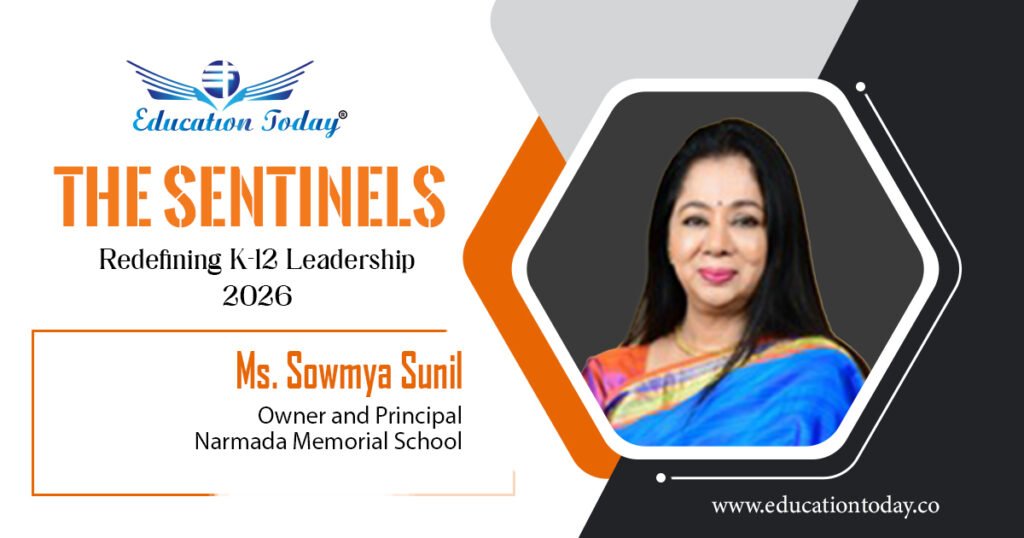
In the dynamic and often shifting terrain of contemporary Indian education, the ability to balance heritage with innovation remains a rare and valuable quality. Ms. Sowmya Sunil, B.Sc., M.Ed., owner and principal of Narmada Memorial School in Bengaluru, embodies this equilibrium precisely, exemplifying values-led education. Her leadership reflects not only an inheritance of educational legacy but also a conscious reimagining of its purpose for a new generation. Rooted in tradition yet responsive to change, her work stands as a testament to the enduring power of values-led education in shaping thoughtful, capable, and future-ready individuals through holistic learning.
A Journey Anchored in Purpose and Continuity
Ms. Sowmya Sunil’s professional trajectory is defined by a deep and sustained engagement with the transformative potential of education. From her formative years as an educator to her current position at the helm of a respected institution, her journey has been marked by a consistent commitment to both academic excellence and human development. Each phase of her career has reinforced a central belief: that education is not merely a structured process, but a profound responsibility, one that shapes the intellectual and moral contours of society, reflecting ethical leadership.
The origins of Narmada Memorial School offer insight into the foundations upon which her leadership rests. Established on 30 January 1965 as Kennedy Memorial School in Wilson Garden by her parents, the distinguished educationists Sri Dr. B. Sridhar and Smt. Narmada Sridhar, the institution quickly earned recognition from the Karnataka Education Department as a centre of academic distinction. Its early ethos was characterised by disciplined teaching, rigorous standards, and a commitment to professional growth among faculty.
A defining moment arrived in 1998, when, following her mother’s passing, Ms. Sowmya Sunil undertook the responsibility of carrying forward this legacy. In rechristening the institution as Narmada Memorial School, she not only honoured her mother’s contributions but also reaffirmed the values upon which the school was built. Over time, she has preserved its foundational principles while introducing contemporary perspectives, ensuring that the institution remains both rooted and relevant. Today, its consistent SSLC results, accomplished alumni, and strong community engagement stand as enduring markers of her stewardship.
Reframing Education: From Instruction to Inquiry
Over the years, Ms. Sowmya Sunil’s educational philosophy has undergone a thoughtful evolution. Moving away from conventional teacher-led models, she has embraced a learner-centred education approach that privileges inquiry, engagement, and reflection. In her view, education must move beyond the mere transmission of information to foster a deeper, more meaningful engagement with knowledge.
This shift is reflected in pedagogical practices that recognise the diversity of learners. Students are encouraged to explore ideas, question assumptions, and develop independent perspectives. Learning becomes a participatory process, shaped by curiosity rather than confined by rigid structures. By acknowledging individual learning styles and cultural contexts, the school creates an environment where each student can find both voice and direction.
At the heart of this philosophy lies a commitment to character formation. Inspired by the teachings of Swami Vivekananda, the guiding principle “Thamasoma Jyotirgamaya,” from darkness to light, serves as a moral and intellectual compass. It reflects the belief that education must illuminate not only the mind but also the conscience, nurturing individuals who are both knowledgeable and principled.
Technology with Discernment: Cultivating Digital Responsibility
In an era defined by rapid technological advancement, Ms. Sowmya Sunil approaches digital integration with clarity and restraint, reflecting thoughtful use of technology in schools. She recognises the immense potential of technology as a tool for enhancing learning, yet remains equally aware of its limitations. For her, the question is not whether technology should be used, but how it can be employed meaningfully.
At Narmada Memorial School, digital tools are incorporated with deliberate intent. They support analytical thinking, creative exploration, and collaborative learning, but never at the expense of human interaction. Students are guided to engage with technology critically – evaluating sources, understanding context, and reflecting on ethical implications.
This balanced approach fosters responsible digital citizenship. Learners are encouraged to navigate the online world with awareness and integrity, recognising both its opportunities and its challenges. By cultivating discernment, the school ensures that technology serves as an enabler of understanding rather than a source of distraction.
Leadership Through Mentorship and Collaboration
Central to Ms. Sowmya Sunil’s leadership is a strong emphasis on mentorship in schools. She views education as a collaborative endeavour, where growth is achieved through shared effort and mutual respect. Her approach to leadership is neither hierarchical nor directive; rather, it is rooted in dialogue, reflection, and collective responsibility.
The faculty, regarded as the cornerstone of the institution, are supported through continuous professional development. Training programmes are designed not only to enhance pedagogical skills but also to reinforce ethical and cultural awareness. Teachers are encouraged to reflect on their practice, adapt to evolving needs, and contribute actively to the school’s vision.
This culture of collaboration extends to students as well. Through a diverse range of activities including sports, cultural programmes, national celebrations, and educational excursions, learners are provided with opportunities to develop leadership, teamwork, and resilience. These experiences, beyond the confines of the classroom, play a vital role in shaping well-rounded individuals.
Community, Wellbeing, and Shared Responsibility
An essential dimension of Ms. Sowmya Sunil’s vision is the recognition that education does not occur in isolation. Parents, educators, and students form an interconnected community, each contributing to the learning process, strengthening community engagement. By fostering open communication and active engagement, the school strengthens these relationships, creating a supportive and inclusive environment.
Student wellbeing is accorded significant importance. Counselling services, workshops on responsible technology use, and initiatives aimed at emotional resilience ensure that learners are supported holistically. The emphasis on mental and emotional health reflects a broader understanding of education as a process that must nurture the whole individual.
Parents are seen not merely as stakeholders, but as partners in this journey. Regular interactions, guidance sessions, and collaborative initiatives help align efforts, ensuring that students receive consistent support both at school and at home.
Preparing for an Uncertain Future
In a world characterised by rapid change and uncertainty, Ms. Sowmya Sunil remains acutely aware of the evolving demands placed upon education. Academic knowledge alone, she recognises, is insufficient to navigate the complexities of the modern world. Instead, students must be equipped with a broader set of competencies – adaptability, critical thinking, communication, and ethical judgement.
At Narmada Memorial School, these life skills are woven into the educational experience. Students are encouraged to approach challenges with confidence, to engage with diverse perspectives, and to act with integrity. By fostering emotional resilience and intellectual agility, the school prepares learners not only for examinations, but for life beyond them.
This forward-looking approach ensures that the institution remains responsive to emerging needs while staying true to its foundational values. It reflects a vision of education that is both timeless and timely, grounded in enduring principles yet adaptable to changing realities, a perspective that continues to shape the educational conversations highlighted by EducationToday.
A Legacy of Purpose and Possibility
At its core, Ms. Sowmya Sunil’s leadership is defined by a quiet yet resolute conviction: that education must remain fundamentally human. In an age of acceleration and complexity, she has created a space where continuity and change coexist, where tradition informs progress, and values guide ambition.
Her stewardship of Narmada Memorial School exemplifies how institutions can evolve without losing their essence. By honouring the legacy she inherited while reimagining its application, she has ensured that the school continues to serve as a beacon of meaningful education.
In shaping young minds with clarity, compassion, and purpose, Ms. Sowmya Sunil reaffirms the enduring role of education as a force for transformation. Her work reminds us that the true measure of a school lies not in its infrastructure or accolades, but in the lives it touches and the futures it helps to illuminate.
Ms. Sowmya Sunil is the Principal of Narmada Memorial School in Bengaluru and holds B.Sc. and M.Ed. degrees.
She is known for continuing her family’s educational legacy while introducing modern techniques and maintaining a strong focus on values and overall child development.
Her approach combines modern learning techniques with moral, ethical, and spiritual values rooted in national culture.
Narmada Memorial School is known for value-driven education, individual student attention, academic performance, and activities supporting children’s overall development.
Her leadership combines traditional educational values with modern learning practices, technology awareness, and a focus on developing confident, capable, and responsible learners.