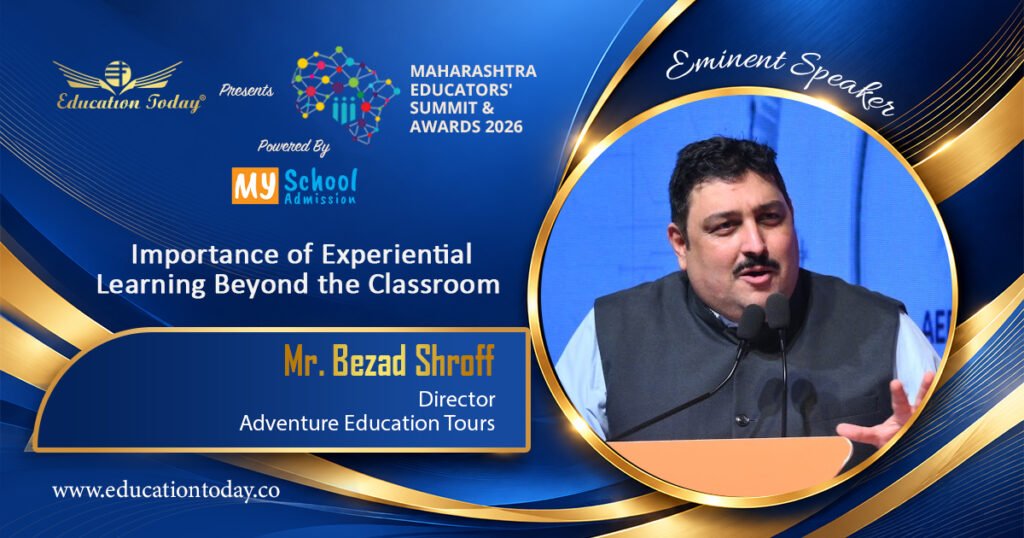
Education extends far beyond textbooks and classroom lessons, offering children opportunities to explore the world, develop practical skills, and learn through direct experiences. Highlighting this perspective, Mr. Bezad Shroff, Director of Adventure Education Tours, introduced Team Adventure and its educational travel initiatives, emphasising how thoughtfully planned school trips can make learning more engaging, interactive and memorable. During his address, Mr. Shroff explained that Team Adventure has spent 29 years organising educational trips for schools across Maharashtra, Pune, Hyderabad, Bengaluru and other cities. The organisation offers a diverse range of experiences designed to combine exploration with meaningful educational outcomes, enabling students to discover new environments while developing essential life skills.
Learning Through Exploration and Discovery
Presenting an overview of the organisation’s activities, Mr. Shroff highlighted its range of programmes, including expeditions, hiking, trekking, camping, domestic tours and international educational visits. The organisation also arranges visits to NASA, student exchange programmes and activities conducted within school premises, providing schools with different ways to incorporate experiential learning into their educational programmes.
He emphasised that each tour incorporates a distinct educational element. Students can explore agriculture, understand traditional practices, learn about the environment and discover the significance of sustainable living through farm visits and organic farming activities. Camping experiences introduce them to outdoor living and practical challenges, while expeditions encourage exploration, teamwork and adaptability.
The programmes are designed to complement school curricula and cater to different educational requirements. Mr. Shroff explained that trips can be customised according to a school’s objectives, allowing educators to connect classroom learning with real-world experiences.
Building Global Awareness and Practical Skills
Team Adventure also facilitates international educational opportunities, including exchange programmes involving countries such as Singapore, Japan, South Korea and Spain. These experiences expose students to different cultures, perspectives and ways of life, helping them develop a broader understanding of the world.
The organisation additionally arranges international trips for students, with Mr. Shroff noting that it takes approximately 200 Indian students to the United States each year. Such opportunities can encourage independence, cultural awareness and confidence while allowing learners to engage with educational environments beyond their own communities.
Another initiative involves village adoption programmes and project-based activities that encourage students to engage with communities and understand local challenges. For college students, the organisation also offers business workshop tours, extending experiential learning opportunities to those preparing for higher education and professional life.
School Partnerships and Meaningful Experiences
The presentation included testimonials from educators who had participated in Team Adventure’s programmes. Their accounts highlighted the value of well-planned itineraries, opportunities for outdoor exploration and experiences that students could remember long after returning to school.
Mr. Shroff also introduced Skill Spots, a campsite in Thane designed to offer children a variety of skill-based activities. The facility provides opportunities for students to participate in outdoor experiences and activities that encourage observation, perception, problem-solving, and practical understanding.
He invited educators to explore the facility and consider how such experiences could complement their schools’ existing educational initiatives.
For education platforms such as EducationToday, these initiatives also highlight the evolving approaches schools can consider to enrich learning beyond conventional classroom boundaries.
Making Learning More Meaningful
Throughout his address, Mr. Shroff reinforced the idea that educational trips should be more than recreational outings. When planned around clear learning objectives, they can help students connect theoretical knowledge with practical experiences, develop social skills and become more confident in unfamiliar situations.
By combining outdoor adventures, cultural exchanges, environmental education and skill-based activities, Team Adventure seeks to provide schools with opportunities to broaden children’s learning experiences.
His presentation at the Maharashtra Educators’ Summit and Awards 2026 served as a reminder that some of the most valuable lessons emerge when students step beyond the classroom, interact with their surroundings and learn through participation. Experiential education, in this sense, offers schools an important opportunity to make learning more relevant, memorable, and connected to everyday life.
Mr. Bezad Shroff is an education professional who highlights the importance of experiential learning beyond traditional classroom settings.
Experiential learning is an approach in which students learn through direct experiences, practical activities, reflection, and real-world problem-solving.
Learning beyond the classroom helps students connect academic concepts with real-life situations, develop practical skills, and gain a broader understanding of the world.
Examples include educational field trips, science experiments, community projects, internships, outdoor learning, role-playing, and hands-on workshops.
Experiential learning can strengthen critical thinking, creativity, collaboration, communication, confidence, and the ability to apply knowledge in practical situations.