
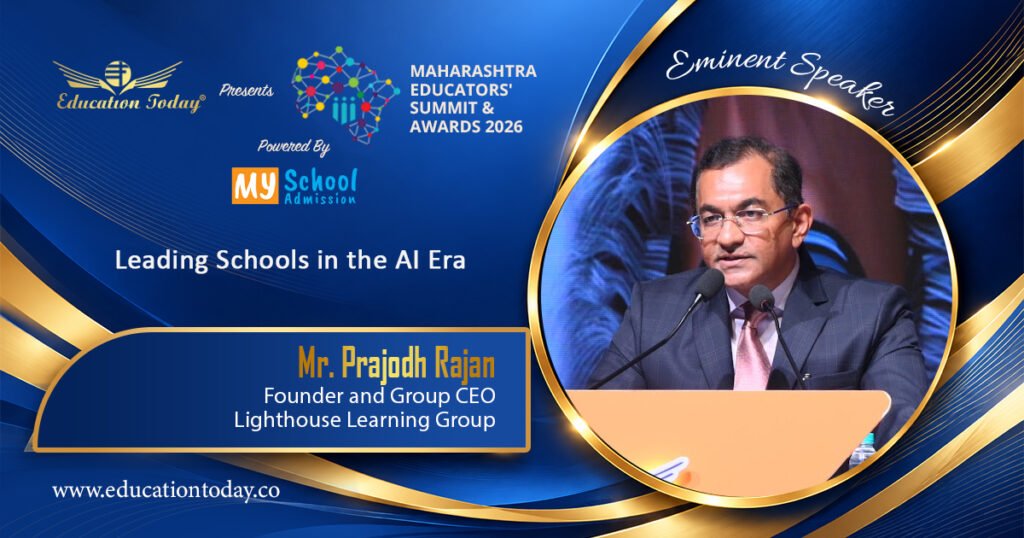
Artificial intelligence is changing how people access information, learn new skills, and interact with technology. At the South India Educators’ Summit 2026, Mr. Prajodh Rajan, Founder and Group CEO of Lighthouse Learning Group, delivered a keynote address titled Leading Schools in the Age of AI: Rethinking the Role of a School Leader, exploring how educational institutions can embrace technological advancements without losing sight of the human values at the heart of learning.
Drawing on his experience in the education sector, Mr. Rajan examined how AI is making knowledge more accessible, enabling personalised explanations and helping teachers prepare lessons, develop learning materials and identify areas where students need additional support. However, he emphasised that the growing capabilities of technology should encourage educators to reconsider traditional teaching methods and assessment practices rather than simply automate existing processes.
A key theme of his address was the distinction between using AI to avoid thinking and using it to think more effectively. He encouraged educators to design assignments that challenge students to evaluate arguments, question assumptions, verify information, and develop independent perspectives. He also highlighted that the process of learning, including making mistakes, revising work and working through difficult problems, remains essential to intellectual development.
Mr. Rajan stressed that AI should complement teachers rather than diminish their role. While technology can reduce administrative workloads and support classroom preparation, qualities such as empathy, professional judgement and the ability to recognise individual students’ needs remain distinctly human responsibilities.
Reflecting on the discussions highlighted by EducationToday, his address offered school leaders a practical framework for approaching AI through three questions: what should be automated, what can be enhanced through technology, and what must remain human?
Ultimately, he argued that the future of education will depend not on how extensively schools adopt AI, but on how wisely they use it to nurture critical thinking, human agency, and the full potential of every learner.
Mr. Prajodh Rajan is an education leader featured in a discussion on rethinking school leadership in the age of artificial intelligence.
It means exploring how school leaders can adapt their strategies, decision-making, and institutional practices as AI becomes more widely used in education.
AI can assist with administrative tasks, data analysis, communication, and planning, allowing school leaders to focus more on educational priorities.
Key challenges include data privacy, responsible use, digital literacy, ethical decision-making, and ensuring technology supports rather than replaces human judgement.
Schools can invest in staff training, establish clear AI-use policies, promote digital literacy, and adopt technology in ways that support teaching and student learning.