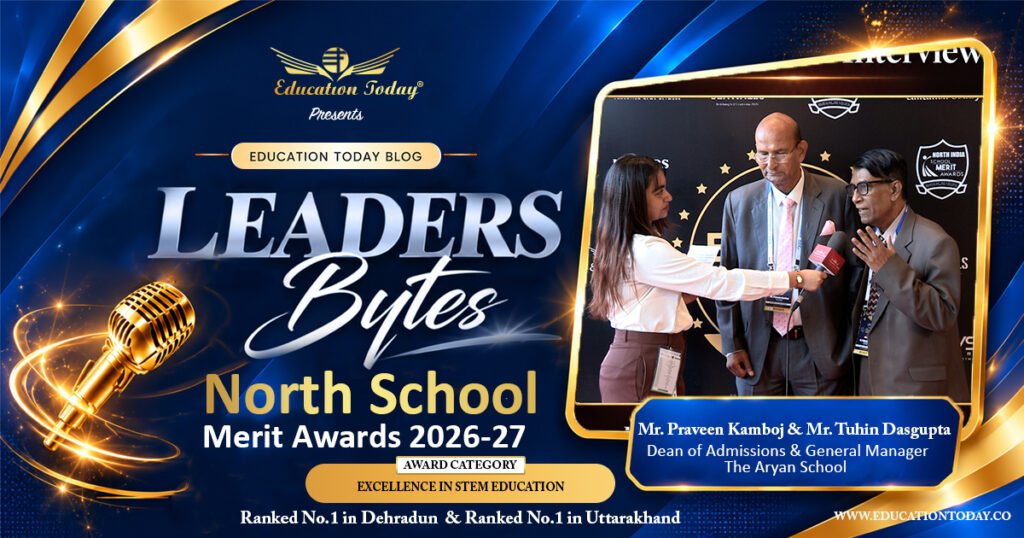
At the North Educators’ Summit & Awards 2026, representatives of The Aryan School, Mr. Praveen Kamboj and Mr. Tuhin Dasgupta, were featured in an award-winning interview highlighting the institution’s commitment to excellence in STEM education.
“STEM education empowers students to think critically, solve real-world problems, and develop the skills needed to navigate an evolving world.”
The interaction highlights the growing importance of science, technology, engineering, and mathematics in preparing students for future opportunities. By placing emphasis on STEM education, The Aryan School reflects the need to connect academic learning with critical thinking, practical application, and problem-solving. The perspectives of its leadership also provide an opportunity to recognise the role of educational institutions in creating meaningful learning experiences that extend beyond traditional classroom instruction. The feature celebrates the institution’s recognition while highlighting the continuing importance of innovation and future-ready learning in school education.
This feature also offers readers of EducationToday a perspective on the ideas and priorities shaping school education.
The Aryan School highlights the importance of STEM education in creating a future-ready learning environment.
STEM education integrates science, technology, engineering, and mathematics to develop practical knowledge and problem-solving skills.
It helps students develop critical thinking, creativity, collaboration, analytical reasoning, and technological skills.
Hands-on learning allows students to apply theoretical concepts through experiments, projects, and real-world problem-solving activities.
Schools can integrate STEM programmes, robotics, coding, digital tools, practical experiments, and interdisciplinary learning into their curriculum.