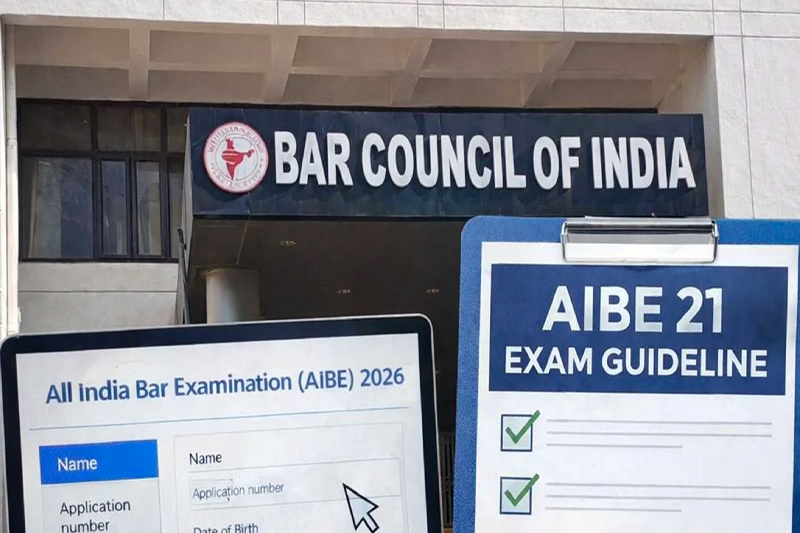
Bar Council of India Releases AIBE 21 Exam Guidelines For June 2026
The Bar Council of India (BCI) has formally announced the opening of registrations for the All India Bar Examination (AIBE) 21, scheduled to be conducted on June 7, 2026. Alongside the notification, the Council has issued a comprehensive set of guidelines intended to ensure procedural clarity, examination integrity and uniform compliance across centres nationwide.
The AIBE remains a crucial qualifying examination for law graduates seeking to practise as advocates in India. Conducted under the aegis of the BCI, it serves as a benchmark assessment to evaluate whether candidates possess the foundational legal knowledge and professional competence required to enter the legal fraternity. With the announcement of AIBE 21, aspirants are once again reminded of the importance of meticulous preparation, not only academically, but administratively.
Registration Window and Application Process
The registration process for AIBE 21 is currently open and will remain accessible until April 30, 2026. Candidates are required to complete the application process exclusively through the official AIBE website. The Council has emphasised that no offline or manual submissions will be entertained under any circumstances.
The online application requires candidates to furnish detailed personal information, enrolment particulars, and academic credentials. Supporting documents must be uploaded in the prescribed format. Once the digital form is completed, applicants are required to pay the examination fee through the designated online payment gateway.
Upon successful submission, candidates are advised to download and retain a copy of the confirmation page. This document serves as an essential record of application and may be required for future reference or in case of any administrative discrepancy.
The BCI has strongly urged applicants to review their entries carefully before final submission. Inaccurate or incomplete information may lead to complications at later stages, including the issuance of admit cards.
Examination Format and Mode
AIBE 21 will be conducted in offline mode using OMR (Optical Mark Recognition) sheets. The examination is scheduled for June 7, 2026, and will be held across multiple designated centres throughout the country.
The use of OMR-based evaluation ensures standardised marking procedures and minimises subjective discrepancies. Candidates must therefore familiarise themselves with the correct method of marking answers on OMR sheets, as improper marking can lead to inadvertent loss of marks.
The Council has reiterated that candidates must report to their allotted examination centre strictly at the time specified on their admit card. Entry gates will close before the commencement of the examination, and late entry will not be permitted under any circumstances. This uncompromising stance underscores the Council’s commitment to procedural discipline.
Mandatory Documents and Identity Verification
One of the most critical aspects of examination day compliance is the production of required documentation. Candidates must carry a printed copy of their admit card along with a valid government-issued photo identity proof.
Accepted identity documents include:
- Aadhaar card
- Passport
- Voter ID card
- Driving licence
Failure to produce both the admit card and a valid ID proof will result in denial of entry to the examination hall. The Council has made it abundantly clear that no exceptions will be entertained, irrespective of the circumstances.
Identity verification protocols form an essential component of maintaining examination integrity. They prevent impersonation and uphold the credibility of the certification process.
Prohibited Items and Examination Conduct
In line with established examination norms, the BCI has issued strict directives regarding prohibited items within the examination hall. Electronic devices of any kind are strictly banned. This includes mobile phones, calculators, smart watches, earphones, Bluetooth devices, and any other communication tools.
Candidates found in possession of such devices may face severe consequences, including disqualification from the examination. The Council has reiterated that these measures are not merely precautionary but essential in preserving the fairness and credibility of the assessment process.
Examination malpractice undermines not only individual integrity but also the collective reputation of the legal profession. As future officers of the court, law graduates are expected to demonstrate adherence to ethical standards from the very outset of their careers.
Provisions for PwD Candidates
The Council has also outlined provisions for candidates with benchmark disabilities. In accordance with prevailing guidelines, such candidates will be granted additional time to complete the examination.
Furthermore, a scribe facility will be made available, subject to the submission and verification of requisite documentation. The Council has advised eligible candidates to ensure that all supporting documents are submitted within the stipulated timeframe to avoid last-minute complications.
This provision reflects a commitment to inclusivity and equal opportunity, ensuring that candidates are assessed on merit without undue disadvantage.
The Significance of AIBE
The All India Bar Examination occupies a unique and consequential position within India’s legal education ecosystem. Unlike university examinations, which assess academic proficiency within a structured curriculum, the AIBE evaluates whether graduates are equipped with the minimum professional competence required to practise law.
By standardising this assessment at a national level, the BCI seeks to uphold uniform standards of legal practice across jurisdictions. The examination also acts as a bridge between academic learning and professional responsibility.
In an era marked by increasing complexity in legal systems, technological advancements, and expanding jurisprudential debates, the importance of maintaining high professional standards cannot be overstated. The AIBE thus serves not merely as a qualifying test, but as a reaffirmation of the legal profession’s ethical and intellectual foundations.
The Importance of Adherence
The guidelines issued for AIBE 21 reflect more than procedural instructions; they embody a broader philosophy of accountability and discipline. Candidates are expected to approach the examination with diligence, preparedness and strict adherence to instructions.
From accurate form submission to timely arrival at examination centres, every stage demands attentiveness. Overlooking seemingly minor details such as failing to carry the correct identification can result in avoidable setbacks.
The Council has urged candidates to carefully review all instructions to prevent disqualification. Such cautionary guidance underscores the seriousness with which the examination process is treated.
Looking Ahead to June 2026
With the examination scheduled for June 7, 2026, aspirants have several months to prepare academically while ensuring compliance with administrative requirements. As the legal profession continues to evolve in response to societal and technological shifts, the AIBE remains a foundational milestone for emerging advocates.
The announcement of AIBE 21 marks the beginning of an important journey for thousands of law graduates across the country. For many, it represents the final formal step before embarking on a professional career in advocacy.
By setting out detailed and unambiguous guidelines, the Bar Council of India has reinforced its commitment to transparency, fairness and professional integrity. Candidates would do well to approach the process with the seriousness it deserves, recognising that adherence to rules is not merely procedural compliance, it is the first demonstration of their readiness to uphold the rule of law itself.