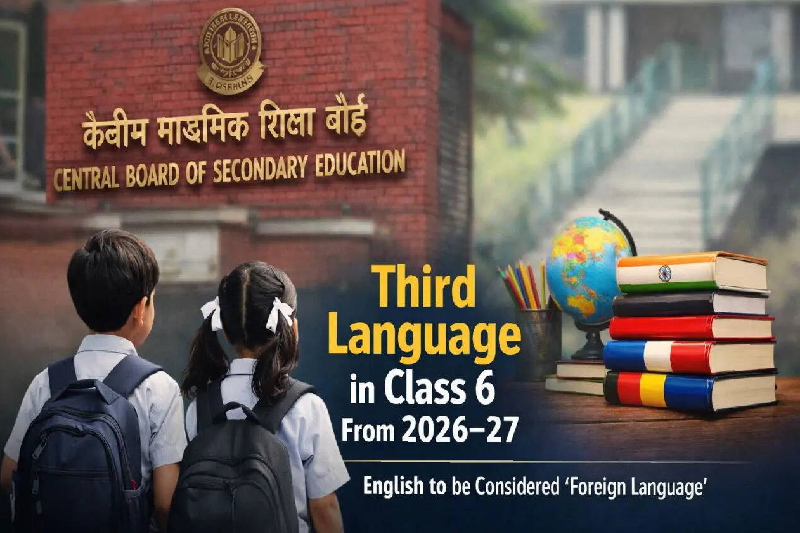
CBSE to Introduce Third Language in Class 6 from 2026–27 in Line with NEP 2020
The Central Board of Secondary Education (CBSE) is set to introduce a third language option for students entering Class 6 from the 2026–27 academic session, in alignment with the vision articulated in the National Education Policy 2020 (NEP 2020). The move represents a significant curricular recalibration aimed at strengthening multilingual competence among learners across the country. The revised framework will apply to all CBSE-affiliated schools nationwide, encompassing both government and private institutions. By embedding a three-language structure at the middle school level, the Board seeks to operationalise one of NEP 2020’s foundational commitments: fostering linguistic diversity while cultivating national cohesion and cognitive flexibility.
The Three-Language Framework: Structure and Requirements
Under the new structure, students in Class 6 will study three languages. Crucially, at least two of these must be Indian languages. Where English is offered as part of the combination, it will be treated as a foreign language. In such cases, students will be required to choose two Indian languages in addition to English. The framework similarly applies if a student opts for another foreign language such as French, Spanish or German. Regardless of the foreign language selected, the core requirement remains unchanged: the inclusion of at least two Indian languages within the three-language combination. This approach reflects the broader intent of NEP 2020, which emphasises multilingual learning as both a cognitive asset and a cultural imperative. While the policy outlines the structure, it also provides states, regions and schools with flexibility to determine the specific languages offered, taking into account local context, linguistic demographics and institutional capacity. Importantly, students retain an element of choice within the framework, provided the minimum requirement of two Indian languages is met. This balance between structure and flexibility aims to accommodate India’s vast linguistic diversity without imposing uniformity.
Medium of Instruction and Foundational Learning
NEP 2020 further recommends that the mother tongue, home language or regional language be used as the medium of instruction at least until Class 5, and preferably until Class 8 and beyond. The emphasis on early instruction in a familiar language is grounded in extensive research demonstrating that children grasp foundational concepts more effectively when taught in a language they understand intuitively.
By introducing the third language in Class 6, the CBSE’s revised structure aligns with this developmental trajectory. Students are expected to have acquired basic literacy and cognitive grounding in their primary language of instruction before expanding their linguistic repertoire more formally. The underlying philosophy is not merely administrative; it is pedagogical. Multilingual education, when thoughtfully implemented, enhances memory, analytical ability and cross-cultural awareness. It encourages learners to navigate different modes of expression, thereby strengthening overall academic proficiency.
Continuity Until Secondary Level
The recommendations of the National Curriculum Framework for School Education 2023 (NCF-SE 2023) reinforce this approach by advocating the continuation of all three languages until Class 10. The rationale is clear: sustained engagement ensures depth of learning rather than superficial acquaintance. If implemented strictly, students who appear for their Class 10 Board examinations in 2031 may be required to sit an examination paper in their third language. At present, CBSE students typically take two language papers at the secondary level. The proposed continuity would therefore mark a notable structural change in assessment patterns. Such a development would demand careful academic planning, including the development of syllabi, teacher training modules and evaluation criteria that maintain parity and rigour across languages.
Historical Context of the Three-Language Formula
The three-language formula is not a novel construct. It was first introduced under the National Policy on Education 1968 and subsequently reaffirmed in the National Policy on Education 1986, before being incorporated once more in NEP 2020. Across decades, it has served as a guiding principle intended to balance national integration with regional autonomy. While its interpretation and implementation have varied across states, the essential premise has remained consistent: students should learn their regional language, Hindi (in non-Hindi-speaking states) or another Indian language, and English or another modern language. The Union government has clarified that the three-language framework functions as a guiding principle rather than a legally binding mandate. It has also reiterated that no language will be imposed on any state or individual. The intent, according to official statements, is to encourage multilingualism while respecting constitutional and cultural sensitivities.
Textbooks, Materials and Implementation Challenges
To facilitate the revised structure, new textbooks and learning materials are expected to be developed in advance of the 2026–27 session. Reports indicate that study materials for nine languages are currently in preparation. These include Tamil, Telugu, Malayalam, Kannada, Gujarati and Bangla, among others. The creation of high-quality pedagogical resources will be central to the success of the initiative. Language instruction demands more than translation; it requires culturally contextualised content, age-appropriate design and progressive skill development across reading, writing, listening and speaking.
Equally critical will be the availability of trained language teachers. Many schools, particularly in semi-urban and rural areas, may face logistical challenges in offering multiple Indian languages. Teacher recruitment, professional development and infrastructural readiness will therefore play a decisive role in effective implementation.
Educational and Cultural Implications
The introduction of a structured third language at the middle school level carries implications that extend beyond the classroom. Linguistic diversity has long been one of India’s defining features. By formalising the study of multiple Indian languages, the policy seeks to deepen students’ engagement with the country’s cultural plurality. At the same time, the recognition of English as a foreign language within this framework is symbolically noteworthy. While English continues to function as a global lingua franca and a medium of higher education and employment, positioning it within a broader multilingual structure underscores the value accorded to Indian languages. From a cognitive perspective, multilingual proficiency is associated with enhanced executive function, improved problem-solving skills and greater adaptability. Exposure to diverse linguistic systems encourages learners to recognise patterns, nuances and contexts with greater sensitivity.
Navigating Practical Realities
Despite its aspirations, the success of the policy will depend on measured implementation. Schools must ensure that the additional language does not become an undue academic burden. Curriculum design must strike a balance between ambition and feasibility, avoiding excessive content while maintaining academic integrity. Assessment reforms will also require deliberation. Introducing a third language paper at the secondary level, if mandated, will necessitate harmonised standards and transparent evaluation criteria to prevent disparities in marking and grading. Parental engagement and awareness will be equally important. Clear communication regarding language options, combinations and long-term academic implications will help families make informed decisions aligned with students’ interests and aptitudes.
A Step Towards Multilingual Competence
The CBSE’s decision to introduce a third language in Class 6 from the 2026–27 session signals a renewed commitment to multilingual education in India’s school system. Rooted in the vision of NEP 2020 and reinforced by the National Curriculum Framework for School Education 2023, the initiative aspires to cultivate linguistic competence, cultural awareness and intellectual versatility among learners. As the policy transitions from announcement to execution, its effectiveness will depend on thoughtful planning, institutional readiness and sustained pedagogical support. If implemented with sensitivity and rigour, the three-language framework has the potential to enrich students’ educational experiences while reinforcing the linguistic tapestry that defines the nation.
In an era marked by global interconnectedness and domestic diversity, the capacity to navigate multiple languages is not merely an academic asset, it is a civic strength. The coming years will reveal how successfully this ambitious reform translates vision into classroom reality.