CUET UG 2026 Dress Code and Exam-Day Guidelines Released
CUET UG 2026: NTA Releases Dress Code and Exam-Day Guidelines Ahead of Undergraduate Entrance Test
With the Common University Entrance Test for Undergraduate admissions (CUET UG) 2026 set to commence from May 11, the National Testing Agency (NTA) has issued an extensive advisory outlining dress code regulations, permitted items, reporting instructions and examination-day protocols for candidates appearing across the country.
The release of these guidelines comes at a crucial juncture as lakhs of students prepare to appear for one of India’s largest undergraduate entrance examinations. Conducted in Computer-Based Test (CBT) mode, CUET UG has rapidly evolved into a central pillar of India’s higher education admission framework, with hundreds of universities now using CUET scores for undergraduate admissions.
As examination season intensifies, the NTA’s latest advisory reflects a growing emphasis on standardised security procedures, operational efficiency and candidate preparedness. From clothing instructions to prohibited electronic devices, the guidelines are intended to ensure the smooth and transparent conduct of examinations across hundreds of centres in India and abroad.
CUET UG 2026 to Be Held Across India and Overseas Centres
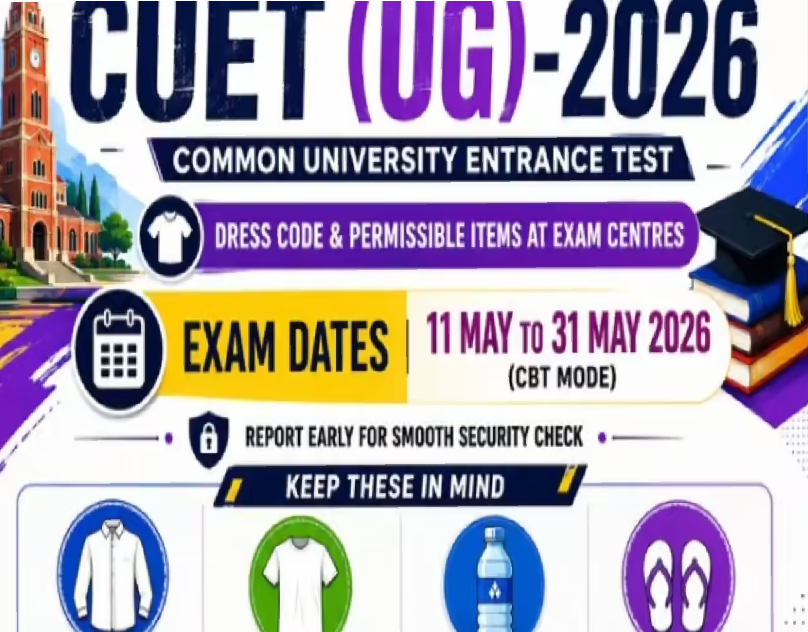
According to the NTA, the CUET UG 2026 examinations will be conducted from May 11 to May 31 in CBT mode across 306 cities in India and 15 international locations. The examination will take place in multiple shifts, depending on subjects and candidate allocation.
Over the past few years, CUET has significantly transformed India’s undergraduate admission ecosystem. Introduced to standardise admission procedures across central universities, the examination now serves as a gateway to numerous central, state, deemed and private universities nationwide.
Institutions such as the University of Delhi, Banaras Hindu University, Jawaharlal Nehru University and several other prestigious universities consider CUET scores during undergraduate admissions. The examination, therefore, carries substantial academic significance for students aspiring to pursue higher education in disciplines ranging from humanities and commerce to sciences, law and management.
Against this backdrop, adherence to examination-day instructions becomes critically important, as even minor procedural violations may lead to denial of entry or disqualification.
NTA Emphasises Simple and Comfortable Dress Code
One of the most discussed aspects of the advisory is the prescribed dress code for candidates. The NTA has advised students to wear simple, light-coloured and comfortable clothing on examination day. White or light-coloured attire has been specifically recommended to facilitate smooth frisking and security procedures at examination centres.
Candidates have additionally been instructed to avoid:
- Heavy garments
- Long sleeves
- Clothing with large buttons
- Metallic accessories
- Fashionable embellishments
- Excessive jewellery
The agency has clarified that slippers, sandals and low-heeled footwear are permitted, whereas footwear with thick soles or elaborate designs may attract additional scrutiny.
Such regulations are increasingly becoming standard practice across major competitive examinations in India, including NEET, JEE and CUET, where frisking procedures are designed to minimise the possibility of unfair practices or unauthorised devices entering examination halls.
Religious and Cultural Attire Permitted Under Specific Conditions
Importantly, the NTA has acknowledged the diversity of candidates appearing for CUET UG and has provided flexibility regarding religious and customary attire.
Candidates wearing articles of faith or cultural clothing, including hijabs, turbans, religious threads such as Kalava or woollen garments required because of weather conditions, will be permitted to appear for the examination. However, students have been advised to inform examination authorities in advance and report early to facilitate proper frisking procedures.
The advisory states that candidates wearing customary or religious attire should ideally arrive at least one hour before the final reporting time so that additional verification procedures can be completed without inconvenience.
This approach reflects an attempt to balance examination security with cultural sensitivity and inclusivity.
Mandatory Documents Candidates Must Carry
The NTA has also issued a detailed list of mandatory documents required for entry into examination centres.
Candidates must carry:
- CUET UG 2026 admit card
- Original valid photo identity proof
- A passport-size photograph matching the application form
- Self-declaration undertaking form
- PwD/PwBD certificate, where applicable
Accepted identity proofs include Aadhaar Card, Passport, PAN Card, Driving Licence and Voter ID. The agency has clarified that photocopies or digital images stored on mobile phones will not be accepted as valid identification. The emphasis on strict document verification highlights the NTA’s broader effort to strengthen examination integrity amid rising concerns regarding impersonation and procedural malpractice in competitive examinations nationwide.
Permitted Items Inside Examination Halls
The list of permitted items inside examination halls remains deliberately minimal.
Candidates may carry:
- Transparent water bottle
- Transparent ballpoint pen
- Small sanitiser bottle (up to prescribed limits)
- Fruits or sugar tablets for diabetic candidates
- Medicines in medically justified cases
The NTA has further clarified that rough sheets required during the examination will be provided within the examination hall itself. Candidates are required to write their name and roll number on all rough sheets and return them to the invigilators before leaving the examination room.
Long List of Prohibited Items
The advisory also contains a stringent list of prohibited items.
Candidates are strictly prohibited from carrying:
- Mobile phones
- Smart watches
- Bluetooth devices
- Earphones
- Calculators
- Electronic pens
- Cameras
- Bags and wallets
- Books and notes
- Pencil boxes and geometry boxes
- Caps, goggles and belts
Possession of prohibited items may result in denial of entry or disciplinary action under examination regulations.
These increasingly rigorous protocols reflect the broader tightening of security measures across Indian entrance examinations, especially after repeated concerns surrounding examination leaks, digital cheating methods and impersonation attempts in recent years.
Importance of Reporting Time and Centre Verification
The NTA has strongly advised candidates to reach their allotted examination centres well in advance.
Students are encouraged to arrive at least one to two hours before the examination begins, as late entry beyond prescribed timelines may not be permitted under any circumstances.
Candidates have additionally been advised to verify the location of their examination centre a day before the exam to avoid delays caused by traffic congestion, unfamiliar routes or logistical confusion.
In major metropolitan areas, especially, examination-day transportation delays have historically caused significant stress among candidates. Educational experts, therefore, continue to stress the importance of planning travel logistics carefully before the examination.
CUET’s Expanding Role in India’s Higher Education Landscape
The significance of the examination-day advisory becomes clearer when viewed against CUET’s rapidly expanding national role.
Since its introduction, CUET has substantially altered India’s undergraduate admission system by shifting emphasis towards a common standardised examination framework. The examination now influences admission decisions across a vast network of institutions and academic programmes.
Supporters of the system argue that CUET promotes uniformity and reduces disparities arising from varying board examination standards across states. Critics, however, continue to raise concerns regarding examination pressure, coaching dependence and the logistical complexity of conducting such a large-scale centralised entrance test.
Regardless of the ongoing debate, CUET has undeniably become one of the most consequential examinations within India’s higher education ecosystem.
Psychological Pressure and Examination Preparedness
Beyond procedural guidelines, the examination season also brings significant emotional and psychological pressure for students.
Competitive entrance examinations in India often carry immense expectations from families, schools and peer networks. Students preparing for CUET simultaneously navigate board examination results, university aspirations and career-related anxieties.
Education counsellors frequently advise students to focus not only on revision but also on sleep, nutrition, hydration and emotional well-being during the final days before the examination.
Experts also caution candidates against excessive last-minute studying or panic-driven preparation. Familiarity with examination-day procedures, reporting schedules and required documentation can significantly reduce stress and improve overall performance.
The Increasing Digitisation of Examination Systems
The CUET UG 2026 process additionally reflects India’s ongoing transition towards technology-driven examination systems.
From online application forms and city intimation slips to digital admit cards and CBT-based examinations, the country’s competitive examination infrastructure is becoming progressively digitised.
While digitisation has improved administrative efficiency and accessibility in many ways, it has also introduced new challenges concerning technical reliability, digital access and large-scale examination management.
The NTA’s detailed advisory, therefore, functions not merely as a procedural notice but as part of a broader effort to standardise candidate experience across a highly complex national examination framework.
A Crucial Examination Season Begins
As CUET UG 2026 begins on May 11, lakhs of students across India now stand at the threshold of one of the most significant stages in their academic journey. For many aspirants, the examination represents an opportunity to secure admission into prestigious universities and pursue future career ambitions. Yet alongside academic preparation, the NTA’s latest advisory serves as a reminder that procedural awareness and disciplined compliance remain equally important components of examination readiness. In an increasingly competitive educational environment, success often depends not only on subject knowledge but also on preparedness, composure and attention to detail. With the examination season now underway, students, parents and institutions alike will be closely watching how CUET UG 2026 shapes the next chapter of undergraduate admissions in India.