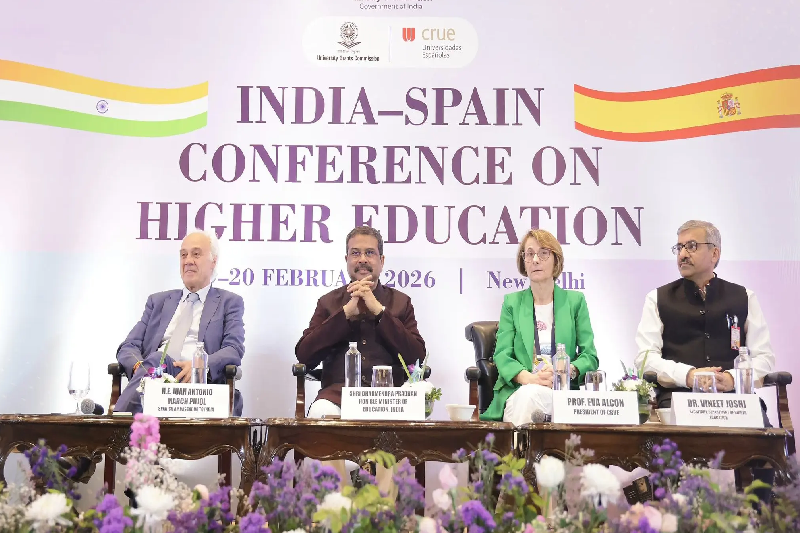
Dharmendra Pradhan Invites Global Universities to Partner in India’s Expanding Education Ecosystem
In a significant assertion of India’s growing educational ambitions, Union Education Minister Dharmendra Pradhan on Monday extended a formal invitation to foreign higher education institutions to collaborate with India’s rapidly evolving and innovation-driven academic landscape. Addressing diplomats from more than 50 nations at the Study in India Edu-Diplomatic Conclave 2026 in New Delhi, the Minister underscored India’s readiness to position itself as a global hub for knowledge, research and intellectual exchange.
The conclave, organised by the Ministry of Education at Sushma Swaraj Bhawan, brought together Ambassadors, High Commissioners and representatives of diplomatic missions to deliberate upon expanding international cooperation in higher education. The gathering served not merely as a ceremonial exchange but as a strategic platform to deepen educational diplomacy at a time when global academic ecosystems are undergoing profound transformation.
Education as the Most Enduring Bridge
In his address, Pradhan situated India’s educational reforms within a broader national aspiration. Referring to Prime Minister Narendra Modi’s vision of transforming India into a developed nation by 2047, the centenary of Independence, he observed that the country remains a “bright spot” in the global economic landscape. Against the backdrop of geopolitical uncertainty and technological disruption, he argued that India offers fertile ground for learning, innovation and research collaboration.
“India invites the world to study, innovate and grow together,” the Minister declared, reiterating that education remains the most enduring bridge between societies in a rapidly changing world. His remarks reflected a deliberate shift in tone from mere student mobility to knowledge co-creation, an ethos that seeks partnership rather than transactional exchange.
NEP 2020 and the Internationalisation Imperative
Central to India’s educational transformation is the National Education Policy 2020 (NEP 2020), which has reconfigured the architecture of higher education over the past six years. Pradhan highlighted the policy’s emphasis on multidisciplinary learning, research integration, and global engagement. He noted that India’s education system is increasingly defined by quality assurance, affordability and innovation, three pillars designed to attract international collaboration.
The Study in India initiative, aligned with NEP 2020, has emerged as a vehicle to promote India as a destination for international students and scholars. By simplifying admission procedures, expanding course offerings in globally relevant disciplines, and ensuring academic mobility, the initiative aims to integrate India more deeply into the global knowledge economy.
The Minister emphasised that India’s demographic dividend, characterised by a young and aspirational population, combined with its expanding economy and technological prowess, provides a compelling case for global academic partnerships.
Emerging Sectors and the Innovation Ecosystem
Beyond rhetoric, India’s invitation rests on tangible advancements in frontier domains. Pradhan highlighted the country’s strides in artificial intelligence, biotechnology, semiconductors and sustainable energy. These sectors, he noted, position India as a trusted innovation partner capable of advancing a collaborative Global South model rooted in shared knowledge and capacity-building.
The emphasis on collaborative research aligns with global trends that increasingly privilege interdisciplinary problem-solving over siloed scholarship. India’s ambition is not limited to hosting foreign campuses; it extends to building joint research centres, facilitating faculty exchanges and developing co-designed curricula that address pressing global challenges from climate resilience to digital governance.
Such partnerships, the Minister suggested, would not only enhance institutional capacity but also foster deeper cultural understanding among nations.
Regulatory Reforms and Institutional Pathways
Secretary, Higher Education, Dr Vineet Joshi, elaborated upon the structural reforms that have enabled India’s outward-facing educational approach. Over the past six years, NEP 2020 has provided a clear direction to higher education reforms, particularly in promoting multidisciplinary education, integrating skilling into mainstream curricula, and strengthening international engagement.
A notable development has been the regulatory framework established by the University Grants Commission (UGC). Under the 2023 regulations, foreign universities are permitted to establish campuses in India within a transparent and time-bound system. Dr Joshi observed that applications from leading institutions in Australia, Italy, the United Kingdom and the United States have been processed within a month, a marked departure from historically protracted approval timelines.
This streamlined approach reflects an effort to align India’s higher education governance with international best practices, while retaining safeguards to ensure academic integrity and institutional accountability.
Indian universities, too, are expanding their global footprint through joint, dual and twinning programmes. Premier institutions are forging cross-border alliances, facilitating credit transfers and collaborative research initiatives that enhance both academic rigour and employability outcomes.
Thematic Deliberations: From Knowledge Systems to AI
The conclave featured thematic sessions spanning a diverse array of subjects. Discussions on Indian Knowledge Systems examined the integration of traditional intellectual heritage with contemporary scholarship. Sessions on academic partnerships through SPARC (Scheme for Promotion of Academic and Research Collaboration) and GIAN (Global Initiative of Academic Networks) explored frameworks for structured international cooperation.
Particular attention was accorded to artificial intelligence and advanced technologies - fields that are redefining the contours of higher education globally. Conversations also centred on UGC regulations governing foreign university campuses, international branch campuses and the internationalisation of skills.
Another focal point was Bharat Innovates 2026, a platform envisioned to catalyse research translation and entrepreneurial ecosystems. The deliberations collectively highlighted concrete avenues for collaboration, including student mobility, joint academic programmes, research partnerships and the establishment of international campuses in India.
Diplomacy Through Education
The Study in India Edu-Diplomatic Conclave 2026 was conceived not merely as an academic symposium but as an instrument of diplomatic engagement. By inviting diplomats from partner countries to participate in structured dialogue, India has positioned education as a central pillar of its foreign policy architecture.
Education diplomacy carries a distinct advantage: it fosters long-term relationships grounded in intellectual exchange rather than short-term strategic alignment. Students who pursue higher education abroad often serve as informal ambassadors of cultural understanding, strengthening bilateral ties for decades to come.
India’s appeal lies in its combination of scale and diversity. With thousands of institutions spanning disciplines from engineering to liberal arts, and tuition costs comparatively lower than many Western destinations, the country offers accessible yet rigorous academic opportunities.
A Global South Collaboration Model
An important dimension of the Minister’s address was the articulation of a Global South collaboration model. Rather than replicating Western-centric paradigms of academic exchange, India envisions partnerships rooted in mutual respect, shared knowledge and capacity-building.
This approach resonates particularly with developing nations seeking affordable and contextually relevant educational opportunities. By fostering collaboration in areas such as climate adaptation, public health innovation and digital infrastructure, India positions itself as both learner and contributor within a multipolar knowledge order.
Such an orientation aligns with broader geopolitical shifts, wherein emerging economies increasingly assert their intellectual sovereignty while engaging constructively with established academic powers.
Towards 2047: Education as a National Imperative
As India approaches the centenary of its Independence in 2047, education occupies a central role in its developmental narrative. The ambition to become a developed nation is intertwined with the creation of a robust, globally integrated higher education ecosystem.
Pradhan’s invitation to global universities reflects confidence in India’s institutional reforms and infrastructural expansion. It signals that the country views higher education not merely as a domestic priority but as a shared global enterprise.
The conclave thus served as both a symbolic and substantive gesture, affirming India’s readiness to host international campuses, nurture joint research ecosystems and welcome students from across continents.
Conclusion
The Study in India Edu-Diplomatic Conclave 2026 represents a pivotal chapter in India’s educational diplomacy. Under the stewardship of Dharmendra Pradhan and guided by the transformative vision of the National Education Policy 2020, the nation is actively recalibrating its higher education architecture to embrace global collaboration.
By combining regulatory reform, sectoral innovation and diplomatic outreach, India has signalled that it seeks not only to attract international institutions but to co-create a knowledge ecosystem that is inclusive, dynamic and future-ready.
In a world defined by interdependence and rapid technological change, the invitation extended from New Delhi carries both strategic foresight and moral conviction: education, at its finest, is a shared human endeavour, one that transcends borders and binds societies in collective progress.