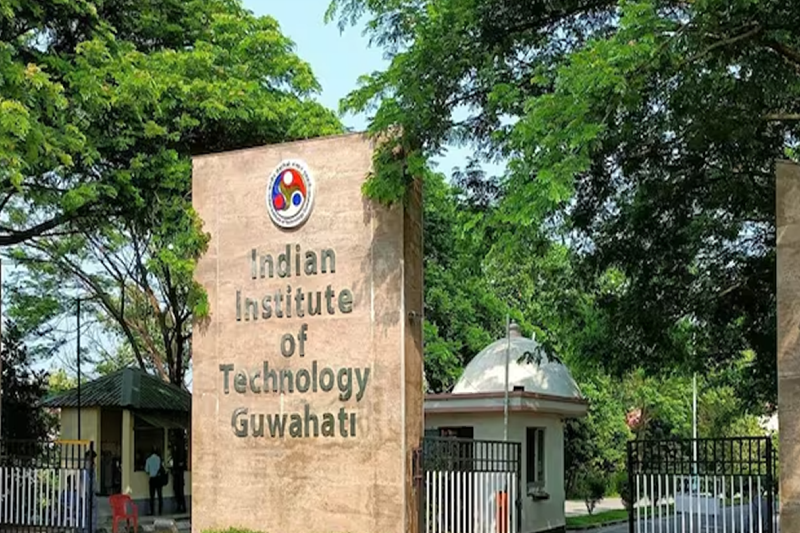
IIT Guwahati’s Online Data Science–AI Programme Sees Major Uptick in Demand
IIT Guwahati’s four-year online Bachelor of Science programme in Data Science and Artificial Intelligence is emerging as one of the most sought-after online undergraduate tech programmes in India. Introduced in 2023 as part of the institute’s broader mission to democratise access to AI and Data Science education, the programme has seen steady and significant growth in enrolment over three consecutive batches.
According to the institute’s director, Prof. Devendra Jalihal, the programme admitted 700 students in its first year, followed by 1,000 in the second and 1,400 in the third, signalling a consistent upward trajectory. If this pace continues, enrolments are projected to reach 5,000 over the next five years, making it one of IIT Guwahati’s largest academic offerings.
What distinguishes this programme from many other national-level online degrees is its flexible structure, built around the Multiple Entry and Exit System (MEES) recommended under the National Education Policy (NEP) 2020. The system allows students to exit at predetermined milestones with recognised certifications, enabling them to continue education or enter the workforce based on personal and financial circumstances. For thousands of learners who cannot commit to a full-time four-year residential programme, this flexibility has emerged as a practical and empowering alternative.
A Mission to Widen Participation in AI and Data Science
IIT Guwahati designed the online BSc programme with a clear goal: to widen participation in AI and Data Science, especially among students who have traditionally been underrepresented in high-tech disciplines. The nationwide response has validated that vision. Students from urban centers, rural regions, working professionals, and aspiring engineers unable to access IITs physically have all sought this programme as an entry point into the tech ecosystem.
Even as the online programme continues to gain traction, IIT Guwahati is simultaneously strengthening the region’s classroom-level AI education ecosystem. A significant milestone in this direction is the Assam government’s decision to introduce Artificial Intelligence as a subject for Class 11 students—a decision in which IIT Guwahati played a key advisory role.
Building AI Capacity in Schools: Training Teachers and Creating Textbooks
Since AI is a relatively new subject for school-level learners, teachers needed dedicated training to ensure meaningful implementation. Responding to this need, IIT Guwahati trained the first batch of 126 teachers from across Assam this year. The training took place at the Mehta Family School of Data Science and Artificial Intelligence (MFSDS&AI), which also houses the institute’s academic programmes in the field.
The institute’s efforts did not stop at teacher training. IIT Guwahati faculty members also helped develop foundational AI learning materials for schools.
Two faculty members—
- Prof. Shymanta M. Hazarika (Mechanical Engineering Department) and
- Assistant Prof. Debanga Raj Neog (MFSDS&AI)
along with Sadiq Hussain from Dibrugarh University, jointly authored the Class 11 AI textbook. The Class 12 textbook is set for release soon. Currently offered as an elective, these books will eventually be translated into Assamese and other regional languages such as Bodo, widening accessibility even further.
Expanding Beyond Assam: Training Teachers from Across the Northeast and Bhutan
IIT Guwahati’s training programmes have already expanded beyond Assam. Prof. Jalihal shared that the institute trained a group of teachers from Bhutan two years ago and will host another batch next year. These initiatives help strengthen AI and data literacy not only in India but also in neighbouring countries.
Closer to home, the institute is preparing to extend its school-teacher training initiative to other northeastern states. Discussions have already taken place with the Tripura Education Minister, and similar partnerships are expected to unfold across the region. The goal is to build a robust eastern and northeastern hub for school-level AI education, with IIT Guwahati at its center.
Addressing Low Regional Enrolment: A Mentoring Initiative for Northeast Students
Despite IIT Guwahati’s expanding influence, the institute observed a surprising trend: very few students from the Northeast enrolled in its online Data Science and AI programme, even as nationwide numbers surged. To bridge this gap and ensure equal participation from local populations, IIT Guwahati launched a targeted mentoring initiative.
The institute approached Assam Education Minister Ranoj Pegu and invited nominations of students from villages, rural towns, and government schools across the state. As a result, 250 students from 28 districts spent a month on IIT Guwahati’s campus, receiving guidance, academic exposure, and structured mentoring.
The results of the mentoring initiative have been encouraging.
- 80 students cleared the programme’s entrance test,
- and 72 received admission offers,
all with full fee waivers.
This outcome reflects IIT Guwahati’s commitment not only to developing talent but also to ensuring that opportunities in high-growth fields like AI and Data Science are accessible to underrepresented communities.
A Broader Vision: Preparing India’s Workforce for an AI-Driven Future
As AI technologies continue to influence every sector—from healthcare and finance to agriculture, logistics, and governance—IIT Guwahati believes that the ability to understand, apply, and innovate with AI will become essential. Through a multi-pronged strategy involving online degree programmes, teacher training, school curriculum development, and targeted mentoring, the institute is working to create a pipeline of AI-literate learners in the Northeast and beyond.
Prof. Jalihal affirmed this long-term vision, noting that IIT Guwahati remains deeply committed to expanding AI and Data Science education at all levels. The institute aims to ensure that students from all backgrounds, regardless of geography or financial condition, can gain meaningful access to high-quality technological education.