Over 2.28 Lakh Students Appear for Delhi University Winter Exams as SOL Candidates Form Nearly 30%
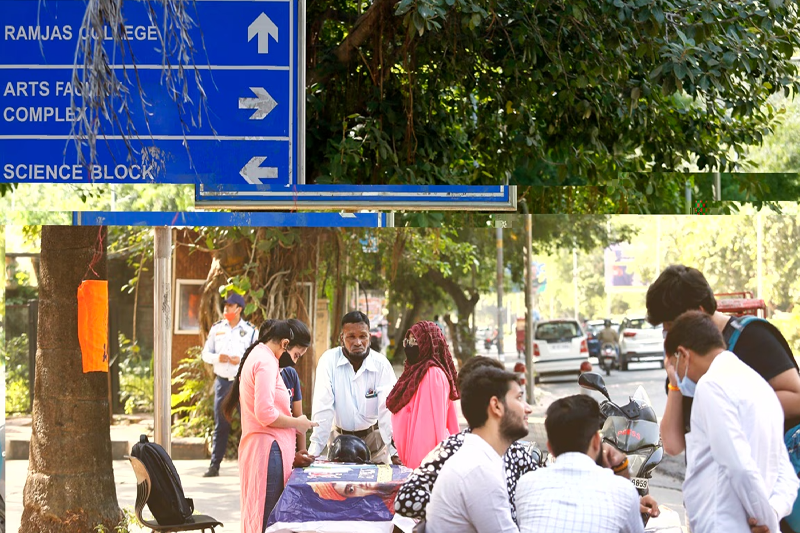
The University of Delhi (DU) witnessed one of its busiest examination days this winter, with 2,28,781 students appearing for exams on Wednesday. According to information shared by news agency PTI, this figure marks one of the highest single-day student turnouts during the ongoing winter examination cycle. The large-scale participation highlights both the size of the university’s student population and the complexity involved in conducting examinations across multiple programmes and study modes.
The exams are part of DU’s winter assessment schedule and include students from regular colleges, the School of Open Learning (SOL), and the Non-Collegiate Women’s Education Board (NCWEB).
Exams Held Under NEP and CBCS Frameworks
The ongoing winter examinations are being conducted under a mix of the National Education Policy (NEP) and the Choice-Based Credit System (CBCS). This reflects the transition phase the university is currently in, as newer batches follow NEP guidelines while older cohorts continue under CBCS structures.
Managing exams under two different academic frameworks adds to the administrative challenge, as course structures, paper patterns, and evaluation methods can vary significantly between NEP and CBCS programmes.
Undergraduate Courses Dominate the Schedule
Undergraduate courses accounted for the overwhelming majority of students and papers on the day. Out of the total 2.28 lakh candidates, 1,61,366 students were from regular undergraduate programmes. No regular postgraduate examinations were scheduled on Wednesday, making UG exams the clear focus of the day.
The dominance of undergraduate exams also explains the high number of question papers required and the heavy load placed on examination centres, invigilators, and logistical teams.
Nearly One-Third Candidates from School of Open Learning
A significant portion of the examinees came from the School of Open Learning (SOL), Delhi University’s distance education wing. According to the internal status report from DU’s examination branch, 65,413 SOL undergraduate students and 2,002 SOL postgraduate students appeared for exams on the day.
This means that nearly 30 per cent of all candidates were from SOL. Since no regular postgraduate exams were held, SOL students made up the entire postgraduate presence for the day, further increasing their share in the overall count.
The strong SOL turnout underlines the growing importance of distance and open learning within the university system.
Morning Session Bears the Heaviest Academic Load
The examination data shows a clear imbalance between the two daily shifts, with the morning session carrying the heaviest load. A total of 795 question papers were conducted in the morning slot alone.
Out of these, 775 papers were for regular undergraduate and NCWEB courses, while 20 papers were for SOL undergraduate students. This concentration made the morning session the most demanding in terms of logistics, coordination, and staffing.
University officials had earlier indicated that around 800 papers were expected in the morning, a figure that closely matched the actual count.
Afternoon Slot Sees Lower Student Numbers
In comparison, the afternoon session involved only 109 question papers, all of which were at the undergraduate level. The number of students appearing in the second shift was significantly lower than in the morning.
This uneven distribution reflects both academic scheduling preferences and student comfort levels, as many candidates tend to prefer earlier exam timings.
Detailed Breakdown of Question Papers Conducted
Overall, an internal report from DU confirmed that 904 different question papers were administered throughout the day. This figure includes papers across regular colleges, SOL, and NCWEB, covering a wide range of subjects and courses.
Coordinating nearly a thousand unique papers in a single day demonstrates the scale at which Delhi University operates, especially during peak examination periods.
Strong Preference for Morning Examinations
Student attendance figures reveal a clear preference for the morning slot. At 9.30 am, as many as 1,52,476 students appeared for their exams—more than double the number who wrote papers in the afternoon.
The morning session included:
- 1,08,122 regular UG students
- 43,467 SOL UG students
- 887 SOL PG students
By contrast, the 2.30 pm session saw 76,305 students, including:
- 53,244 regular UG students
- 21,946 SOL UG students
- 1,115 SOL PG students
This data highlights how scheduling patterns can significantly influence attendance and workload distribution across exam sessions.
Logistical Challenges and Missed Papers
While the exams largely proceeded as planned, the university acknowledged that a few papers could not be conducted at certain centres. Earlier, DU had stated that some question papers were not dispatched due to logistical issues, which led to their cancellation at those locations.
Such challenges are not uncommon during examinations of this scale, especially when hundreds of centres and thousands of papers are involved. The university has not indicated widespread disruption, suggesting that these issues were limited in scope.
Smooth Conduct of Exams Across Centres
Despite the high turnout and heavy morning load, officials said that the examinations proceeded smoothly across centres. Invigilation, student entry, and paper distribution were reported to be orderly, reflecting careful planning by the examination branch.
With several days of winter exams still ahead, Wednesday’s experience provides important operational insights for the university. The strong SOL participation, preference for morning slots, and sheer volume of undergraduate candidates are likely to shape how DU plans and manages upcoming examination schedules.
Overall, the single-day turnout of over 2.28 lakh students underscores the scale, diversity, and complexity of Delhi University’s examination system in 2025.