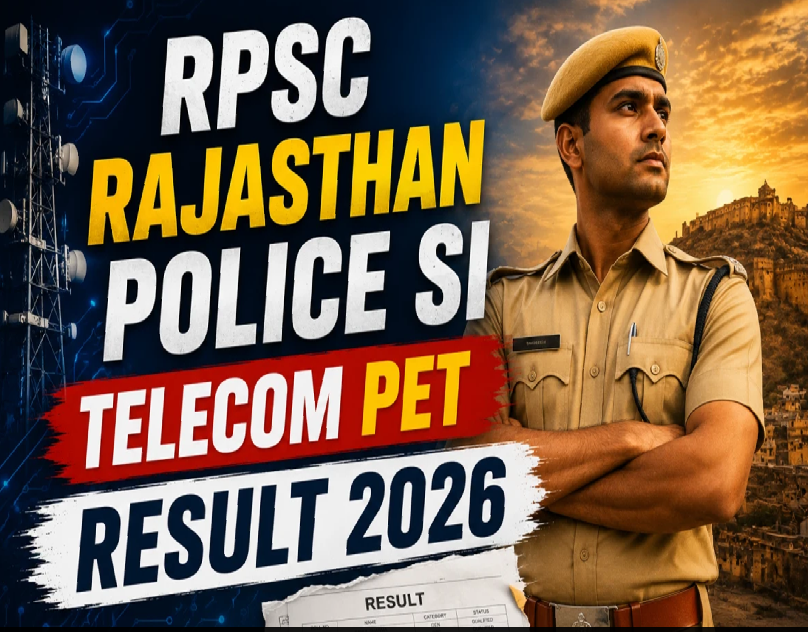
Rajasthan Police SI Telecom PET Result 2026 Declared
Rajasthan Police SI (Telecom) PET Result 2026 Announced: Advancing Towards the Final Stage of Selection
The announcement of the Rajasthan Police Sub-Inspector (Telecom) Physical Efficiency Test (PET) Result 2026 marks a decisive juncture in one of the state’s most closely followed recruitment processes. Released by the Rajasthan Public Service Commission, the result not only determines the candidates who progress further but also signals the transition into the final phase of selection, the interview. For aspirants, this moment embodies both culmination and continuation: the end of one demanding stage and the beginning of another that requires a markedly different set of skills.
Accessing the Result and Immediate Implications
The PET results have been made available on the official RPSC website in a downloadable PDF format, listing the roll numbers of candidates who have successfully qualified. Applicants must navigate to the “Results” section to access the document. While the process is straightforward, the implications are anything but routine. For those whose roll numbers appear on the list, the pathway to appointment becomes distinctly clearer, though not yet assured. The PET itself, conducted earlier in the year, serves as a crucial evaluative stage. It is designed to assess physical endurance, agility and stamina, attributes indispensable for effective functioning within the police force. In this regard, the test complements the written examination by ensuring that intellectual capability is matched by physical readiness.
The Evolving Nature of Police Recruitment
The inclusion of rigorous physical assessments such as the PET reflects a broader evolution in recruitment standards. Modern policing demands a multidimensional skill set, combining analytical ability with physical resilience and situational responsiveness. The Sub-Inspector (Telecom) role, in particular, occupies a specialised niche, where technical expertise intersects with operational responsibilities. Officers in this cadre are entrusted with managing communication networks, maintaining signal systems and ensuring uninterrupted coordination during critical operations. In an era defined by rapid technological advancement, the efficiency of communication infrastructure can significantly influence the effectiveness of law enforcement. Consequently, the recruitment process is structured to identify candidates capable of navigating both physical and technical demands.
From Physical Competence to Personal Evaluation
With the declaration of the PET results, attention inevitably shifts to the interview stage. Unlike the objective nature of written examinations and the measurable benchmarks of physical tests, the interview introduces a more subjective dimension. It seeks to evaluate not only what candidates know or can do, but also how they think, communicate, and respond under pressure.
This phase is often regarded as the most nuanced component of the selection process. It examines qualities such as leadership potential, ethical judgement, clarity of expression and overall demeanour. For a role that entails responsibility, decision-making, and public interaction, these attributes are of paramount importance.
Preparing for the Interview: A Strategic Shift
Candidates who have qualified for the interview must now recalibrate their preparation strategies. The emphasis shifts from physical conditioning and academic revision to intellectual engagement and self-presentation. A thorough awareness of current affairs, particularly those related to policing, governance and technology, becomes essential.
Equally important is the ability to articulate thoughts with clarity and confidence. Mock interviews, group discussions and regular reading can prove invaluable in refining communication skills. Candidates are also advised to revisit fundamental concepts related to their field, as well as broader societal issues, to ensure a well-rounded perspective.
Staying informed about official updates is critical during this phase. Details regarding interview schedules, admit cards and procedural guidelines will be released on the RPSC website, and any lapse in attention could have serious consequences.
The Psychological Dimension of Competitive Examinations
Beyond the logistical and academic aspects, the journey through competitive examinations carries a significant psychological dimension. The declaration of results often brings a mix of relief, anticipation and for some, disappointment. Managing these emotions is an integral part of the process. For successful candidates, it is important to maintain composure and avoid complacency. The interview stage demands a fresh approach and sustained focus. For those who did not qualify, the experience, though disheartening, can serve as a foundation for future attempts. Many successful candidates have navigated similar setbacks before achieving their goals.
The Role of Transparency and Digital Accessibility
The dissemination of results through digital platforms underscores the increasing emphasis on transparency and efficiency in public sector recruitment. By making information readily accessible, the RPSC ensures that candidates can obtain updates without unnecessary delay or ambiguity. However, this accessibility also places the onus on candidates to remain vigilant. Regularly monitoring the official website is essential to staying informed of developments and avoiding missing critical notifications.
Broader Implications for Public Service
The significance of the Rajasthan Police SI (Telecom) recruitment process extends beyond individual candidates. It reflects the state’s commitment to maintaining high standards in public service appointments. By implementing a multi-stage selection process that includes written examinations, physical tests and interviews, the RPSC ensures a comprehensive evaluation of candidates.
Such rigour is particularly important in roles that directly impact public safety and governance. The selection of capable, well-rounded individuals contributes to the effectiveness and credibility of law enforcement institutions.
A Journey Defined by Discipline and Determination
For aspirants, the journey towards securing a position as a Sub-Inspector (Telecom) is characterised by sustained effort and disciplined preparation. The PET result represents a milestone within this journey, but it is by no means the final destination. Each stage of the process demands a distinct set of competencies and success requires the ability to adapt accordingly. The competitive nature of the examination further underscores the importance of perseverance. With a large number of candidates competing for a limited number of posts, even minor lapses can prove consequential. Conversely, consistent effort and strategic preparation can yield significant rewards.
Looking Ahead
As the recruitment process progresses towards the interview stage, the focus will increasingly shift to individual performance and personal attributes. Candidates who have qualified must seize this opportunity to distinguish themselves, demonstrating not only competence but also character. The announcement of the PET result thus serves as both an endpoint and a beginning. It concludes a phase defined by physical evaluation while inaugurating another that will ultimately determine the final selection. For those who advance, it is a step closer to a role that carries both responsibility and prestige. In the broader context, the process reaffirms the principle that public service demands excellence across multiple dimensions. Knowledge, physical capability and personal integrity must converge to create individuals capable of meeting the challenges of modern policing. The Rajasthan Police SI (Telecom) recruitment process, in its structure and execution, exemplifies this holistic approach, ensuring that those who succeed are truly prepared for the responsibilities that lie ahead.