SBI Apprentice Recruitment 2026: 7,150 Vacancies Announced
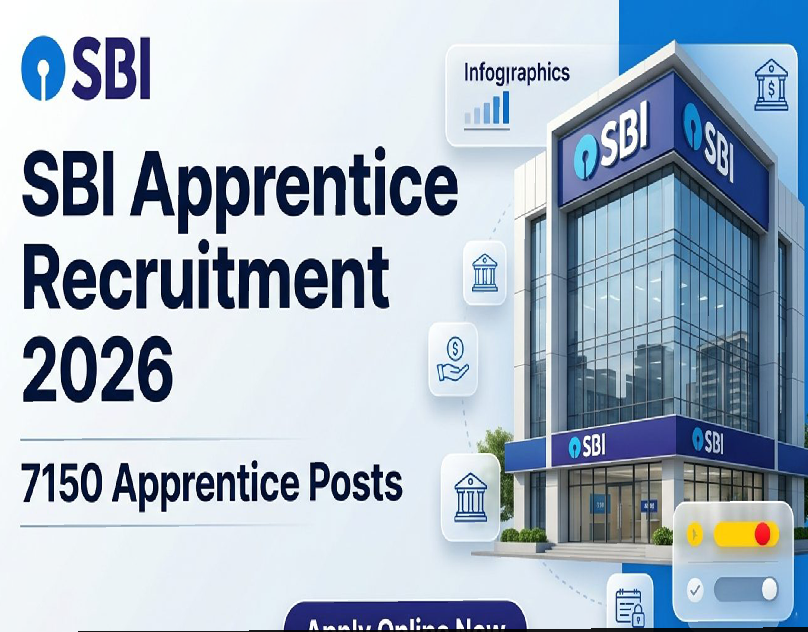
SBI Apprentice Recruitment 2026: 7,150 Vacancies Announced Across India, Applications Begin from May 19
The State Bank of India (SBI), the country’s largest public sector bank, has officially released the Apprentice Recruitment 2026 notification, announcing 7,150 apprentice vacancies across multiple states and union territories. The recruitment drive, one of the largest apprenticeship initiatives in the banking sector this year, is expected to attract a massive number of applicants seeking entry-level exposure to India’s banking ecosystem.
Eligible candidates can begin submitting online applications from May 19, 2026, through the official SBI careers portal. The recruitment process is being conducted under the Apprentices Act and is intended to provide graduates with practical training and operational experience in banking services.
The announcement arrives at a time when competitive government and banking sector opportunities continue to witness exceptionally high demand among graduates across India. With limited formal employment opportunities and growing interest in public sector careers, the SBI apprenticeship programme is likely to emerge as one of the most closely followed recruitment drives of the year.
A Major Recruitment Drive in the Banking Sector
The release of more than 7,000 apprenticeship vacancies reflects SBI’s continued emphasis on workforce training and skill development within the banking sector. Public sector banks have increasingly used apprenticeship programmes as a means of preparing young graduates for operational responsibilities while simultaneously strengthening customer-facing services.
Unlike permanent recruitment drives for Probationary Officers (POs) or Clerks, the apprenticeship programme functions as a structured training initiative designed to familiarise candidates with day-to-day banking operations, administrative processes, customer handling and financial services management.
According to the official notification, apprentices selected under the programme will undergo training for a period of one year. During this time, candidates will gain practical exposure to branch-level functioning, banking products, customer service systems and digital banking operations.
The programme is particularly attractive to graduates seeking professional exposure within India’s formal financial sector, especially those preparing for future banking examinations or administrative careers.
Distribution of Vacancies Across States
The total 7,150 vacancies have been distributed across various states and union territories based on regional banking requirements and operational needs. Larger states with extensive branch networks, such as Uttar Pradesh, Maharashtra, Bihar, Rajasthan, Madhya Pradesh and West Bengal, have received a substantial share of the openings.
The recruitment process also considers local language proficiency. Candidates applying for vacancies in a particular state are generally expected to possess reading, writing, speaking and understanding abilities in the specified regional language.
This emphasis on regional language proficiency reflects the operational realities of public banking services in India, where customer interaction frequently occurs in local languages, particularly in semi-urban and rural areas.
Eligibility Criteria for Applicants
The SBI Apprentice Recruitment 2026 notification specifies several eligibility conditions relating to educational qualifications, age criteria, and language proficiency.
Applicants must possess a graduate degree in any discipline from a recognised university or equivalent institution approved by the government. Candidates who have completed their graduation on or before the prescribed cut-off date are eligible to apply.
The prescribed age limit for applicants is expected to follow standard recruitment norms outlined in the official notification, with relaxation provisions applicable for reserved categories in accordance with government guidelines.
Additionally, candidates are required to fulfil local language requirements for the state or region in which they apply. Those unable to provide evidence of language proficiency through educational records may be required to undergo a language test during the selection process.
The inclusion of regional language assessment highlights the importance of communication skills in branch-level banking operations, particularly in customer service and financial inclusion programmes.
Selection Process and Examination Pattern
The selection process for SBI Apprentice Recruitment 2026 will primarily consist of:
- Online written examination
- Local language proficiency test
- Document verification
The online examination is expected to assess candidates across multiple areas, including:
- General awareness
- Quantitative aptitude
- Reasoning ability
- English language proficiency
- Basic banking awareness
Given the scale of the recruitment drive, competition is likely to remain intense despite the apprenticeship nature of the programme.
Banking examinations in India routinely witness participation from lakhs of graduates due to the sector’s reputation for structured career progression, financial stability and professional credibility.
The local language test, meanwhile, serves as a functional assessment to ensure candidates can effectively communicate with customers within their assigned regions.
Monthly Stipend and Training Structure
Selected apprentices will receive a monthly stipend during the one-year training period. However, unlike regular bank employees, apprentices will not receive allowances, pension benefits, or additional service privileges applicable to permanent staff.
The programme is intended primarily as a training and skill development opportunity rather than direct employment.
Nevertheless, the apprenticeship experience often proves valuable for candidates preparing for:
- SBI Clerk examinations
- SBI Probationary Officer recruitment
- IBPS banking examinations
- Insurance sector recruitment
- Financial services careers
The practical exposure gained through branch operations, digital systems, documentation processes and customer interaction frequently strengthens candidates’ understanding of banking administration.
For fresh graduates lacking prior professional experience, the programme may also enhance employability within the private banking and financial services sectors.
Why Banking Apprenticeships Remain Popular
Apprenticeship programmes in the banking sector have gained increasing popularity over the past decade due to multiple economic and employment-related factors.
India continues to witness intense competition for government and public sector jobs. Rising graduate unemployment, limited formal-sector opportunities and economic uncertainty have contributed to growing demand for stable institutional training programmes.
The banking sector, particularly public sector banks like SBI, remains highly attractive because of:
- Organised work structure
- Nationwide institutional presence
- Professional credibility
- Exposure to financial systems
- Opportunities for future career progression
Even though apprenticeships do not guarantee permanent employment, many candidates view them as stepping stones towards long-term banking careers.
Moreover, the exposure to real banking operations offers practical knowledge often unavailable through purely academic education.
SBI’s Expanding Digital Banking Ecosystem
The recruitment drive also comes at a time when SBI continues to expand its digital banking infrastructure and customer outreach systems.
India’s banking sector has undergone a rapid technological transformation in recent years, with increasing emphasis on:
- Online banking
- Mobile transactions
- AI-driven customer service
- Digital payment systems
- Cybersecurity frameworks
- Financial inclusion technologies
As the country’s largest public sector bank, SBI manages one of the widest banking networks in India, serving millions of customers across urban and rural regions alike.
Training apprentices within this environment provides candidates with exposure not only to conventional banking operations but also to evolving digital financial ecosystems.
This is particularly relevant for younger graduates entering a financial sector increasingly shaped by fintech integration and digital service delivery.
Challenges Facing Banking Recruitment Aspirants
Despite the scale of opportunities, banking recruitment remains highly competitive and demanding.
Candidates preparing for examinations often face:
- Intense competition
- Limited vacancies relative to applicant numbers
- Multiple-stage selection processes
- Constant syllabus revisions
- Pressure of repeated examination cycles
Additionally, many graduates apply simultaneously for banking, SSC, railways, insurance, and state government recruitment examinations due to uncertainty in employment opportunities.
The SBI apprenticeship programme may therefore serve as a relatively accessible opportunity for candidates seeking professional experience while continuing preparation for larger competitive examinations.
At the same time, experts caution candidates against assuming that an apprenticeship automatically translates into permanent employment within SBI. The programme should instead be viewed as a training-based professional development opportunity.
How Candidates Can Apply
Interested applicants must complete the online registration process through SBI’s official careers portal within the prescribed application timeline.
The application process generally includes:
- Online registration
- Submission of personal and academic details
- Uploading required documents
- Payment of the application fee, where applicable
- Final submission and confirmation
Candidates are advised to carefully review the official notification before applying to ensure compliance with eligibility conditions and documentation requirements.
Applicants should also regularly monitor the official website for updates related to:
- Examination dates
- Admit card release
- Language test schedules
- Result announcements
- Document verification procedures
Given the large number of expected applicants, completing the application process well before the deadline may help avoid technical issues during peak traffic periods.
The Wider Significance of the Recruitment Drive
The SBI Apprentice Recruitment 2026 notification holds significance beyond immediate vacancy numbers.
At a broader level, the recruitment reflects:
- Continued investment in workforce development
- Expansion of banking outreach systems
- Increasing emphasis on practical training models
- Public sector engagement with skill-building initiatives
Apprenticeship-based recruitment has become an important component of India’s employment and training ecosystem, particularly for sectors requiring large-scale operational exposure.
For graduates entering a challenging job market, such programmes provide institutional work experience that may improve both technical competence and professional confidence.
Concluding Insight
The announcement of 7,150 apprentice vacancies under SBI Recruitment 2026 marks a major opportunity for graduates aspiring to gain exposure within India’s banking sector. At a time when formal employment opportunities remain fiercely competitive, structured apprenticeship programmes continue to offer an important bridge between academic education and professional experience.
While the programme does not guarantee permanent employment, it provides candidates with valuable operational training, banking knowledge and institutional exposure within one of India’s most influential financial organisations.
For thousands of applicants across the country, the coming recruitment cycle may represent not merely a training opportunity but the beginning of a longer journey into the world of banking and financial services.