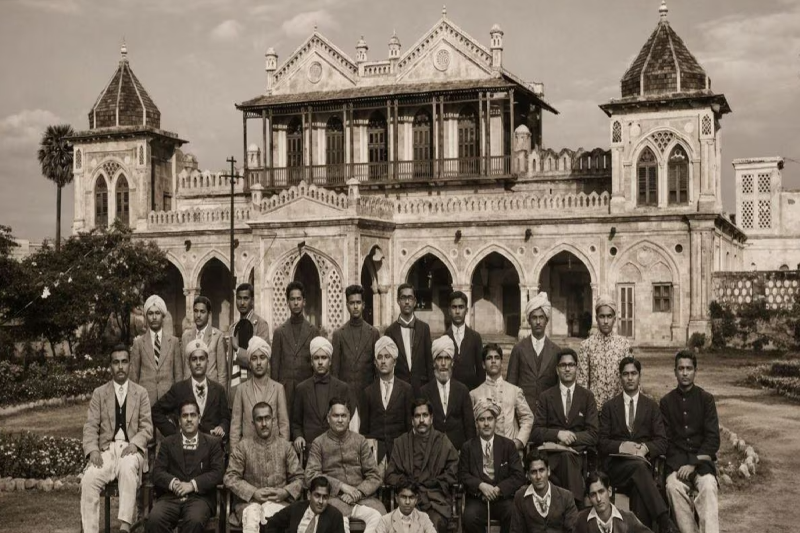
SRCC Turns 100: From a 12-Student Classroom to Delhi University’s Premier Commerce College
Delhi University’s Shri Ram College of Commerce (SRCC) has entered its second century, celebrating 100 years of shaping commerce and economics education in India. From its humble beginnings in 1926, when just 12 students and four teachers studied in a modest Daryaganj bungalow, SRCC has grown into one of the country’s most sought-after colleges, known for academic excellence, innovation, and a strong alumni network.
The centenary celebrations began with a curtain-raiser event at Delhi University’s North Campus, attended by dignitaries, alumni, faculty, and policymakers. The milestone provides a moment to reflect on SRCC’s journey—from a small commerce school to a national brand—and its vision for the future.
Humble Beginnings: The Vision of Sir Shri Ram
SRCC’s story began before 1926. In 1920, industrialist Sir Shri Ram established the Commercial Education Trust, driven by a belief that trade and economics education could contribute to India’s economic self-reliance. Alongside his brother-in-law Lala Sher Singh and friend Lala Diwan Chand, Sir Shri Ram envisioned a college that would teach commerce not merely as theory but as a practical, professional discipline.
This vision materialized with the founding of the Commercial College in 1926. The institution was renamed Shri Ram College of Commerce in 1951, and in 1954, it moved to a new campus in Maurice Nagar, inaugurated by then Vice-President of India, Dr Sarvepalli Radhakrishnan. Over the decades, SRCC evolved into a respected center of learning, blending academic rigor with a strong focus on student development and professional readiness.
Academic Structure: Depth Over Breadth
Since its inception, SRCC has focused on providing high-quality education through a limited but specialized set of programmes. At the undergraduate level, it offers two courses:
- BCom (Honours)
- BA (Honours) Economics
The college first affiliated with Delhi University in 1926 and became a degree college in 1932, awarding the BA (Pass) degree in Commerce. The BA (Hons) Commerce programme was introduced in 1943, followed by MA (Economics) the same year and a Master’s in Commerce in 1948. When Delhi University launched the BCom (Honours) programme in 1949, SRCC was among the first colleges to offer it. Later, in 1958, BA (Hons) Economics completed the undergraduate structure that continues to this day.
While SRCC has gradually introduced postgraduate diplomas and management-oriented programmes, particularly since the 2000s, the college has retained its core focus on depth and specialization rather than a multiplicity of degree options, according to Principal Simrit Kaur.
Demand Remains High in the CUET Era
Despite offering only two undergraduate programmes, SRCC continues to be Delhi University’s most sought-after college. In the 2025 admissions cycle, conducted through CUET-UG, SRCC received 38,795 top-choice applications, more than any other DU college. Hindu College followed with around 32,000 preferences.
Principal Kaur explains that while the National Education Policy (NEP) framework allows students to take minor courses across colleges, most SRCC students remain within the commerce and economics domains. She emphasizes that SRCC’s academic model combines classroom teaching, student societies, internships, mentoring, and alumni engagement to create a holistic educational experience.
The college boasts a strong alumni network of over 25,000 graduates, with professionals in public service, corporate leadership, policy, and entrepreneurship. Notable alumni include former Finance Minister Arun Jaitley, IAS officer Sanjeev Sanyal, and actors Gulshan Grover and Nimrat Kaur. Currently, SRCC has more than 70 active student societies covering finance, commerce, debating, dramatics, and social initiatives.
Infrastructure and Expansion Plans
Over the past decade and a half, SRCC’s student strength has grown from around 1,700 in 2007 to nearly 4,000 today, fueled by reservation policies and the four-year undergraduate programme under NEP. This surge has put pressure on the college’s infrastructure.
To address the challenge, interim measures like portacabins for classrooms have been installed, supported by alumni funding. Regulatory constraints, including floor area ratio norms, have limited physical expansion, but the college is now planning two major projects approved by the Municipal Corporation of Delhi:
- A seven-storey academic block with a basement
- Expansion of the girls’ hostel by two floors
Funding for these projects is being sought from the Higher Education Financing Agency (HEFA). However, there are no immediate plans to increase undergraduate seats, as the four-year programme has already added 450–500 students to the campus.
Embracing the Future: AI, Entrepreneurship, and Innovation
As SRCC enters its second century, the focus is shifting from producing job-ready graduates to enabling enterprise creation. Delhi University Vice-Chancellor Yogesh Singh called SRCC “a powerful brand” and emphasized that its legacy must be protected while continuously reinventing the institution.
The college is exploring the integration of Artificial Intelligence (AI) into teaching methods and the creation of centres of excellence for advanced student research. Faculty upskilling will play a key role in this digital transformation. Additionally, entrepreneurship initiatives are being discussed, supported by active alumni engagement.
Principal Kaur notes that SRCC’s approach to digitalization and AI will be guided by ethical considerations, ensuring that students adapt to technological and economic changes while maintaining a focus on social responsibility.
Chairman Ajay S Shriram emphasized the urgency: “If you don’t take necessary steps today, those who will follow us will not forgive us for tardiness, negligence, complacency, and a status quo attitude.”
Looking Ahead: The Next 100 Years
SRCC’s centenary is not just a celebration of the past but a reflection on the future. From its modest 12-student classroom to a campus of 4,000 students, the college has demonstrated consistent academic excellence and societal impact.
The challenge for the next 100 years is clear: to leverage its legacy, innovate in teaching and research, embrace technology like AI, foster entrepreneurship, and create graduates who not only succeed in careers but also drive India’s economic growth.
As Vice-Chancellor Singh aptly put it: “The question is what’s next for SRCC? Accomplished journey of 100 years, no doubt, but next 100 years, what we want to do — this is a question which should be discussed.”
With its strong brand, committed faculty, and engaged alumni, SRCC is poised to remain a beacon of commerce education in India for generations to come.