TN SSLC 2026 Provisional Mark Sheets Released Across Tamil Nadu
TN SSLC 2026 Provisional Mark Sheets Released: What Tamil Nadu’s Distribution Process Reveals About Academic Transition and Administrative Precision
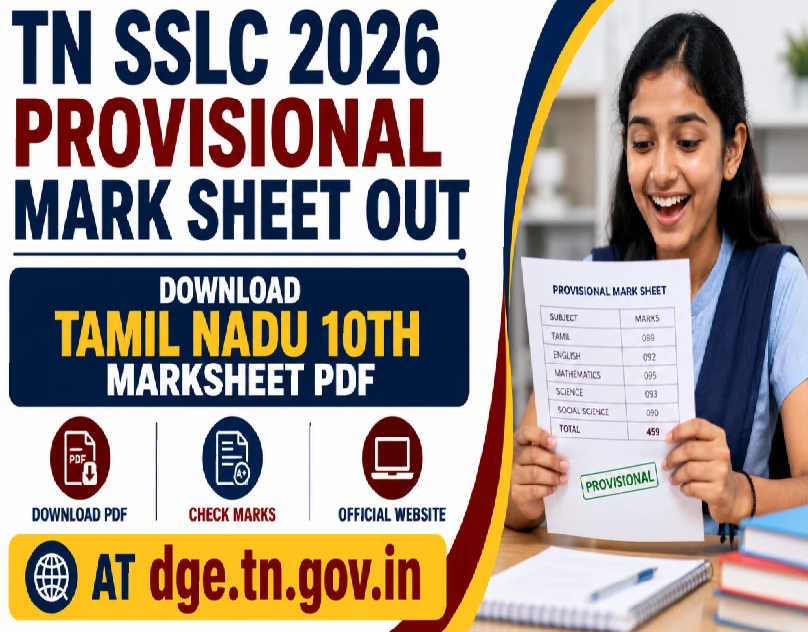
The release of the TN SSLC 2026 provisional mark sheets marks a pivotal moment in Tamil Nadu’s academic calendar, signalling not merely the conclusion of secondary schooling but the beginning of a transformative transition for lakhs of students. As schools across the state commence the distribution of these crucial documents, the process underscores the intricate interplay between examination systems, institutional responsibility and student progression. In an era where digital dissemination increasingly dominates academic administration, Tamil Nadu’s structured approach, combining online accessibility with school-based distribution, reflects a carefully calibrated balance between technological efficiency and institutional oversight. The provisional mark sheet, though interim in nature, carries significant weight in determining a student’s immediate academic trajectory, particularly in the context of higher secondary admissions.
The Significance of the Provisional Mark Sheet
For students who have recently completed the Secondary School Leaving Certificate (SSLC) examinations, the provisional mark sheet serves as the first official record of their academic performance. While the final, consolidated certificate is issued at a later stage, this provisional document functions as an essential credential for admission into higher secondary courses.
Its importance lies in its immediacy. Educational institutions, especially those offering Class XI admissions, rely on these mark sheets to assess eligibility, allocate streams and initiate enrolment processes. In a competitive academic environment where timelines are often compressed, any delay in documentation can disrupt the continuity of a student’s educational journey.
The Tamil Nadu Directorate of Government Examinations has therefore ensured that the distribution process is both timely and accessible, enabling students to proceed with their next academic steps without unnecessary hindrance.
A Dual System: Digital Access and Physical Distribution
One of the defining features of the TN SSLC 2026 mark sheet release is its dual-mode dissemination strategy. Students can access their provisional mark sheets online through the official examination portal, thereby ensuring immediate availability regardless of geographical location. This digital access is particularly beneficial in a state as demographically diverse as Tamil Nadu, where students may be spread across urban centres, rural hinterlands and remote regions.
Simultaneously, schools have begun distributing physical copies of the mark sheets, reinforcing the role of educational institutions as custodians of academic records. This hybrid approach not only enhances accessibility but also introduces an additional layer of verification, reducing the likelihood of discrepancies or unauthorised alterations.
In combining these two modes, Tamil Nadu’s examination system demonstrates a pragmatic understanding of the evolving educational landscape, one that embraces digital innovation without entirely relinquishing traditional institutional frameworks.
Institutional Responsibility and Administrative Coordination
The distribution of provisional mark sheets is not merely a logistical exercise; it is a coordinated administrative endeavour requiring precision, accountability and efficiency.
Schools play a central role in this process. As the primary point of contact for students, they are responsible for ensuring that mark sheets are distributed accurately, promptly and securely. This involves verifying student identities, maintaining distribution records and addressing any discrepancies that may arise.
Such institutional involvement is particularly important in maintaining the integrity of the examination system. While digital platforms offer speed and convenience, they cannot entirely replace the trust and accountability associated with school-based verification.
The TN SSLC 2026 distribution process thus reflects a broader principle: that effective educational governance depends as much on institutional engagement as it does on technological advancement.
Academic Transition: From Secondary to Higher Secondary
Perhaps the most consequential aspect of the SSLC mark sheet lies in its role as a gateway to higher secondary education.
The transition from Class X to Class XI is a critical juncture in a student’s academic life. It is at this stage that subject specialisation begins, shaping future academic and professional pathways. Students must choose streams, such as Science, Commerce or Humanities, decisions that often carry long-term implications.
The provisional mark sheet becomes the basis upon which these choices are made. Performance in key subjects can influence eligibility for certain streams, particularly in highly sought-after disciplines like Science, where competition is intense.
Consequently, the timely distribution of mark sheets is essential not only for administrative efficiency but for enabling informed decision-making among students and families.
The Emotional Dimension of Results
While administrative processes and academic transitions form the structural backbone of result distribution, the emotional dimension cannot be overlooked.
For many students, the SSLC examination represents their first encounter with a high-stakes, board-level assessment. The release of mark sheets, therefore, carries significant emotional weight, often shaping self-perception and confidence.
Educational stakeholders must recognise that this moment extends beyond numerical scores. It is a formative experience that can influence a student’s attitude towards learning, resilience and future aspirations.
Schools, in particular, have a responsibility to guide students through this phase, offering counselling and support where necessary. By contextualising results within a broader educational journey, institutions can help mitigate anxiety and foster a more balanced perspective.
Digitalisation and Its Implications
The integration of digital platforms into the SSLC result process reflects a wider trend within India’s education system.
Over the past decade, states have increasingly adopted online mechanisms for examination management, result dissemination and certificate storage. These developments have enhanced transparency, reduced administrative delays and improved accessibility.
However, digitalisation also introduces new challenges. Issues such as data security, website reliability and digital literacy must be carefully addressed to ensure that technological advancements do not inadvertently create barriers.
Students accessing their provisional mark sheets online must exercise caution, relying only on official portals and safeguarding their login credentials. The proliferation of fraudulent websites and misinformation highlights the importance of digital awareness, particularly during critical academic events.
Tamil Nadu’s Educational Ecosystem
The TN SSLC 2026 mark sheet distribution also offers insights into the broader educational ecosystem of Tamil Nadu. The state has long been recognised for its robust public education system, characterised by high enrolment rates, structured curricula and a strong emphasis on examination integrity. The efficient handling of SSLC results is indicative of this institutional strength.
Moreover, Tamil Nadu’s commitment to ensuring smooth academic transitions reflects its broader educational philosophy, one that prioritises continuity, accessibility and student welfare.
By streamlining processes such as mark sheet distribution, the state reinforces its role as a facilitator of educational mobility, enabling students to progress seamlessly through different stages of learning.
Looking Ahead: Beyond the Mark Sheet
As students receive their provisional mark sheets and prepare for higher secondary education, it is important to situate this moment within a larger context.
The SSLC examination is a milestone, but it is not an endpoint. The skills, knowledge and attitudes developed during subsequent years will play an equally, if not more, significant role in shaping future outcomes.
For policymakers and educators, the focus must therefore extend beyond examination results to encompass holistic development. Academic performance should be complemented by critical thinking, creativity and adaptability, qualities essential for navigating an increasingly complex world.
The TN SSLC 2026 mark sheet distribution, while administrative in nature, thus becomes part of a larger narrative about educational progression, institutional responsibility and the evolving aspirations of students.
Closing Reflections
The release and distribution of TN SSLC 2026 provisional mark sheets represent far more than a procedural step in the academic calendar. They embody the culmination of effort, the promise of progression and the intricate coordination of an educational system striving to balance efficiency with equity. As students across Tamil Nadu embark on the next phase of their academic journeys, these mark sheets will serve as both records of achievement and gateways to future opportunities. And in the careful orchestration of their distribution, one finds a reflection of the state’s enduring commitment to educational excellence and administrative integrity.