UP Govt Mandates Daily Newspaper Reading in Schools: How the New Policy Aims to Build Reading Habits and Reduce Screen Time
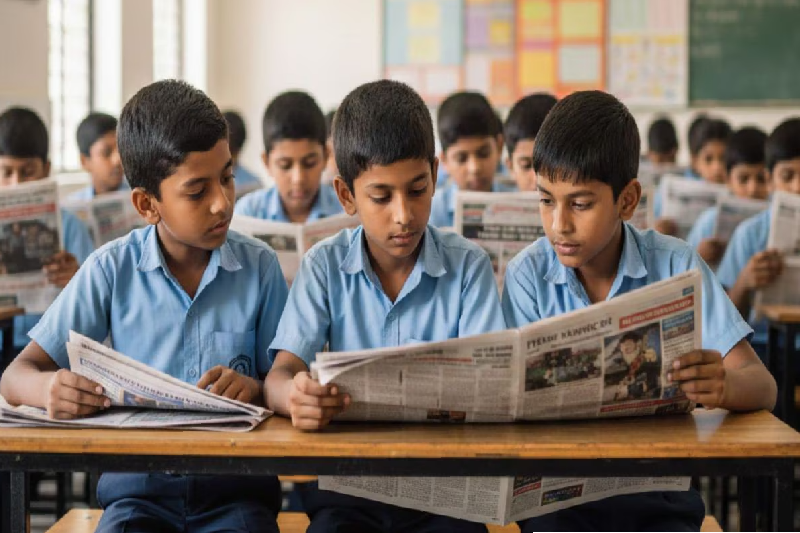
At a time when excessive screen exposure and declining reading habits among children have become growing concerns, the Uttar Pradesh government has taken a decisive step to bring students back to print. In a significant policy move, the state has mandated daily newspaper reading in all secondary and basic primary schools, positioning reading as a core part of the school routine rather than an optional activity.
Issued just before the end of 2025, the directive signals a broader shift in how schools are expected to nurture literacy, critical thinking, and informed citizenship. Alongside newspaper reading, the government has also launched the “No Bouquet, Only Book” campaign, reinforcing its message that books—not decorative gifts—should be central to academic culture.
What the New Order Mandates
The guidelines were issued on December 23 by Additional Chief Secretary (Secondary and Basic Primary Education) Parth Sarathi Sen Sharma. The order applies uniformly to all government and aided secondary and basic primary schools across Uttar Pradesh.
At the heart of the directive is a clear requirement:
Every school must dedicate at least 10 minutes daily during morning assembly to newspaper reading.
During this time, students will read aloud key editorials and major news developments on a rotational basis. The news selection will cover:
- National affairs
- International developments
- Sports-related updates
The intent is to ensure that students are exposed to a wide range of topics, encouraging them to engage with the world beyond textbooks and syllabi.
Hindi and English Newspapers Made Mandatory
To support this initiative, the order mandates that both Hindi and English newspapers be made available in school libraries. This dual-language approach reflects the state’s objective of strengthening reading proficiency in both languages, while also ensuring inclusivity for students from different linguistic backgrounds.
By integrating newspapers into school libraries, the government aims to normalise print reading as part of everyday learning rather than treating it as an occasional enrichment activity.
“Word of the Day”: Building Vocabulary Systematically
A key pedagogical element of the order is the introduction of a “word of the day” exercise. Under this activity:
- Five difficult or unfamiliar words will be selected daily from newspapers.
- These words will be displayed on the school notice board.
- Teachers will help students understand their meanings and usage.
This practice is designed to expand vocabulary organically through real-world language, rather than relying solely on memorisation-based methods. Officials believe that regular exposure to newspaper language will sharpen comprehension skills and improve students’ command over formal and analytical writing.
Why the Government Is Pushing Newspaper Reading
According to the education department, the initiative serves multiple academic and developmental goals.
First, it aims to strengthen reading culture, which has been steadily eroding due to increased dependence on mobile phones, short-form content, and social media. Second, it is seen as a practical tool to reduce excessive screen time by offering a structured, offline alternative during school hours.
Beyond literacy, the government expects tangible benefits in:
- General knowledge and current affairs awareness
- Critical and analytical thinking
- Concentration and attention span
- Social and civic awareness
Officials have also highlighted that regular newspaper reading can better prepare students for competitive examinations, many of which test comprehension, vocabulary, and awareness of current events.
Importantly, the initiative is also intended to sensitise students against fake news, teaching them to differentiate between credible reporting and misinformation—an increasingly essential skill in the digital age.
Activities Beyond Reading: Making News Interactive
The order does not limit schools to passive reading alone. Instead, it actively encourages institutions to transform newspaper engagement into creative and participatory learning experiences.
Schools have been advised to:
- Publish their own school newspapers or magazines
- Organise editorial-based writing exercises or group discussions for Classes 9 to 12
- Conduct crossword and Sudoku competitions linked to newspapers
- Promote scrapbook-making using news cuttings for junior students
These activities are meant to deepen engagement with content, help students articulate opinions, and develop collaboration and communication skills. By linking newspapers to creative expression, the government hopes to make reading enjoyable rather than routine-driven.
Continuation of a Broader Reading Campaign
This directive builds on an earlier order issued on November 2, under which the Uttar Pradesh government launched a statewide reading campaign. That initiative focused on reviving book-reading habits and curbing excessive use of mobile phones and social media among students.
Key measures under the earlier order included:
- Allowing students access to government district libraries
- Making it mandatory for students to issue at least one non-syllabus book every week
- Introducing incentives such as appreciation certificates for avid readers
Together, the November and December orders form a cohesive policy framework aimed at embedding reading into students’ daily lives—both inside and outside the classroom.
“No Bouquet, Only Book”: A Cultural Shift in Schools
One of the most symbolic aspects of the policy is the launch of the “No Bouquet, Only Book” campaign. Under this initiative, books will be gifted instead of bouquets or trophies at school functions, ceremonies, and official events.
The move seeks to replace short-lived tokens with lasting educational value, reinforcing the idea that books are the most meaningful reward in an academic environment. Officials see this as a way to subtly but powerfully reshape school culture, placing learning at the centre of recognition and celebration.
Implementation and Accountability
Both the newspaper-reading directive and the broader reading campaign orders have been circulated to:
- Divisional education officials
- District inspectors of schools
- Basic education officers
Senior officials have issued strict instructions to ensure full implementation across the state. Schools are expected to integrate these activities into their daily schedules rather than treating them as optional or symbolic gestures.
Conclusion: Reclaiming Attention Through Print
The Uttar Pradesh government’s mandate marks a deliberate effort to reclaim students’ attention from screens and re-anchor learning in sustained reading and reflection. By institutionalising newspaper reading, promoting books over trophies, and encouraging creative engagement with print media, the state is attempting to address both academic and behavioural challenges facing students today.
If implemented effectively, the policy has the potential to not only improve literacy and awareness, but also reshape how young learners interact with information—slowly, critically, and thoughtfully—in an increasingly fast-paced digital world.