Viksit Bharat Adhishthan Bill: A Tough Crackdown on Illegal Universities — But Who Bears the Cost?
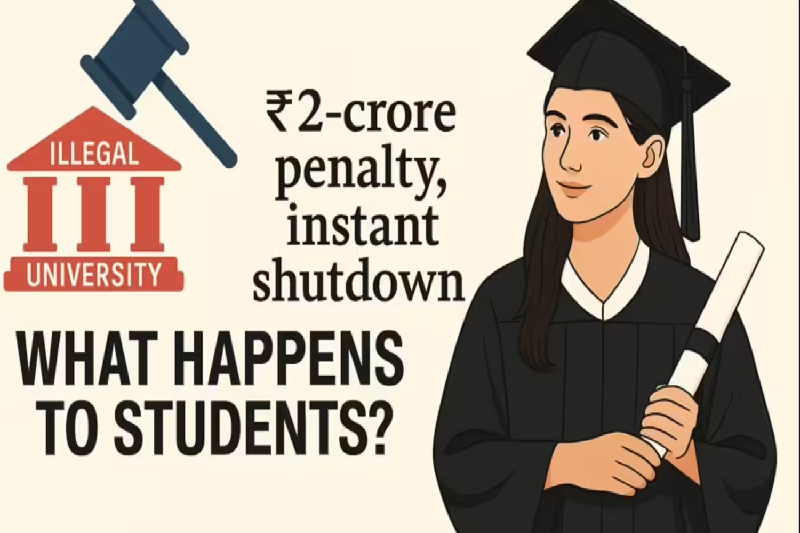
India’s higher education landscape may be on the brink of a significant legal shift. The proposed Viksit Bharat Adhishthan Bill, circulated to Members of Parliament and expected to be tabled shortly, seeks to dramatically tighten the noose around unauthorised universities. At its core is a hard deterrent: any university or higher education institution established without approval from the Centre or a state government could face an immediate shutdown and a minimum penalty of ₹2 crore.
On paper, the Bill reads like a long-overdue response to a problem regulators have acknowledged for decades — the persistence of fake, unrecognised, and illegally operating institutions. But beyond the headlines and penalties lies a deeper issue that affects thousands of students: while the law is precise about punishing institutions, it remains strikingly unclear about protecting students who find themselves enrolled in them.
What the Bill proposes
The Viksit Bharat Adhishthan Bill introduces two major changes. First, it strengthens enforcement. The ₹2-crore fine is designed to be punitive, not symbolic, signalling that operating outside the legal framework will no longer be treated as a minor regulatory violation. The provision for immediate closure aims to eliminate the prolonged grey periods during which illegal institutions often continue to admit students despite warnings.
Second, the Bill mandates sweeping transparency. Universities will be required to publicly disclose key information — financial audits, infrastructure details, faculty qualifications, course offerings, student outcomes and accreditation status. This information must be hosted both on a regulator-managed portal and on the institution’s own website. The intent is to reduce information asymmetry and make it harder for dubious institutions to hide behind glossy brochures.
What the law already says — and doesn’t
Indian higher education law has long been unambiguous on one central point. Under the University Grants Commission (UGC) Act, 1956, only universities established by a Central or State Act, or institutions explicitly authorised by law, can award degrees. Any institution operating outside this framework has no legal authority to confer valid qualifications.
UGC advisories reiterate this year after year: degrees from unrecognised or fake universities are not valid for higher education, government employment or regulated professions. The ambiguity lies not in the rule, but in its enforcement. Many institutions continue to function for years before regulatory action catches up.
If a university is shut down, do students lose everything?
Legally, the answer hinges on one crucial question: Was the institution recognised at the time the degree was awarded? Courts have consistently held that if an institution was validly recognised when a student completed the programme and received the degree, that qualification generally remains valid, even if the institution later loses recognition or shuts down.
However, the situation is starkly different when an institution never had valid recognition or was operating in violation of statutory requirements. In such cases, the UGC’s position is uncompromising: degrees issued by unauthorised institutions are invalid, regardless of subsequent penalties or closures.
For students, this distinction often becomes clear only after years of study, substantial financial investment and irreversible career decisions.
Is there any automatic legal protection for students?
There isn’t. India has no statutory framework that guarantees protection to students when a university is shut down or derecognised. There is no automatic right to transfer credits, no guaranteed relocation to recognised institutions and no built-in compensation mechanism.
Relief, when it comes, usually arrives through the courts. Students file writ petitions seeking permission to migrate, complete courses elsewhere or receive special consideration. Outcomes vary widely. Relief is discretionary, uneven and slow — and often comes after the damage is already done. In practical terms, student protection in India remains judicial rather than legislative.
What the new Bill changes — and what it does not
The Viksit Bharat Adhishthan Bill decisively strengthens the state’s hand against illegal institutions. Faster closures and mandatory disclosures are meant to end the prolonged uncertainty that has characterised enforcement in the past.
What the Bill does not yet address is the student gap. There is no publicly available provision ensuring that students affected by closures will be rehabilitated, relocated or compensated. Enforcement becomes tougher; student vulnerability remains largely the same.
Why this matters more now
For years, weak enforcement created an unintended cushion. Institutions were flagged but not immediately shut down, allowing many students to graduate before consequences arrived. That cushion is thinning.
If the Bill becomes law in its current form, regulators will have both the authority and the incentive to act swiftly. For students enrolled in institutions operating at the margins of legality, this compresses timelines. A shutdown could occur mid-semester, not years later.
While the transparency mandate is meant to prevent such situations by enabling informed choices, it assumes a level of legal awareness that many first-generation applicants simply do not have.
What students must verify — beyond marketing claims
Brochures and advertisements have no legal standing. Recognition does.
Students must verify:
- Whether the university appears on the UGC’s official list of recognised universities
- Whether the specific programme requires approval from a statutory council
- Whether accreditation claims are current, valid and independently verifiable
Phrases such as “approval applied for,” “proposed university” or “international collaboration” carry no legal weight unless backed by statutory recognition. Good faith does not convert an invalid degree into a valid one — under existing law or the proposed Bill.
The looming question for Parliament
As the Bill comes up for debate, one question will overshadow the penalties: Should students continue to bear the cost of regulatory clean-ups? The state already has the power to shut illegal institutions. What it lacks is a clear, codified framework to protect those who enrolled believing they were making a legitimate choice.
Without that, tougher enforcement risks repeating an old pattern — faster closures, same human cost.
Why this is a turning point
Warnings are giving way to penalties, and grey zones are shrinking. For students, the implication is sobering. Choosing a university is no longer just an academic or financial decision; it is a legal one.
The Viksit Bharat Adhishthan Bill raises the cost of illegality for institutions. Until student safeguards are written into law, it also raises the cost of getting that choice wrong — paid not in fines, but in years of life that cannot be returned.