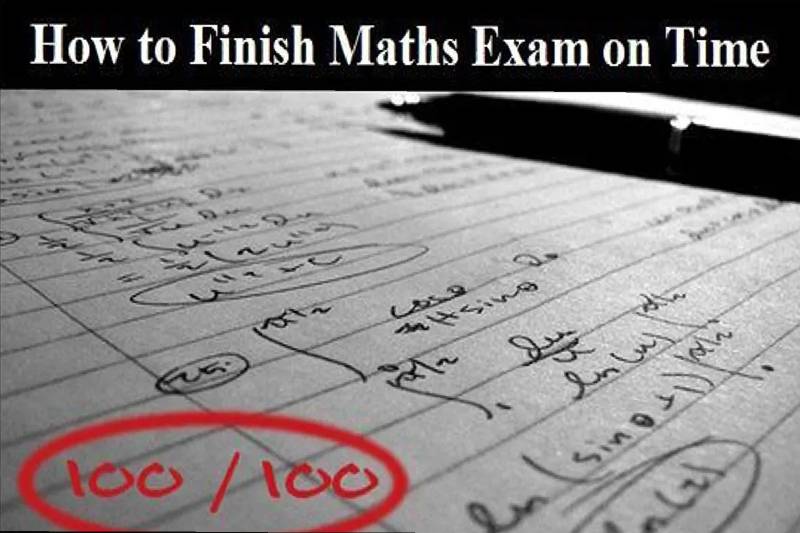
Want to Score Full Marks in CBSE Class 10 Maths? Don’t Miss These Tips
As the CBSE Class 10 board exams 2026 draw closer, Mathematics stands out as one of the most scoring and strategic subjects. With the exam scheduled on 17 February 2026 (10:30 am – 1:30 pm), students must adopt a focused and systematic approach to ensure top marks. While every topic is important, certain high-yield areas and consistent practice strategies can make a significant difference in performance.
Streamline Your Preparation for Success
With limited time left, it is crucial for students to plan their revision, understand the exam pattern, and practise rigorously. Mathematics is not just about memorising formulas—it requires conceptual clarity, problem-solving speed, and accuracy. A structured preparation strategy helps reduce last-minute stress and boosts confidence.
Key steps for effective preparation include:
- Revision Plan: Divide topics into manageable sections and revise daily.
- Time Management: Solve questions under timed conditions to simulate the board exam environment.
- Focus on Weak Areas: Identify difficult topics and allocate extra practice time.
- Consistent Practice: Solve a variety of problems to strengthen understanding and application skills.
Important Topics to Focus On
While the entire syllabus matters, certain topics are both conceptually significant and frequently tested. Prioritising these areas can maximize scoring potential.
1. Real Numbers
- Fundamental concepts including Euclid’s division lemma and properties of numbers.
- Proofs and applications of number theory concepts.
- Practice problems involving LCM, HCF, and divisibility rules.
2. Polynomials
- Zeros of a polynomial and their relationships.
- Identities such as ((a+b)^2), ((a-b)^2), and ((x+a)(x+b)).
- Factorisation and algebraic manipulation problems.
3. Pair of Linear Equations in Two Variables (PLT)
- Graphical method: Plotting and finding intersections.
- Algebraic methods: Substitution, elimination, and cross-multiplication.
- Word problems based on real-life scenarios.
4. Quadratic Equations
- Standard form and discriminant.
- Solutions using factorisation and the quadratic formula.
- Applications in problem-solving involving age, motion, and geometry.
5. Arithmetic Progressions (AP)
- Finding the nth term and sum of n terms.
- Word problems involving sequences and series.
6. Triangles and Congruence
- Criteria for congruence (SSS, SAS, RHS) and similarity (AA, SSS, SAS).
- Important theorems like Pythagoras’ theorem and basic properties of triangles.
7. Coordinate Geometry
- Distance formula, section formula, and midpoint formula.
- Area of triangles using coordinates.
- Straight line equations and graph plotting.
8. Geometry (Circles & Constructions)
- Tangents, arcs, and chords of circles.
- Compass and ruler constructions: bisectors, triangles, and perpendiculars.
- Application-based problems that combine theorems and constructions.
9. Trigonometry
- Trigonometric ratios and standard identities.
- Problems involving heights and distances.
- Angle-of-elevation and depression calculations.
10. Mensuration
- Surface areas and volumes of cylinders, cones, spheres, and combinations.
- Word problems involving practical applications.
11. Statistics and Probability
- Measures of central tendency: mean, median, mode.
- Probability of simple events.
- Interpretation of graphs and charts.
By focusing on these high-yield topics, students can cover conceptually important and frequently tested areas, increasing the chance of scoring well.
Why Solving Sample Papers Is Crucial
Sample papers are more than just practice—they are blueprints for success. Regularly solving official CBSE sample papers helps students:
- Understand the Exam Pattern
- Familiarity with question types, marking scheme, and difficulty level.
- Knowing which sections carry higher weightage.
- Build Accuracy and Confidence
- Timed practice improves speed and precision.
- Reduces chances of errors and miscalculations during the exam.
- Identify Weak Areas
- Reviewing mistakes highlights gaps in understanding.
- Provides a roadmap for focused revision.
- Simulate Exam Conditions
- Attempting papers under timed conditions trains students to manage time effectively.
- Helps reduce exam anxiety and boosts confidence.
Experts recommend solving at least 3-5 official sample papers before the board exam while reviewing every mistake and reinforcing concepts that caused errors.
Tips for Last-Minute Preparation
With less than a month left, students should follow a targeted and efficient strategy:
- Daily Revision: Dedicate 2-3 hours daily for Mathematics revision and problem-solving.
- Short Notes: Keep formulas, theorems, and shortcuts handy for last-minute review.
- Mixed Practice: Solve problems from different topics together to improve flexibility.
- Time Yourself: Simulate exam conditions to enhance speed and reduce pressure.
- Focus on High-Scoring Questions: Prioritize topics that are conceptually important and frequently appear in past papers.
Remember, consistent practice and clarity of concepts outweigh last-minute cramming.
Conclusion
Scoring full marks in CBSE Class 10 Mathematics is achievable with strategic preparation, focused revision, and timed practice. Prioritising high-yield topics like Real Numbers, Polynomials, PLT, Quadratic Equations, Trigonometry, and Mensuration, while practising official sample papers, can significantly boost confidence and accuracy.
Mathematics is as much about problem-solving skills as it is about conceptual understanding. With the exam just around the corner on 17 February 2026, students who follow a structured revision plan, practice rigorously, and manage time effectively will be well-positioned to excel and achieve top marks.