India-Canada Academic Ties Deepen as 13 University Agreements Signed; McGill to Establish AI Centre in India
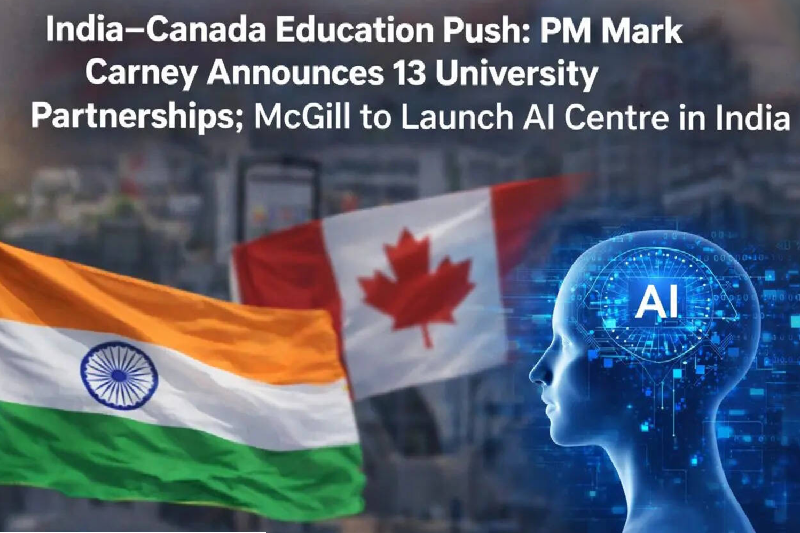
In a significant advancement of bilateral engagement, India and Canada have signed 13 new university-level agreements aimed at strengthening research collaboration and enhancing student mobility. The announcement, made during Canadian Prime Minister Mark Carney’s four-day official visit to India, signals a renewed commitment to educational diplomacy as a cornerstone of the broader strategic partnership between the two nations.
The agreements, covering joint research initiatives and the establishment of artificial intelligence (AI) centres of excellence, reflect a shared recognition that higher education remains a powerful conduit for long-term cooperation. Among the most prominent developments is McGill University’s decision to set up an AI education and research centre in India by 2027, a move that underscores the evolving character of Indo-Canadian academic relations.
Education at the Heart of Strategic Partnership
In a message shared on X, Prime Minister Carney noted that Canadian universities are widening their engagement with Indian institutions through new talent partnerships. The 13 agreements, he said, are designed to facilitate joint research, expand academic exchanges and offer students meaningful international exposure.
Carney’s visit to India, held from 27 February to 2 March at the invitation of Prime Minister Narendra Modi, included engagements in both Mumbai and New Delhi. Upon arrival in the national capital, he was received by Union Minister of State for Commerce and Industry and Electronics and IT, Jitin Prasada. Formal delegation-level talks between the two Prime Ministers were scheduled at Hyderabad House, where both leaders were expected to review progress under the India–Canada Strategic Partnership.
According to India’s Ministry of External Affairs, discussions during the visit spanned a wide spectrum, including trade and investment, energy cooperation, critical minerals, agriculture, education and research collaboration, as well as people-to-people ties. The educational agreements therefore form part of a broader diplomatic architecture aimed at deepening institutional and economic linkages.
McGill University’s AI Centre: A Flagship Initiative
Among the 13 agreements, the most high-profile announcement came from McGill University, which confirmed plans to establish a centre of excellence in AI education and research in India. The announcement was made during an academic mission led by Universities Canada, attended by Prime Minister Carney and Canada’s Foreign Minister Anita Anand.
Scheduled to commence operations in May 2027, the centre will admit its first cohort of approximately 50 students in the autumn of that year. Over time, enrollment is expected to expand to around 200 students. The academic offering will comprise a master’s programme that integrates rigorous classroom instruction with industry-linked projects in the AI sector.
McGill’s Faculty of Engineering will design the curriculum, establish academic benchmarks and oversee research priorities. Meanwhile, the Indian partner institution will manage local coordination, regulatory compliance and stakeholder engagement. This division of responsibilities reflects a model of collaborative governance, one that blends international academic standards with contextual adaptability.
Industry Collaboration and Infrastructure Support
The AI centre will be developed in partnership with the Jubilant Bhartia Group, which will provide land, infrastructure and operational support. The group will also facilitate linkages with companies operating within India’s expanding technology and AI ecosystem.
This tripartite collaboration linking a globally ranked Canadian university, an Indian academic partner and a leading Indian conglomerate, embodies the increasingly hybrid nature of higher education ventures. By integrating academic research with industry application, the centre aims to bridge the gap between theoretical scholarship and real-world innovation.
The focus on artificial intelligence is particularly noteworthy. As AI reshapes sectors ranging from healthcare and finance to manufacturing and governance, the need for advanced research and skilled professionals has intensified globally. India’s burgeoning digital economy, combined with Canada’s established strengths in AI research, creates fertile ground for mutually beneficial cooperation.
Broadening Academic Mobility and Research Exchange
Beyond the McGill initiative, the 13 agreements collectively aim to expand student mobility and joint research projects. These partnerships are expected to encourage faculty exchanges, co-supervised doctoral programmes and collaborative publications across disciplines.
For Indian students, the agreements may offer expanded pathways to international academic exposure without necessarily relocating for the entirety of their studies. For Canadian institutions, deeper engagement with India provides access to one of the world’s largest and youngest student populations, as well as opportunities to participate in high-growth sectors.
Such collaborations also strengthen institutional resilience in a global higher education environment marked by financial pressures and shifting demographics. Diversified partnerships mitigate risk while enhancing intellectual diversity.
Diplomatic Context and High-Level Engagements
Carney’s visit forms part of a sustained series of high-level interactions between the two leaders. Prior meetings in Kananaskis in June 2025 and Johannesburg in November 2025 laid the groundwork for renewed engagement. The current visit builds upon those discussions, translating political goodwill into tangible institutional agreements.
Ahead of the delegation-level talks, India’s External Affairs Minister S. Jaishankar met his Canadian counterpart Anita Anand to review the agenda and align priorities. The inclusion of education prominently within these discussions signals recognition that knowledge exchange is integral to long-term diplomatic stability.
In addition to official meetings, Prime Ministers Modi and Carney were scheduled to participate in the India–Canada CEOs Forum, highlighting the intersection between academic collaboration and commercial partnership. Education, research and enterprise are increasingly viewed as interconnected pillars of economic diplomacy.
Artificial Intelligence as a Shared Frontier
The decision to anchor a flagship initiative in AI reflects broader strategic priorities. Both India and Canada have articulated ambitions to lead in emerging technologies. Canada has long been recognised for pioneering AI research, particularly in machine learning, while India has leveraged its vast talent pool to become a global technology hub.
By setting up the AI centre in India, McGill and its partners aim to harness local expertise, engage with industry stakeholders and contribute to capacity-building within the region. The emphasis on industry-linked projects ensures that graduates are not only academically proficient but also professionally adaptable.
Such initiatives also align with India’s aspirations to enhance its domestic research ecosystem and attract high-calibre international institutions to establish a sustained presence in the country.
Educational Diplomacy in a Changing Global Order
The India-Canada academic agreements exemplify a broader trend in international relations: the elevation of education as a strategic instrument. Unlike traditional trade agreements, educational partnerships cultivate long-term networks of trust, understanding and shared innovation.
Students who benefit from these programmes may later assume roles in academia, government or industry, carrying with them a nuanced appreciation of bilateral cooperation. In this sense, academic diplomacy operates as a multiplier of soft power.
The presence of over 50 diplomatic representatives during the academic mission underscores the multilateral interest in such collaborations. As higher education becomes increasingly globalised, bilateral agreements can serve as catalysts for broader regional engagement.
Looking Ahead
The signing of 13 university agreements and the announcement of McGill’s AI centre represent more than isolated initiatives. They signal a recalibration of Indo-Canadian relations towards sustained, knowledge-based collaboration.
By 2027, when the AI centre welcomes its first cohort, the partnership may well serve as a template for future ventures, combining international academic excellence with local industry integration and governmental support.
As Prime Minister Carney’s visit concludes, the tangible outcomes in the educational sphere provide a constructive narrative amid complex global dynamics. For India and Canada alike, the expansion of academic ties affirms a shared belief that the future of diplomacy lies not only in political accords but also in classrooms, laboratories and collaborative research hubs.
In strengthening these institutional bonds, both nations are investing in a generation of scholars and innovators whose work will shape technological, economic and societal landscapes in the decades to come.