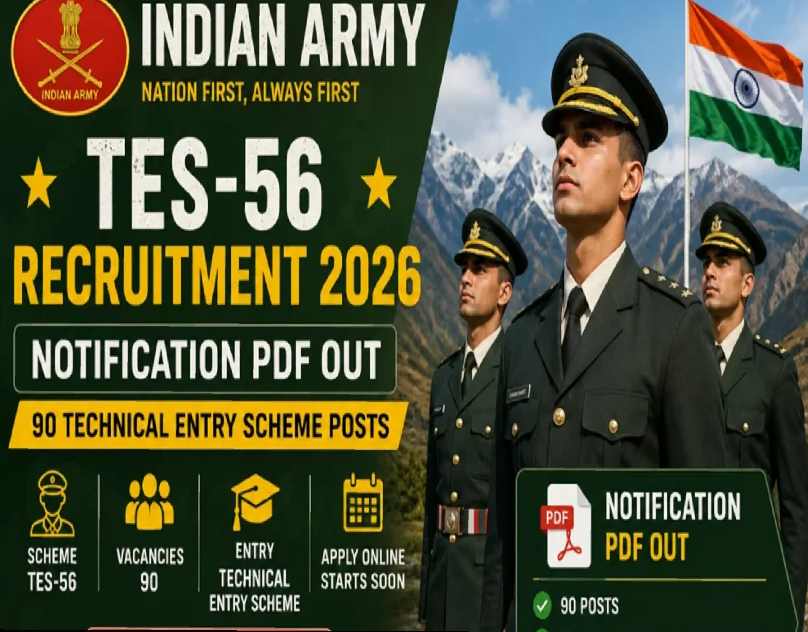
Indian Army TES-56 Recruitment 2026 Opens for 90 Lieutenant Posts Through JEE Main Scores Entry Now!
Indian Army Opens TES-56 Recruitment for 90 Lieutenant Posts Through JEE Main 2026
The Indian Army has officially commenced the application process for the Technical Entry Scheme (TES)-56 course, inviting applications for 90 vacancies for the post of Lieutenant through the JEE Main 2026 route. Scheduled to commence in January 2027, the recruitment initiative offers eligible candidates an opportunity to secure a Permanent Commission in one of the country’s most respected defence institutions. The announcement has generated widespread attention among students pursuing Science education with Physics, Chemistry and Mathematics (PCM), particularly those aspiring to combine technical expertise with a career in military leadership. Unlike conventional recruitment examinations, the Technical Entry Scheme represents a direct officer-entry pathway after Class 12, making it one of the most prestigious early-career opportunities available to young aspirants in India.
A Direct Pathway into the Officer Cadre
The TES entry scheme occupies a distinctive position within the Indian Army’s recruitment structure. Unlike many defence recruitment pathways that require graduation, TES allows candidates to enter the officer training framework immediately after completing higher secondary education, provided they satisfy the eligibility conditions and qualify through the selection process.
Candidates selected through TES undergo integrated military and technical training before being commissioned as Lieutenants in the Indian Army. The programme combines engineering education, leadership development and military preparedness, thereby producing technically trained officers equipped for operational and administrative responsibilities within the armed forces.
For many students, particularly those exploring alternatives to traditional engineering or civilian career routes, TES represents a unique convergence of academic advancement, professional discipline and national service.
Eligibility Criteria for TES-56
According to the recruitment notification, candidates applying for TES-56 must have completed Class 12 or its equivalent examination with Physics, Chemistry and Mathematics, securing a minimum aggregate of 60 per cent marks in PCM subjects. In addition, appearing for JEE Main 2026 has been made mandatory for eligibility.
The inclusion of JEE Main scores as a shortlisting criterion reflects the Army’s increasing emphasis on technical aptitude and academic competence. However, unlike engineering institute admissions, TES selection does not rely solely on exceptionally high JEE ranks. Shortlisting is conducted comparatively among applicants, followed by further stages of evaluation.
The scheme is currently open to unmarried male candidates within the prescribed age bracket, generally between 16.5 and 19.5 years, subject to the official notification guidelines.
Application Process and Important Dates
The online application process began on May 13, 2026, and eligible candidates can submit their forms through the official recruitment portal of the Indian Army until June 12, 2026.
Applicants are required to complete the registration process online by entering educational details, uploading documents and providing their JEE Main credentials. Authorities have advised candidates to complete the process well before the closing date to avoid technical delays or server congestion during the final days of application submission.
Importantly, the Indian Army has reiterated that no application fee is required for TES recruitment. The selection process remains entirely merit-based, and candidates have been warned against unofficial intermediaries or fraudulent claims related to recruitment assistance.
Selection Procedure: More Than Academic Merit
The TES-56 recruitment process extends far beyond academic eligibility. After the initial shortlisting based on JEE Main performance and educational qualifications, shortlisted candidates will be invited for the Services Selection Board (SSB) interview process.
The SSB assessment is widely regarded as one of the most rigorous and comprehensive evaluation systems in Indian competitive recruitment. Rather than focusing solely on written knowledge, the process evaluates personality traits, leadership potential, psychological resilience, communication ability and decision-making skills.
Candidates who successfully clear the SSB interview are subsequently required to undergo detailed medical examinations before final merit lists are prepared. Only those satisfying all stages are granted admission into the TES training programme.
Experts familiar with defence recruitment often note that the SSB process cannot be approached as a conventional examination. Preparation requires not merely academic competence but confidence, situational awareness, emotional composure and the ability to demonstrate officer-like qualities under observation.
Integrated Military and Technical Training
One of the defining features of the Technical Entry Scheme is its integrated training structure. Selected cadets undergo approximately four years of combined military and engineering education before commissioning.
During the training period, cadets are exposed to military discipline, tactical instruction, physical conditioning and technical coursework. The Army’s objective is not simply to produce engineers in uniform but officers capable of functioning effectively in technologically advanced operational environments.
Upon successful completion of training, cadets receive Permanent Commission as Lieutenants and are inducted into various technical arms and services of the Indian Army, including the Corps of Engineers, Corps of Signals and Corps of Electronics and Mechanical Engineers, depending on organisational requirements and merit.
Why TES Continues to Attract Aspirants
The Technical Entry Scheme has steadily emerged as one of the most sought-after defence recruitment opportunities for science students in India. Several factors contribute to its popularity.
First, it offers direct officer entry immediately after school education, eliminating the need to wait for graduation before pursuing a military career. Secondly, it provides technical education alongside structured military training, thereby ensuring both academic and professional development.
Additionally, commissioned officers in the Indian Army receive competitive salaries, allowances, accommodation benefits, healthcare support and long-term career progression opportunities. Reports suggest that officers commissioned through TES enter the pay matrix at Level 10, alongside broader service-related benefits.
However, defence experts frequently caution aspirants against viewing TES merely as a secure government job. Military service involves demanding operational responsibilities, frequent transfers, field postings and long-term commitment to national service. The profession requires resilience, discipline and adaptability under difficult conditions.
The Expanding Role of Technical Expertise in Defence
The growing emphasis on technical recruitment within the armed forces reflects broader changes in contemporary warfare and defence administration. Modern military operations increasingly depend upon sophisticated communication systems, cyber infrastructure, surveillance technologies and engineering capabilities.
Consequently, technically trained officers now play an increasingly important role in operational readiness and strategic defence planning. The TES framework aligns with this evolving requirement by identifying technically capable candidates at an early stage and integrating them into structured military leadership pathways.
The inclusion of JEE Main as an eligibility requirement further underlines the Army’s attempt to attract academically strong candidates with demonstrated analytical aptitude.
Competitive Landscape and Candidate Preparation
Competition for TES entry remains intense due to the limited number of vacancies and the prestige associated with officer-level recruitment. With only 90 vacancies announced under TES-56, aspirants across the country are expected to compete aggressively for selection.
Preparation strategies among candidates increasingly involve a combination of academic focus, personality development and physical fitness training. Coaching institutions specialising in SSB preparation have also witnessed growing enrolment over recent years as awareness regarding defence careers expands among students and families.
Candidates are generally advised to maintain balanced preparation rather than concentrating exclusively on written academic performance. Communication skills, leadership qualities and psychological readiness remain central components of the selection process.
A Career Defined by Responsibility and Service
The Indian Army’s TES-56 recruitment drive arrives at a time when career conversations among students are becoming increasingly diversified. While conventional engineering, medicine and corporate careers continue to dominate educational aspirations, defence services are simultaneously attracting candidates seeking purpose-driven professions that combine leadership, technical expertise and national responsibility.
For successful applicants, TES-56 represents far more than a recruitment notification. It offers entry into a structured institutional environment shaped by discipline, technical competence and service ethos.
With applications now open and the selection process underway, thousands of aspirants across India are expected to pursue one of the country’s most competitive and prestigious officer-entry opportunities. The coming months will determine which candidates ultimately secure a place in the January 2027 course and begin the demanding yet distinguished journey towards becoming commissioned officers in the Indian Army.