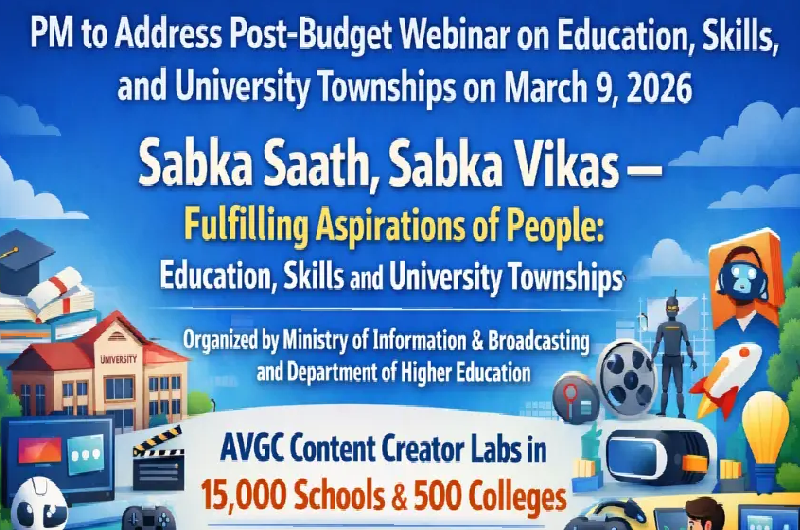
Post‑Budget Education and Skills Agenda: PM Modi to Lead National Webinar on March 9
On 9 March 2026, India’s political and educational landscape will be enlivened by a high‑profile Post‑Budget webinar focused on the nation’s trajectory in education, skills development and the conception of university townships. The webinar, titled “Sabka Saath, Sabka Vikas – Fulfilling Aspirations of People: Education, Skills and University Townships”, is scheduled to bring together a broad cross‑section of stakeholders from policymakers and academic leaders to industry representatives, innovators and young learners, to deliberate on translating the Union Budget’s vision into substantive action.
Prime Minister Narendra Modi is set to deliver the keynote address at the opening session, outlining the government’s strategy for deploying the 2026–27 Budget’s education‑related investments and initiatives aimed at nurturing human capital, stimulating creativity and fostering India’s rapidly evolving creative economy.
In this comprehensive blog, we explore the context and significance of this event, the core initiatives being highlighted, the rationale behind the government’s education and skills agenda, and what the outcomes might signify for India’s students, educators and broader economy.
A National Forum on Education and Skills
The post‑Budget webinar on education, skills and university townships is being organised by the Ministry of Information and Broadcasting, in collaboration with the Department of Higher Education. It is scheduled for 11:30 AM IST on 9 March 2026 and will convene participants from government, academia and industry to discuss implementation pathways for several key Budget announcements.
Entitled Sabka Saath, Sabka Vikas – Fulfilling Aspirations of People, the event underscores a core message of inclusion, suggesting that the government’s economic and social policies aim to bring broad‑based benefits across regions and socio‑economic groups. The thematic pairing of education, skills development and university townships reflects an understanding that future‑ready human capital and integrated learning ecosystems are pivotal to national competitiveness.
The Vision Behind the Webinar
At the heart of the upcoming webinar is the government’s desire to transform the landscape of education and skill acquisition in India. Rather than being confined to traditional frameworks, the emphasis is on connecting policy pronouncements to practical, scalable solutions. This requires aligning the aspirations embedded in the 2026–27 Budget with concrete programmes that can catalyse innovation, employment and sustainable growth.
One of the most discussed facets of the Budget, and a key subject of the webinar, is the spotlight on the Animation, Visual Effects, Gaming and Comics (AVGC) creator economy. This sector, often referred to as part of the broader ‘orange economy’, has witnessed accelerating growth due to expanding digital platforms, global content consumption and India’s burgeoning creative talent.
Prime Minister Modi’s address is anticipated to frame the government’s push for the AVGC sector as not merely a creative pursuit but a strategic economic priority, one that can generate skilled jobs, enhance indigenous intellectual property creation and contribute to India’s cultural imprint globally.
AVGC Content Creator Labs: A Bold Initiative
A centrepiece of the webinar and perhaps the most direct expression of Budget policy into execution, is the emphasis on AVGC Content Creator Labs (CCLs). These labs are envisioned as hands-on environments where students and young creators can cultivate practical skills in animation, visual effects, gaming and comic creation.
Under the announcement, 15,000 schools and 500 higher‑education institutions across India are to be equipped with such labs. This expansive rollout represents one of the most ambitious education‑linked initiatives in recent memory, aiming to democratise access to creative and digital skill development at scale.
By embedding CCLs within existing educational infrastructures, the government intends to nurture a pipeline of skilled creators capable of competing on global platforms, contributing to the domestic creative ecosystem, and reinforcing India’s place in sectors characterised by rapid technological advancement.
University Townships: Integrating Learning with Community
Beyond skills labs, the webinar also seeks to articulate the government’s broader vision for university townships, integrated campuses that go beyond conventional academic precincts to include residential communities, research facilities, cultural spaces and innovation hubs.
The township concept reflects the belief that quality education thrives not in isolation, but within vibrant ecosystems where learners, researchers and industry collaborators intersect. A well‑designed township can serve as a magnet for national and international talent, foster interdisciplinary exploration, and contribute to regional development through knowledge spillovers.
By convening stakeholders to discuss how such townships can be established and scaled, the webinar aims to initiate dialogue that bridges policy intent with infrastructure planning, financing approaches and governance models that ensure sustainability and inclusiveness.
Broader Significance: Linking Education, Economy and Employment
While education and skills development are intrinsically valuable, the government’s repeated emphasis on these themes also speaks to their economic multiplier effects. A workforce equipped with digital and creative capabilities is better positioned to thrive in sectors where innovation and adaptability are crucial.
The inclusion of industry leaders and startup representatives in the webinar’s agenda suggests an emphasis on public‑private partnerships, where government resources and policy frameworks can be synergised with market‑driven expertise to foster ecosystems that support both learning and entrepreneurship.
Moreover, the focus on the AVGC economy, alongside broader education and skills discourses, signals an understanding that future job markets will valorise creativity, critical thinking and technological fluency. Preparing students to navigate these arenas requires a deliberate shift from rote learning towards project‑based, interdisciplinary, and industry‑aligned education models.
Panel Discussions and Breakout Sessions
A distinguishing aspect of the webinar format is the inclusion of breakout sessions and panel discussions. One featured breakout session, focused explicitly on AVGC Content Creator Labs in schools and colleges, is designed to be an interactive forum where policymakers, sector experts and students can exchange perspectives on both opportunities and implementation challenges.
The session will be moderated by leaders from the creative and educational sectors, and will include experts from government departments as well as private industry, such as representatives from the Federation of Indian Chambers of Commerce & Industry (FICCI) AVGC Forum, major tech and creative content companies, and student voices from leading institutes.
Such diverse participation is intended to generate actionable insights that can inform pilot implementations, curriculum integration strategies, and resource allocations that shape how the CCLs and associated initiatives unfold.
Anticipated Outcomes and Strategic Importance
The webinar’s ultimate goal is to move beyond exposition to collaborative strategy creation. In bringing together different segments of the education ecosystem, the forum aims to lay down a roadmap for how the educational objectives of the 2026–27 Budget can be realised in tangible, measurable ways.
Experts anticipate that discussions will address questions such as:
- How can CCLs be integrated into existing academic schedules without overburdening educators?
- What industry partnerships can ensure that curriculum content remains relevant to evolving technological standards?
- How might university townships be financed, governed and connected to broader economic clusters?
- What mechanisms can be used to track outcomes in terms of employment, innovation outputs and student achievements?
Answers to such questions will have implications not only for India’s education sector but for its global competitiveness in knowledge‑intensive industries where leadership is increasingly contingent on the sophistication of human capital.
Looking Ahead: Education in the 21st Century
As the country prepares for the webinar on 9 March 2026, it is worth recognising the broader context in which this event sits. Education in the 21st century is not merely about imparting information, it is about empowering learners to navigate complex systems, innovate, collaborate and adapt to rapid technological change.
By orienting policy towards skills, creativity and infrastructure ecosystems such as university townships, the government is attempting to bridge traditional divides between academic knowledge and industry requirements. Such efforts, if executed effectively, have the potential to reshape India’s educational profile and support its emergence as a global talent powerhouse.
Prime Minister Modi’s address is therefore more than a ceremonial highlight: it is a confirmation of political will and strategic direction at the highest level, laying the groundwork for initiatives that could influence how millions of Indians learn, work and contribute to societal progress in the years ahead.
Conclusion: A Confluence of Policy, Practice and Potential
The post‑Budget webinar on education, skills and university townships manifests an ambitious endeavour to translate fiscal vision into educational reality. With a multidimensional agenda encompassing the creative economy, skill integration and ecosystem‑based learning models, the event promises to spark discussions that will reverberate across classrooms, boardrooms and innovation hubs alike.
As policymakers, educators and the next generation of creators convene virtually on 9 March 2026, the true impact of this dialogue will unfold in how policies are implemented, how partnerships are forged, and how India’s youth are equipped to lead in domains where imagination intersects with technological prowess.