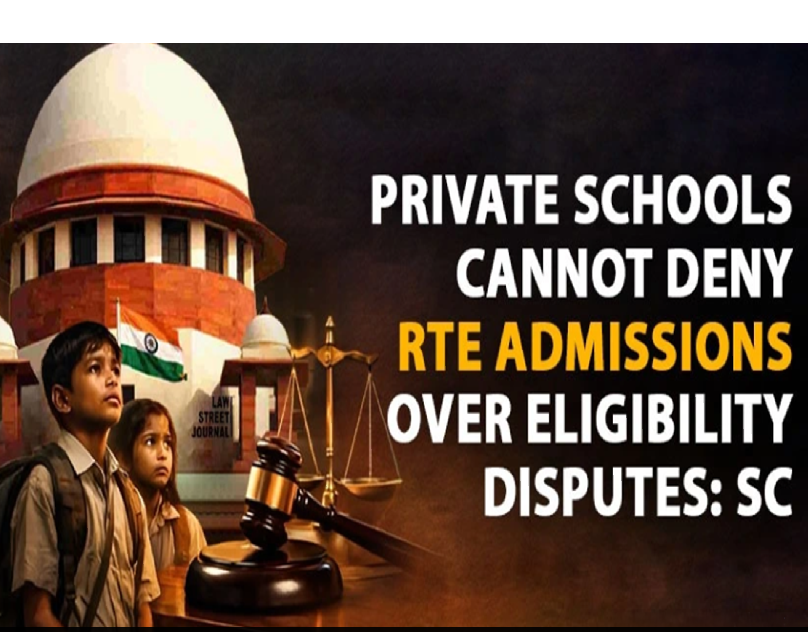
Supreme Court Upholds RTE Rule Orders Private Schools to Admit All Government Allotted Students Now!
Supreme Court Reaffirms RTE Mandate: Private Schools Cannot Deny Admissions Under Government Allotment
In a significant reaffirmation of India’s constitutional commitment to equitable education, the Supreme Court has ruled that private schools cannot refuse admission to students allotted under the Right of Children to Free and Compulsory Education (RTE) Act, 2009. Describing the implementation of the RTE framework as a “national mission”, the Court’s decision underscores the non-negotiable nature of access to education for children from disadvantaged and economically weaker sections. This judgment arrives at a time when recurring disputes between private institutions and state authorities have raised concerns about the effective implementation of the RTE Act. By unequivocally clarifying the legal position, the apex court has sought to eliminate ambiguity and reinforce the primacy of children’s rights over administrative or institutional disagreements.
The Core of the Judgment
At the heart of the ruling lies a simple yet powerful principle: once a student is allotted a seat by the government under the RTE framework, the concerned school is legally bound to grant admission without delay. The Court made it clear that private schools do not possess the authority to question or override the selection process conducted by the state.
This clarification is particularly significant in light of cases where schools have attempted to deny admission, citing doubts about eligibility or procedural discrepancies. The Court firmly rejected such justifications, observing that any grievances or disputes must be addressed separately and cannot serve as grounds to withhold admission.
In essence, the judgment reinforces the idea that administrative disagreements cannot be allowed to impede a child’s fundamental right to education.
Education as a Fundamental Right
The Court’s reasoning is anchored in Article 21A of the Constitution, which guarantees free and compulsory education to children between the ages of 6 and 14. By linking the RTE Act directly to this constitutional provision, the bench emphasised that denial of admission is not merely a procedural lapse but a violation of a fundamental right. The judges observed that if schools are permitted to delay or deny admissions, the right to education would be rendered “an empty promise”. This articulation highlights the broader constitutional philosophy underpinning the RTE Act, one that seeks to move beyond formal guarantees and ensure substantive access to education for all children.
The RTE Act and Its Vision
Enacted in 2009, the RTE Act represents a landmark legislative effort to universalise elementary education in India. One of its most significant provisions is Section 12(1)(c), which mandates that private unaided schools reserve at least 25 per cent of their entry-level seats for children from economically weaker sections and disadvantaged groups.
This provision is not merely a welfare measure; it is a deliberate attempt to foster social integration by bringing together children from diverse socio-economic backgrounds within the same educational spaces. The Supreme Court, in its recent judgment, reiterated this objective, describing the RTE framework as a transformative instrument for achieving equality of status and opportunity.
By enforcing strict compliance with this mandate, the Court has reinforced the idea that education is both a right and a tool for social change.
A ‘National Mission’ for Inclusion
One of the most striking aspects of the judgment is the Court’s characterisation of RTE admissions as a “national mission”. This description elevates the implementation of the Act beyond routine governance, framing it as a collective responsibility shared by the state, educational institutions and society at large.
The Court emphasised that the 25 per cent reservation policy has the potential to reshape the social fabric by promoting inclusivity and reducing entrenched inequalities. By ensuring that children from marginalised backgrounds have access to quality education in private institutions, the RTE Act seeks to create a more equitable and cohesive society.
This broader vision underscores the importance of strict adherence to the law, as any deviation would undermine not only individual rights but also the larger goal of social justice.
The Limits of Institutional Discretion
A key takeaway from the judgment is the limitation it places on the discretion of private schools. Once the government completes the admission process and forwards the list of selected students, schools are obligated to comply without raising objections at the point of admission.
The Court clarified that if institutions have concerns regarding eligibility, documentation, or reimbursement, they may approach the appropriate authorities. However, such concerns cannot justify delaying or denying admission to a child.
This distinction is crucial, as it balances the rights of institutions with the overarching need to protect children’s access to education. By separating grievance redressal from admission processes, the Court has ensured that the latter remains uninterrupted and time-sensitive.
Addressing Persistent Challenges
Despite its progressive intent, the implementation of the RTE Act has faced several challenges over the years. Private schools have frequently cited delays in reimbursement from state governments as a major concern. Additionally, issues such as a lack of awareness among beneficiaries, documentation barriers and administrative inefficiencies have hindered the effective utilisation of available seats.
The recent judgment does not directly resolve these systemic challenges but sends a clear message that they cannot be used as excuses to deny admissions. Instead, it places the onus on authorities to address these issues through improved governance and policy implementation.
In doing so, the Court has drawn a clear line between operational difficulties and legal obligations, ensuring that the latter remains paramount.
Implications for Schools and Policymakers
For private schools, the ruling serves as a definitive reminder of their statutory responsibilities under the RTE Act. Compliance is no longer a matter of interpretation but a legal necessity backed by constitutional authority. Institutions must now ensure that their admission processes align strictly with government allocations, leaving no room for discretionary refusal.
For policymakers, the judgment highlights the need to strengthen administrative mechanisms, particularly in areas such as reimbursement, monitoring, and grievance redressal. Ensuring timely payments to schools and simplifying admission procedures can help mitigate friction and improve compliance.
Moreover, the decision calls for greater awareness among parents and communities about their rights under the RTE framework, enabling more children to benefit from its provisions.
The Broader Social Impact
Beyond its immediate legal implications, the judgment carries profound social significance. By reinforcing the mandatory nature of RTE admissions, the Supreme Court has reaffirmed its commitment to building an inclusive education system that transcends socio-economic barriers.
Integrated classrooms, where children from diverse backgrounds learn together, have the potential to foster empathy, reduce prejudice, and promote social cohesion. The RTE Act, supported by judicial enforcement, thus becomes a powerful instrument for shaping not only individual futures but also the collective ethos of society.
The Court’s emphasis on education as a shared civic space further underscores its role in nation-building, positioning schools as environments where equality is not merely taught but practised.
Summing it Up
The Supreme Court’s ruling on RTE admissions marks a decisive step towards strengthening the implementation of one of India’s most important educational reforms. By declaring that private schools cannot deny government-allotted admissions and framing the initiative as a national mission, the Court has reinforced the centrality of education in the country’s constitutional and social framework. At its core, the judgment is a reaffirmation of a fundamental principle: that every child, irrespective of socio-economic background, has an equal right to quality education. In ensuring that this right is upheld without obstruction, the Court has not only clarified the law but also advanced the broader cause of equity and inclusion in Indian society.