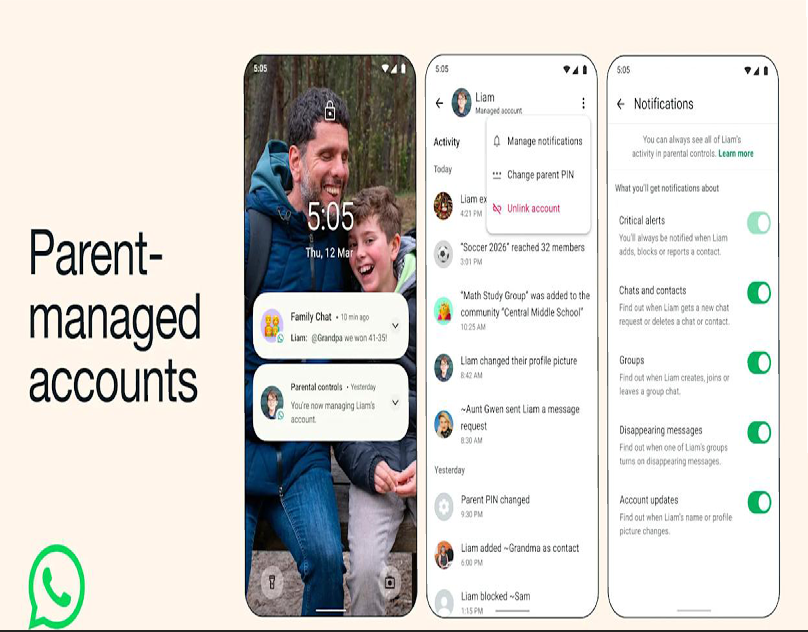
WhatsApp Launches Parent-Managed Accounts for Kids Under 13 With Controls
Parent-managed accounts to let U-13 kids use WhatsApp
In a notable shift in digital communication policy, WhatsApp, owned by Meta Platforms, has introduced parent-managed accounts designed for children under the age of 13. The feature marks a significant development in how messaging platforms approach younger users, balancing the desire for connectivity with the growing global demand for stronger online safety measures.
For years, WhatsApp’s official age requirement meant that users were expected to be at least 13 years old. Yet, in practice, many pre-teens were already using the platform to communicate with parents, siblings, and close relatives. Recognising this reality and responding to feedback from families, the company has now developed a supervised account structure that allows younger users to access the service under parental oversight.
The initiative represents an attempt to create a controlled digital environment where children can communicate safely while parents retain meaningful control over their online interactions.
Why WhatsApp Introduced Parent-Managed Accounts
Messaging platforms have become deeply embedded in family life. Parents frequently rely on apps such as WhatsApp to coordinate daily routines, communicate with children after school, and remain connected with extended family members. However, concerns about children’s online safety - particularly exposure to strangers, harmful content, or cyberbullying have intensified in recent years.
Many governments, regulators, and advocacy groups have raised questions about how technology companies safeguard younger users. In response, major platforms have begun introducing features aimed at protecting children online.
WhatsApp’s parent-managed accounts are part of this broader trend toward digital wellbeing and responsible platform design. By allowing parents to supervise their children’s messaging activity without compromising privacy, the company hopes to create a safer entry point into digital communication.
The initiative also reflects the evolving expectations of families. Many parents want their children to have limited access to communication tools, particularly for safety or convenience, without granting unrestricted access to social media features.
How Parent-Managed Accounts Work
The newly introduced accounts are designed as a simplified and tightly controlled version of WhatsApp. While children can use the app to message and call people they know, most advanced features are restricted by default.
The system requires a parent or guardian, aged 18 or above to set up and manage the child’s account. During the setup process, the parent links their own WhatsApp account to the child’s device, enabling supervision and management of key settings.
Once linked, parents gain access to a set of tools that allow them to regulate how their child uses the platform.
Key parental controls include:
- Contact approval: Parents decide who can communicate with the child’s account.
- Group permissions: Parents control which group chats the child can join.
- Message request monitoring: Requests from unknown contacts are reviewed by parents before the child can respond.
- Privacy settings management: Parents can adjust visibility settings such as profile information or last-seen status.
- PIN-protected controls: All parental settings are protected by a secure parent-controlled PIN.
This framework ensures that children cannot alter privacy settings or interact freely with unknown contacts without parental approval.
Limited Features for Younger Users
To further enhance safety, WhatsApp has restricted several features that are commonly available to adult users. Parent-managed accounts focus primarily on core communication functions - messaging and calling, while excluding features that may expose children to broader social interactions.
Features typically unavailable to child accounts include:
- WhatsApp Channels
- Meta AI integration
- Status updates
- Location sharing
- Disappearing messages in private chats
Group participation is also restricted unless explicitly approved by a parent. These limitations are intended to minimise risks associated with online communication while still enabling children to stay connected with trusted contacts.
By narrowing the scope of the platform’s functionality, WhatsApp hopes to ensure that younger users interact within a safer and more predictable environment.
Privacy and Encryption Remain Intact
Despite the additional supervisory controls, WhatsApp has emphasised that the platform’s end-to-end encryption remains unchanged. This means that messages and calls exchanged through parent-managed accounts remain private and cannot be accessed by the company or third parties.
Encryption has long been one of WhatsApp’s defining features, ensuring that communication remains secure between participants. The introduction of parental oversight does not alter this fundamental aspect of the service.
Instead of reading messages, parents supervise the environment of the account, such as who can contact the child or which groups they can join, rather than monitoring the content of conversations.
Setting Up a Parent-Managed Account
The process of creating a supervised account involves both the parent’s and the child’s devices. After installing the latest version of WhatsApp on the child’s phone, parents follow a series of steps to link the two accounts.
The setup generally includes:
- Downloading WhatsApp on the child’s device.
- Selecting the option to create a parent-managed account.
- Registering and verifying the child’s phone number.
- Entering the child’s birth date to confirm eligibility.
- Linking the child’s account with the parent’s WhatsApp using a QR code.
- Creating a parent PIN to secure account settings.
Once the process is complete, the parent becomes the administrator of the child’s account settings.
A Response to Growing Concerns About Children Online
The introduction of parent-managed accounts comes amid increasing scrutiny of how technology platforms address child safety. Policymakers and researchers have highlighted the risks associated with children’s unrestricted access to social media and messaging platforms.
Several countries are currently considering stricter regulations governing children’s digital activity, including age verification rules and potential restrictions on social media use for minors. In this context, technology companies are under pressure to demonstrate proactive measures that protect younger users.
WhatsApp’s new feature can therefore be viewed as part of a broader industry movement toward safer digital ecosystems for children.
Balancing Safety with Digital Independence
One of the challenges facing technology platforms is striking the right balance between parental supervision and a child’s developing sense of independence. While parents understandably want to protect their children from online risks, excessive monitoring can raise concerns about privacy and autonomy.
WhatsApp’s parent-managed accounts attempt to navigate this tension by focusing on environmental controls rather than message surveillance. Parents regulate contacts and permissions, while personal conversations remain encrypted and private.
This approach reflects an evolving philosophy in digital safety: rather than restricting access entirely, platforms aim to create graduated levels of supervision that adapt as children grow older.
The Broader Context of Parental Controls in Technology
WhatsApp is not the first platform to introduce parental supervision tools. Over the past several years, many technology companies have developed similar features to address concerns about children’s digital wellbeing.
For instance, social media platforms have introduced mechanisms that allow parents to monitor screen time, approve contacts, and limit certain interactions. Messaging apps have also begun implementing safeguards such as blocking messages from unknown users or restricting access to specific features.
Within this wider landscape, WhatsApp’s parent-managed accounts represent a significant step because of the platform’s enormous global reach. With billions of users worldwide, the app plays a central role in everyday communication for many families.
Gradual Global Rollout
WhatsApp has indicated that the new feature will be rolled out gradually across regions. This phased introduction allows the company to monitor how the system functions in real-world settings and gather feedback from families.
Not all users may see the feature immediately, as availability will depend on the latest version of the app and regional rollout schedules. Over time, however, the company expects parent-managed accounts to become widely accessible.
What This Means for Families
For many families, the introduction of supervised accounts may simplify the question of when children should begin using messaging platforms. Rather than prohibiting access entirely or allowing unrestricted use, parents can now choose a controlled middle ground.
Children gain the ability to communicate with trusted contacts, while parents maintain oversight over key aspects of their online experience.
The feature also acknowledges a practical reality: smartphones and messaging apps have become essential tools in modern life. By integrating parental supervision directly into the platform, WhatsApp aims to support families navigating the complexities of digital communication.
Looking Ahead
The launch of parent-managed accounts signals a broader transformation in how technology companies approach younger audiences. As digital communication becomes increasingly central to everyday life, platforms must reconcile accessibility with responsibility.
For WhatsApp, the introduction of supervised accounts represents an effort to align its services with the expectations of families, educators, and policymakers. The success of the initiative will likely depend on how effectively it balances safety, privacy, and usability.
If implemented thoughtfully, the new feature could mark an important step toward creating a digital environment where children can communicate safely while gradually learning the responsibilities that accompany online interaction.