
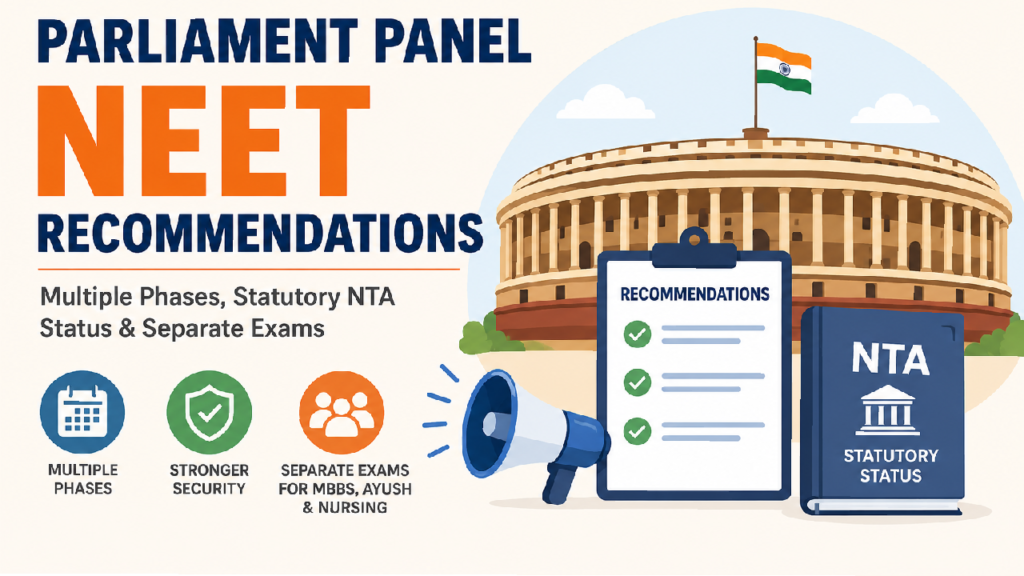
India’s medical entrance examination system may be on the verge of significant reform. In the wake of concerns surrounding the conduct of the National Eligibility cum Entrance Test (NEET-UG), a Parliamentary Standing Committee has proposed a series of recommendations aimed at strengthening the examination framework. Among the most notable suggestions are conducting multi-phase NEET-UG examinations and granting statutory status to NTA, the National Testing Agency responsible for administering several national entrance tests. These recommendations are intended to enhance transparency, improve operational efficiency, and restore confidence in one of the country’s most competitive examinations.
The recommendations come after recent scrutiny of the NEET-UG examination process and discussions on strengthening the country’s entrance examination ecosystem. The Parliamentary Standing Committee on Education, Women, Children, Youth and Sports reviewed the functioning of the National Testing Agency and suggested structural reforms to improve accountability and examination management. The committee believes that reforms are necessary to address logistical challenges associated with conducting a single nationwide examination for millions of candidates while maintaining fairness and security.
The Parliamentary panel has proposed several measures to improve the examination system.
Some of the major recommendations include:
- Conduct multi-phase NEET-UG examinations instead of holding a single nationwide test.
- Grant statutory status for NTA through appropriate legislation.
- Strengthen the institutional framework governing the National Testing Agency.
- Continue enhancing security measures for national entrance examinations.
- Examine the feasibility of conducting separate entrance examinations for MBBS, AYUSH and nursing admissions.
These recommendations aim to improve examination management while reducing operational risks associated with large-scale entrance tests.
One of the committee’s most significant proposals is introducing a multi-phase NEET-UG.
Instead of examining all candidates on a single day, the test could potentially be held in multiple phases. Such a model has already been adopted successfully for several national and international competitive examinations.
Potential advantages include:
- Better crowd management at examination centres.
- Reduced logistical pressure on authorities.
- Greater flexibility in scheduling examinations.
- Improved security monitoring.
- Faster response to unforeseen disruptions.
However, implementing multiple examination phases would require robust question paper standardisation and score normalisation to ensure fairness across different sessions.
According to EducationTodayNews, conducting examinations in multiple phases could improve operational efficiency, provided that question papers and evaluation standards remain uniform across all sessions.
Another major recommendation is granting statutory status for NTA.
Currently, the National Testing Agency functions as an autonomous organisation established by the government. Providing it with statutory backing through legislation could strengthen its legal authority, define its responsibilities more clearly, and improve institutional accountability.
A statutory framework may help:
- Clearly define governance structures.
- Improve transparency in examination processes.
- Strengthen operational independence.
- Enhance long-term institutional stability.
- Increase public confidence in national entrance examinations.
The committee believes that a stronger legal foundation would enable the agency to discharge its responsibilities more effectively while ensuring greater accountability.
During the discussions, some Members of Parliament also proposed separate entrance examinations for MBBS, AYUSH and nursing programmes instead of relying on a common NEET score.
The objective behind this suggestion is to reduce the number of candidates appearing for a single examination and simplify examination management.
However, officials from the National Testing Agency informed the committee that such a proposal may not currently be feasible because admissions to these programmes are presently linked to NEET scores.
Although these recommendations have not yet been implemented, they could significantly influence the future of medical entrance examinations if accepted by the government.
For students, potential benefits may include:
- Better organised examinations.
- Enhanced transparency.
- Reduced logistical challenges.
- Improved examination security.
- Greater confidence in the admission process.
At the same time, aspirants should note that the existing NEET admission process remains unchanged unless official policy decisions are announced.
Click below to watch the video.
While the proposals offer several advantages, implementing them will require careful planning.
Some important considerations include:
- Developing an effective score normalisation system across multiple phases.
- Ensuring equal difficulty levels in every examination session.
- Expanding examination infrastructure.
- Maintaining cybersecurity and examination confidentiality.
- Coordinating with medical regulatory authorities and state governments.
Any reform must balance operational efficiency with fairness for candidates across the country.
The Parliamentary Committee’s recommendations reflect broader discussions on improving India’s national entrance examination system. In recent years, authorities have increasingly focused on strengthening examination security, introducing advanced digital monitoring, and enhancing institutional oversight. The latest proposals build upon these ongoing efforts by suggesting structural reforms rather than only procedural improvements. If implemented, they could redefine the administration of one of India’s largest competitive examinations.
For current NEET aspirants, there is no immediate change in the admission process.
Students should continue to:
- Follow official notifications issued by the National Testing Agency.
- Prepare according to the existing NEET syllabus and examination pattern.
- Avoid relying on unofficial reports regarding policy changes.
- Stay informed about government announcements on examination reforms.
Any future modifications to the examination system will be communicated through official channels before implementation.
The Parliamentary Standing Committee’s recommendations for multi-phase NEET-UG examinations and statutory status for NTA represent an important step in the ongoing discussion on strengthening India’s entrance examination framework. While these proposals are still recommendations and require further consideration before implementation, they highlight the growing emphasis on transparency, accountability and efficient examination management.
If adopted, these reforms could significantly improve the conduct of one of the country’s most important entrance examinations while enhancing confidence among students, parents and educational institutions.
For the latest updates on examination reforms, admissions, policy developments and higher education news, stay connected with EducationTodayNews, your trusted source for comprehensive and reliable education coverage.