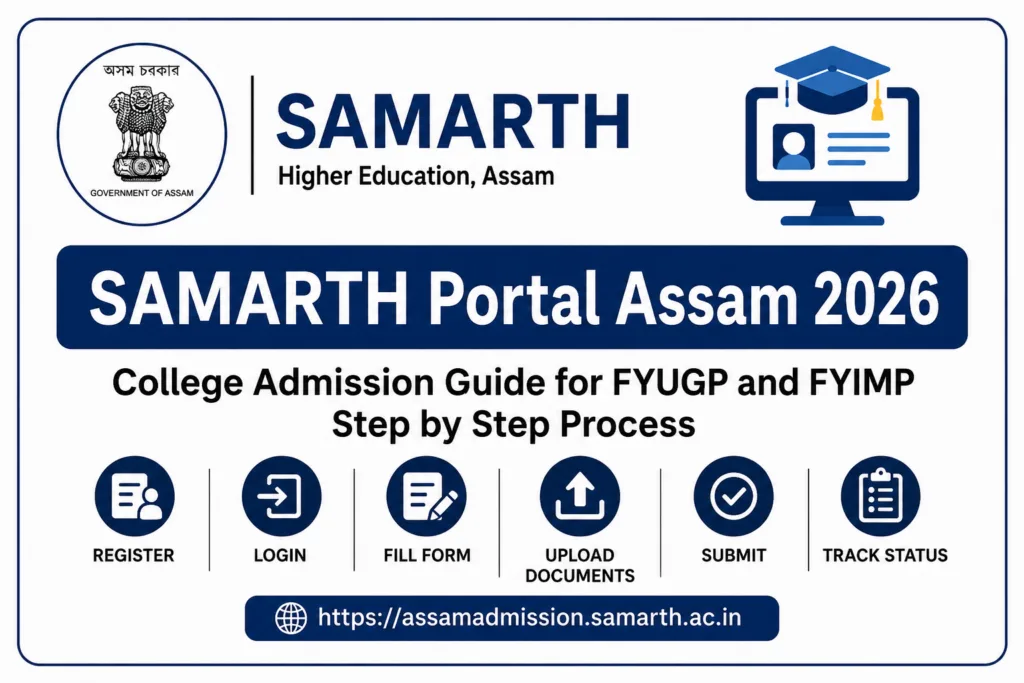
As higher education in India continues to embrace digital transformation, state governments are introducing technology-driven reforms to improve transparency, efficiency and student mobility. In a significant move, the Directorate of Higher Education (DHE), Assam, has made the SAMARTH Portal mandatory for all student migrations and lateral entries under the provisions of NEP 2020. The decision has come into immediate effect and applies to universities and colleges across the state, marking another important milestone in the implementation of the National Education Policy. The new directive ensures that all migration-related processes are conducted exclusively through the online portal, eliminating manual or offline procedures. The move is expected to standardise academic administration, strengthen record management and facilitate seamless implementation of the Multiple Entry-Exit (MEE) framework introduced under NEP 2020.
Understanding the New Directive
The Directorate of Higher Education has instructed all higher education institutions in Assam to process student migrations and lateral entries solely through the SAMARTH Lateral Entry Portal. The rule covers admissions or migrations into the third, fifth and seventh semesters of undergraduate programmes under the Multiple Entry-Exit and horizontal mobility framework. Under the notification, institutions are prohibited from processing migration requests through manual methods or any alternative digital system. Any migration completed outside the official portal will not be recognised for academic or administrative purposes.
What Students Should Know
Students pursuing higher education in Assam should be aware of several important aspects of the new system:
- All migration requests must be submitted through the SAMARTH Portal
- Offline migration procedures will no longer be accepted
- The portal will handle lateral entry, horizontal mobility and programme changes under NEP 2020
- Academic records and credit transfers will only be recognised if processed through the official system
- Universities and colleges are required to comply with the new directive immediately
Why the Change Matters
The National Education Policy 2020 introduced several student-centric reforms, including flexible learning pathways through the Multiple Entry-Exit framework. Students now have greater freedom to pause their education, return later, switch programmes or move between institutions while retaining earned academic credits.
Managing such flexibility requires an integrated digital infrastructure capable of maintaining accurate academic records across institutions. The SAMARTH Portal addresses this need by creating a centralised platform where student information, admissions, migrations and credit transfers can be securely managed.
Without a unified system, inconsistencies in documentation and delays in verification could affect students’ academic progress. By making the portal compulsory, Assam aims to ensure that every migration is properly recorded and easily verifiable.
Supporting the Vision of NEP 2020
One of the defining features of NEP 2020 is its emphasis on flexibility and learner mobility. Unlike traditional higher education systems where students often had limited options after enrolling in a programme, the policy allows learners to explore different academic pathways without losing previously earned credits.
The mandatory use of the SAMARTH Portal strengthens this vision by ensuring that student movements are digitally tracked and uniformly managed across participating institutions.
The portal also supports efficient student lifecycle management by maintaining updated academic records, simplifying administrative processes and reducing paperwork for both institutions and students.
Benefits for Institutions
The directive is expected to offer several operational advantages for universities and colleges.
A centralised digital platform reduces administrative burden by replacing multiple manual processes with a standardised workflow. It minimises errors in student records, improves coordination between institutions and enables quicker verification of academic credentials.
Digital processing also promotes greater transparency. Since every migration request is recorded within the same system, institutions can avoid duplication, discrepancies and unauthorised admissions while ensuring compliance with state regulations.
These improvements contribute to better governance and more efficient management of higher education institutions across Assam.
Click below to watch the video.
A Step Towards Digital Governance in Education
The decision reflects a broader trend in Indian higher education towards digital governance. Over the past few years, several states have adopted common admission portals and online academic management systems to simplify student services.
Platforms like SAMARTH not only streamline admissions but also support scholarship management, academic monitoring, student records and institutional reporting. Such integrated systems improve coordination between universities and government departments while delivering faster and more reliable services to students.
As digital governance becomes increasingly central to educational administration, initiatives like this are expected to enhance efficiency and improve the overall student experience.
Building a Future-Ready Higher Education System
The mandatory implementation of the SAMARTH Portal demonstrates Assam’s commitment to modernising higher education in line with the objectives of NEP 2020. By replacing fragmented administrative processes with a unified digital platform, the state is creating a more transparent, efficient and student-friendly academic ecosystem.
For students, the reform promises smoother migration procedures, secure academic record management and hassle-free credit transfers. For institutions, it offers improved governance and standardised administration across campuses.
As more states continue adopting technology-driven solutions, digital platforms will play an increasingly important role in delivering flexible, accessible and accountable higher education. Stay connected with EducationTodayNews for the latest updates on education policies, higher education reforms and initiatives shaping the future of learning in India.