
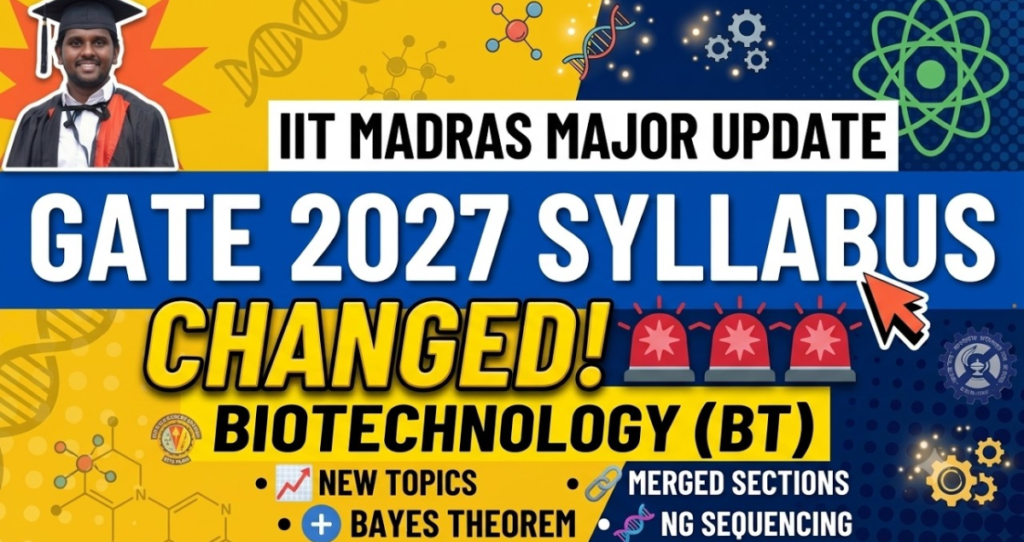
The Indian Institute of Technology Madras (IIT Madras) has introduced important updates for the Graduate Aptitude Test in Engineering (GATE) 2027 by revising the Biotechnology (BT) syllabus and expanding the list of permissible two-paper combinations. The revised information brochure has been released on the official GATE 2027 website, providing candidates with updated details to plan their preparation effectively.
The changes have been introduced to align the examination syllabus with emerging academic developments and industry requirements. While modifications have been made to the Biotechnology paper and subject combinations, IIT Madras has confirmed that the examination schedule, eligibility criteria and admission-related rules will remain unchanged.
With a focus on student-centric updates, EducationToday brings the latest information on entrance examinations, syllabus changes and evolving trends in higher education.
Major Updates Introduced in GATE 2027
The revised GATE 2027 brochure includes changes aimed at improving flexibility for candidates and introducing more interdisciplinary opportunities. One of the significant updates is the expansion of two-paper combinations, allowing students to select additional subject options based on their academic interests and career goals.
The key updates include:
- Revision of the Biotechnology (BT) syllabus with new topics and reorganised sections
- Expansion of permitted two-paper combinations for multiple disciplines
- Introduction of greater flexibility for candidates choosing interdisciplinary subjects
- No changes in examination dates, eligibility requirements or admission rules
These updates are expected to benefit students who wish to explore multiple domains and prepare for advanced academic and professional opportunities through GATE.
Revised Biotechnology Syllabus for GATE 2027
The Biotechnology syllabus has undergone significant modifications to reflect advancements in biological sciences and engineering applications. Existing sections have been reorganised, and new areas have been incorporated to provide a more comprehensive understanding of the subject.
A new section titled “Fundamentals of Biological Engineering” has been introduced by merging two existing sections. Topics related to material and energy balances, thermodynamics and transport processes have also been reorganised to improve the structure of the syllabus.
The updated syllabus also includes changes in multiple subject areas, such as:
- Engineering Mathematics now includes topics like Bayesian statistics and vector calculus
- General Biology places greater emphasis on metabolism, immunology and microbiology
- Recombinant DNA technology has been expanded to include recombination-based cloning, biosensors and omics tools
- Biological engineering concepts have received increased focus
The revised structure aims to provide candidates with a broader understanding of biotechnology concepts while keeping the syllabus aligned with modern research and industry requirements.
Expanded Two-Paper Combination Options
Another major change in GATE 2027 is the expansion of two-paper combination choices. Candidates appearing for the newly introduced Robotics and Automation (RA) paper will now have more options for selecting their second paper.
Earlier, RA candidates could choose limited combinations. Under the revised guidelines, students opting for Robotics and Automation can select from subjects including:
- Computer Science and Information Technology (CS)
- Data Science and Artificial Intelligence (DA)
- Electronics and Communication Engineering (EC)
- Electrical Engineering (EE)
- Instrumentation Engineering (IN)
- Mechanical Engineering (ME)
Similarly, Electronics and Communication Engineering (EC) candidates can now select Robotics and Automation as an additional second-paper option. Instrumentation Engineering candidates can also pair their paper with RA along with existing choices.
The expanded combinations provide students with greater academic flexibility and encourage interdisciplinary learning across engineering and technology fields.
GATE 2027 Examination Pattern Remains Unchanged
Despite the syllabus revisions, the overall examination structure of GATE 2027 will remain the same. The examination will continue to include 30 test papers, with each paper carrying a total of 100 marks and being conducted in English.
Each paper will consist of a General Aptitude section carrying 15 marks, while the remaining 85 marks will focus on subject-specific questions. Candidates can appear for one or up to two test papers according to the permitted combinations.
The unchanged exam pattern provides stability for aspirants who have already started their preparation while allowing them to adapt to the updated syllabus requirements.
Click below to watch the video.
Preparation Strategy for GATE 2027 Aspirants
With the revised syllabus now available, candidates preparing for GATE 2027 should carefully analyse the updated topics and modify their study plans accordingly. Understanding the changes early will help aspirants allocate sufficient time for new concepts and strengthen their preparation.
Candidates should focus on:
- Reviewing the revised subject-wise syllabus from the official website
- Identifying newly added topics and preparing detailed study plans
- Practising previous years’ question papers for conceptual clarity
- Balancing preparation between primary and secondary papers for two-paper combinations
- Following official notifications for further updates
A structured preparation approach will help candidates adapt to the changes and perform effectively in the examination.
Significance of the GATE 2027 Syllabus Revision
The revision of the Biotechnology syllabus reflects the evolving nature of engineering and scientific education in India. As biotechnology continues to grow across sectors such as healthcare, research, agriculture and industrial applications, updated academic frameworks can help students develop relevant knowledge and skills.
The introduction of broader subject combinations also highlights the increasing importance of interdisciplinary expertise. Fields such as robotics, artificial intelligence, biotechnology and data science are becoming increasingly interconnected, creating new opportunities for graduates.
For students preparing for one of India’s most competitive postgraduate entrance examinations, staying updated with official changes is essential. GATE 2027 aspirants can use these revisions as an opportunity to strengthen their preparation and explore diverse academic pathways.
The updated GATE 2027 guidelines mark an important development in engineering education, offering students a more flexible and contemporary examination framework. As preparations continue, candidates should refer to the revised brochure and align their strategies with the latest syllabus and paper combination updates.