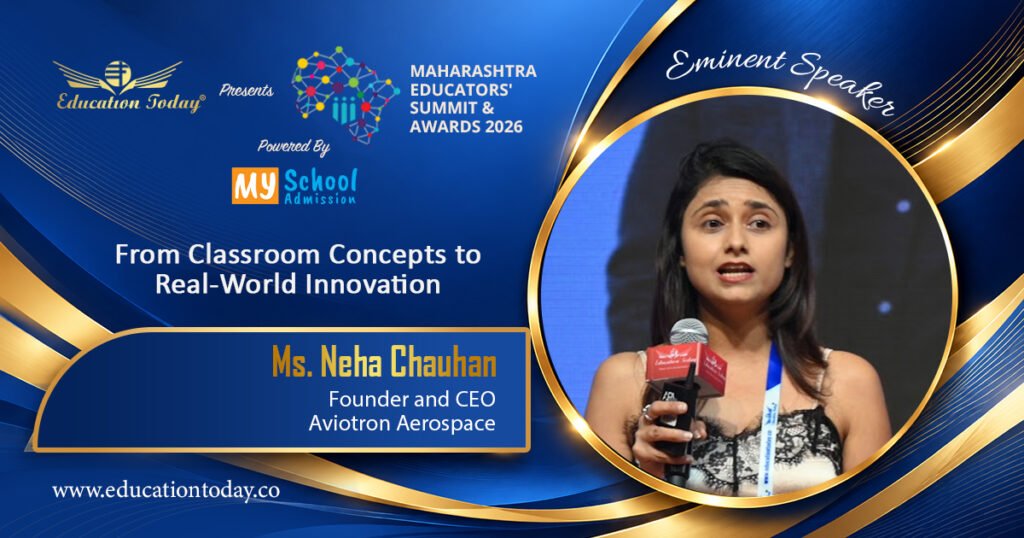
Education must go beyond theoretical knowledge to equip students with the practical skills needed to solve real-world problems. Emphasising this vision, Ms. Neha Chauhan, Founder and CEO of Aviotron Aerospace, presented an integrated approach to education that combines design thinking, technology, manufacturing and industry exposure at the Maharashtra Educators’ Summit and Awards 2026. Her address highlighted the importance of creating learning environments where students can transform classroom concepts into practical solutions. Drawing on her academic and professional journey, Ms. Chauhan explained how her experience studying aerospace engineering at the University of Liverpool, pursuing postgraduate studies in propulsion technology, and working towards an opportunity with NASA shaped her perspective on education. During her exposure to an aircraft project powered by hydrogen fuel, she observed school students contributing to different aspects of industrial projects. While some worked on coding and robotics, others explored budgeting, cost analysis, and design. This experience inspired her to create an educational ecosystem that enables children to discover and develop their interests much earlier.
Making Design a Core Skill
Ms. Chauhan emphasised that design should be treated as an essential problem-solving skill rather than a subject limited to software or product development. She explained that students must learn to connect academic concepts with practical applications across diverse fields, including aerospace, drones, automobiles, electric vehicles, meteorology and agriculture.
Through Aviotron Aerospace, she advocates an integrated learning model that brings academic knowledge, technology and manufacturing together. Rather than relying exclusively on ready-to-assemble robotics kits, the approach encourages students to design, develop, test and manufacture products themselves.
She highlighted the importance of specialised laboratories equipped with manufacturing machinery, design facilities and advanced testing equipment. Wind tunnels, for instance, allow students to examine how the shapes and structures they create perform under simulated conditions, helping them understand the relationship between theoretical principles and practical applications.
Building Skills from Early Childhood
Recognising that learning begins long before formal technical education, Ms. Chauhan discussed the development of activity-based learning environments for younger children. These laboratories use interchangeable, mechanical learning resources built around themes such as space and railway stations to introduce foundational concepts, phonics and numeracy through exploration.
The organisation also integrates emerging technologies, including artificial intelligence, into its programmes. Rather than treating AI tools simply as platforms for obtaining information or completing assignments, Ms. Chauhan encouraged students to incorporate AI into products and robotic systems. This approach helps them understand how technology can be applied creatively to address practical challenges.
She also highlighted the growing relevance of drone technology, stressing the importance of equipping students with skills in drone design, simulation, operation, and manufacturing.
Connecting Learning with Industry
A significant part of Ms. Chauhan’s vision involves creating pathways between school education and industry. Through collaborations with startups across sectors such as agriculture, healthcare, software and sustainability, students can access practical problem statements and gain exposure to professional working environments.
She shared an example of students collaborating with a company that recycles flowers collected from temples into incense products. The students were challenged to explore ways of recycling plastic jewellery, gaining experience in technical research, product development and creative problem-solving. The initiative also offered a tangible connection between their contributions and the commercial outcome.
To support students in documenting their progress, Aviotron Aerospace has developed a learning management system through which their projects, assessments and achievements can be recorded. In collaboration with STEM.org, the initiative also offers blockchain-based certification, helping learners build portfolios that demonstrate their skills and retain access to their achievements beyond school.
Preparing Students for Tomorrow
Concluding her address, Ms. Chauhan reinforced the need for an educational ecosystem that connects academics, technology, practical experience and industry exposure. Her vision places equal importance on developing technical competence, creativity and the ability to apply knowledge meaningfully. By encouraging students to design, experiment, manufacture and solve authentic problems, her approach seeks to make learning more relevant and purposeful. Ultimately, she called for an education system that enables young people to identify their strengths early, build demonstrable skills, and approach future academic and professional opportunities with greater confidence, with EducationToday highlighting the importance of evolving educational practices.
Ms. Neha Chauhan is the education professional featured in the discussion on connecting classroom concepts with real-world innovation.
It means applying academic knowledge to practical situations, helping students understand how classroom learning can address real-life challenges.
Real-world innovation encourages students to think creatively, solve problems, explore new ideas, and develop skills relevant to changing career opportunities.
Teachers can use project-based learning, practical experiments, case studies, field visits, collaborative activities, and real-world problem-solving tasks.
Students can strengthen critical thinking, creativity, communication, collaboration, adaptability, and decision-making through practical learning experiences.