Table of Contents
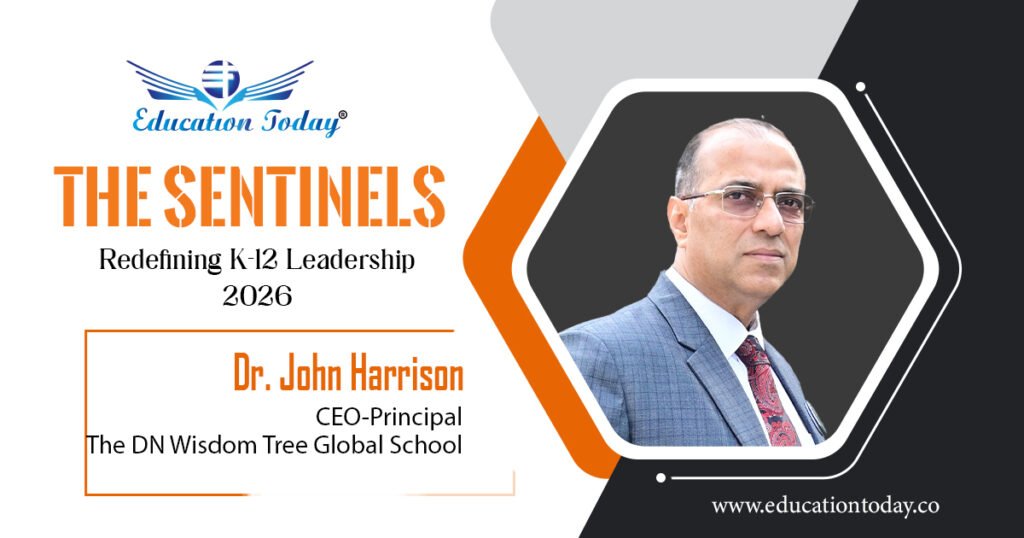
In the burgeoning intellectual corridor of Bhubaneswar, Odisha, the traditional contours of schooling are undergoing a radical recalibration. As the global economy pivots toward automation, data ubiquity, and artificial intelligence, the true differentiator in institutional leadership has shifted from administrative efficiency to profound philosophical depth. At the vanguard of this evolution stands Dr. John Harrison, the CEO-Principal of The DN Wisdom Tree Global School. An alumnus of the prestigious St. Stephen’s College, Delhi University, Dr. Harrison brings over three decades of sophisticated expertise to the academic sector. His tenure is not merely an exercise in management; it is an ambitious experiment in holistic learning, one that seeks to harmonise the ancient wisdom of the Indian ethos with the relentless demands of a modern, technocentric world, redefining education leadership in India.
A Legacy of Inclusive Impact: Milestones Beyond the Boardroom
To understand the leadership of Dr. John Harrison is to recognise a career defined by the pursuit of equity and the democratisation of high-quality learning. Unlike many who view educational leadership through a purely corporate or urban lens, Dr. Harrison’s odyssey has been marked by a profound geographical and social breadth. Over thirty years, he has spearheaded the establishment of four K-12 schools, six pre-primary institutions, and a staggering 100 literacy centres across the diverse topographies of Haryana, Rajasthan, Uttar Pradesh, and Uttarakhand.
This expansive footprint reflects a commitment to education as a fundamental humanitarian right and a tool for socio-economic mobility. From the high-pressure environments of elite international CBSE and IB schools to the resource-strained corridors of urban slums and remote rural hamlets, his work has consistently prioritised the marginalised adolescent girls, women, and the elderly. His two-decade association with the YMCA as Director of Education, Programmes, and Community Outreach further solidified his reputation as a builder of social capital. For Dr. Harrison, the school is not an island of privilege but a catalyst for community-wide transformation, a philosophy that continues to inform the inclusive culture of The DN Wisdom Tree Global School.
The Evolution of Purpose: From Instruction to Ethical Awakening
In a world saturated with information, Dr. Harrison posits that the mere transfer of knowledge is an increasingly obsolete objective. His pedagogical framework has evolved into a more nuanced “awakening” of the learner’s spirit. At The DN Wisdom Tree Global School, this is operationalised through a curriculum that treats moral discernment as a core competency, standing on equal footing with mathematical or linguistic proficiency. He understands that a student who possesses brilliance without character is a liability to the future, whereas a student anchored in ethics is a leader in the making, embodying the essence of ethical education.
Central to this vision is the Wisdom Srimad Bhagavad Gita Curriculum. Rather than a static religious study, this initiative is utilised as a sophisticated psychological toolkit for resilience, conflict resolution, and ethical decision-making. By engaging with these foundational texts, students develop a robust internal compass that allows them to navigate the moral ambiguities of the 21st century. This is complemented by the Leader in Me (LIM) Programme, which integrates the principles of self-governance and interpersonal efficacy into the daily rhythm of school life. Under Dr. Harrison’s stewardship, leadership is taught as a habit of character, ensuring that students emerge as “innovators with integrity,” capable of leading themselves before they attempt to lead others.
Mindful Innovation: Navigating the Digital Frontier
While many institutions adopt technology with uncritical, often performative enthusiasm, Dr. Harrison advocates for a stance of digital discernment. He recognises that while screens provide unprecedented access to global repositories of information, they can also paradoxically erode the capacity for deep, sustained reflection and critical thought. Consequently, the integration of technology at The DN Wisdom Tree Global School is strictly purposeful, experiential, and inquiry-based.
The school’s STREAM Lab & Electric Vehicle (EV) Learning Centre serves as the primary arena for this mindful innovation. Here, the traditional silos of Science, Technology, Research, Engineering, Arts, and Mathematics are dissolved in favour of interdisciplinary fluency. Students engage in project-based learning that has real-world utility, such as understanding the mechanics of sustainable transport and green energy. However, this technical acumen is consistently balanced by the Wisdom Finishing School Programme (WFSP). This initiative focuses on the “human” skills that AI cannot replicate: social grace, nuanced communication, and the subtle art of ethical negotiation. By marrying high-tech proficiency with high-touch emotional intelligence, Dr. Harrison ensures his students are prepared to lead the Fourth Industrial Revolution, not merely serve as its cogs.
Mentorship and the Sentinel Leader: Forging a Culture of Trust
For Dr. Harrison, the institutional health of a school is directly proportional to the strength of its internal relationships and the psychological safety of its stakeholders. He rejects the hierarchical “command and control” model of leadership in favour of a relational approach grounded in mutual mentorship and lateral accountability. In his view, the Principal is a “Sentinel”, a guardian of values whose primary role is to create a safe harbour for intellectual risk-taking among both faculty and students.
This culture of trust is visible in the school’s Heritage Code initiative. By encouraging faculty and students to deeply engage with the cultural and historical legacy of Odisha and India, Dr. Harrison fosters a sense of belonging and collective identity. He insists that for a student to “soar high,” they must first be “deeply rooted” in their own heritage and cultural linguistic foundations. This dialectic between tradition and modernity is the hallmark of his leadership, creating a stable institutional foundation that allows for radical pedagogical experimentation. By honouring the past, he provides students with the security to explore the future without losing their sense of self.
Educating for the Unwritten: Preparing for Volatility
As we move toward the final years of the 2020s, the velocity of global change has rendered traditional educational endpoints increasingly fragile and prone to obsolescence. Dr. Harrison’s “Beyond the Classroom” philosophy is a strategic response to this pervasive uncertainty. It prioritises adaptability, critical inquiry, and environmental stewardship over rote memorization or the pursuit of ephemeral grades. He believes that the ability to unlearn and relearn is the most critical survival skill for the next generation, strengthening long-term student development.
Through the Green Portfolio initiative, students are not just taught about ecology; they are made responsible for it, embedding sustainable thinking into their personal identities. Dr. Harrison believes that the graduates of tomorrow must be comfortable with ambiguity and the “messiness” of real-world problem-solving. By providing them with a rigorous academic foundation, a sophisticated technological toolkit, and a robust ethical framework, he ensures they possess the intellectual agility to pivot as new global challenges emerge. The school serves as a microcosm of the world, allowing students to test their leadership in a supportive yet challenging environment, aligned with future-ready skills and modern pedagogy.
Conclusion: A Vision of Compassionate Excellence
The impact of Dr. John Harrison extends far beyond the administrative corridors of The DN Wisdom Tree Global School. He has successfully redefined the educational paradigm in Odisha, proving that global standards can and should be anchored in local wisdom. His leadership, recognised by EducationToday for his contribution to progressive educational practices, is a testament to the power of a vision that balances the “what” of learning with the “why” of living. Under his guidance, the school has become a beacon for those who believe that excellence and empathy are not mutually exclusive, but are in fact interdependent.
Under his guidance, students are nurtured to become “citizens of the world”, individuals who are ethically grounded, technically capable, and emotionally resilient. As Dr. Harrison often reflects, the ultimate measure of a school is not found in its grade point averages or its trophies, but in the character of the community it fosters and the wisdom of the leaders it produces. In the heart of Bhubaneswar, he continues to architect a future where excellence is always synonymous with compassion, ensuring that his students are prepared to thrive in an uncertain future with wisdom and courage.
Dr. John Harrison is an education leader dedicated to advancing education through values-driven leadership, technology integration, and purposeful learning.
His vision focuses on blending technology, ethical values, and purposeful education to create future-ready learners and innovative schools.
Technology enhances personalized learning, collaboration, digital literacy, and student engagement, preparing learners for a technology-driven future.
Values-based education nurtures integrity, empathy, responsibility, and ethical leadership alongside academic achievement.
He promotes innovation, digital learning, critical thinking, leadership, and holistic development to equip students for lifelong success.