Table of Contents
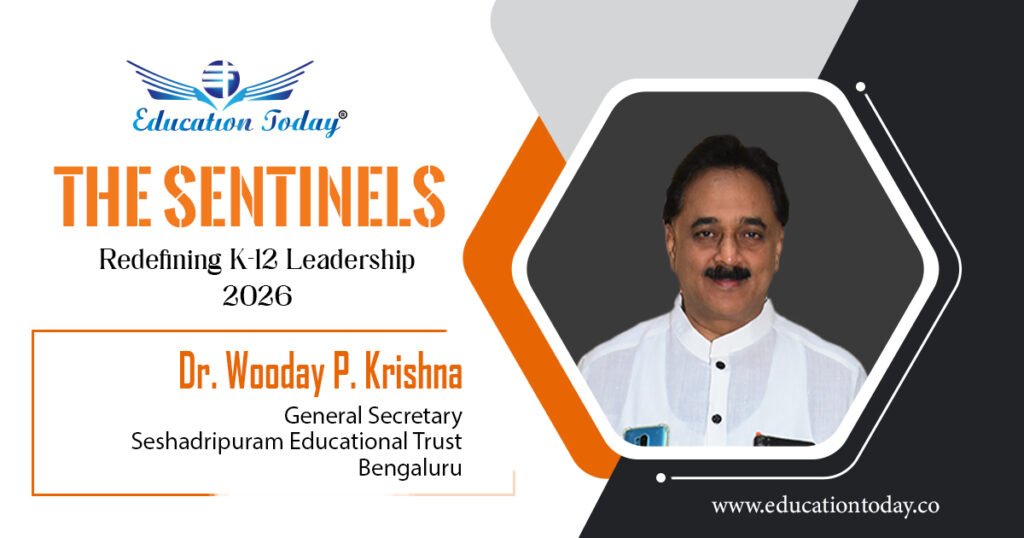
In an age where education is often evaluated through metrics and measurable outcomes, there remain leaders who uphold its deeper purpose as a force for human transformation. Among them, Dr. Wooday P. Krishna, Hon. General Secretary of the Seshadripuram Educational Trust, Bengaluru, stands as a distinguished figure whose work exemplifies the harmonious integration of intellect, service, and ethical conviction, reflecting ethical leadership. His journey reflects not merely professional accomplishment, but a lifelong dedication to shaping individuals and communities through education grounded in values and holistic education.
Born into a lineage steeped in public service and the legacy of India’s freedom movement, Dr. Krishna’s formative years were shaped by ideals of humility, discipline, and social responsibility. These influences, combined with the mentorship of inspiring teachers, instilled in him a belief that education must empower individuals rather than merely transmit knowledge. Deeply inspired by the philosophies of Swami Vivekananda and Mahatma Gandhi, he has consistently championed an educational vision that nurtures the mind, strengthens the body, and elevates the spirit through transformative learning.
A Journey Marked by Purpose and Achievement
Dr. Wooday P. Krishna’s professional trajectory is both expansive and deeply impactful, spanning engineering, education, law, and social service. A certified chartered engineer, accomplished academic and Gandhian social activist, he embodies a rare interdisciplinary approach that enriches his leadership in education.
Since assuming a key leadership role within the Seshadripuram Educational Trust in 2001, he has overseen the growth of an extensive network of 34 institutions, collectively serving more than 24,500 students each year. Under his stewardship, these institutions have not only expanded in scale but have also strengthened their commitment to providing accessible, value-based education that remains inclusive and socially responsive, fostering inclusive schooling.
His academic credentials are equally formidable, reflecting a lifelong commitment to learning. With master’s degrees in Engineering, Law and Sociology, a Ph.D. in Business Administration, an LL.M. specialising in Contracts and Mercantile Law, along with qualifications in Journalism and Industrial Engineering & Management, Dr. Krishna exemplifies intellectual breadth and depth. This multidisciplinary foundation informs his holistic approach to education, enabling him to view learning as an interconnected and evolving process.
Beyond academia, his international engagements have further enriched his perspective. Representing India at professional and academic forums across countries such as Germany, Russia, Israel, Singapore and New Zealand, he has engaged with global best practices while remaining rooted in Indian values. His contributions to engineering inspection, arbitration and valuation have earned international recognition, while his work in public service, particularly through organisations such as the Red Cross Society and Karnataka Gandhi Smarak Nidhi, has underscored his enduring commitment to humanitarian causes.
Accolades including the President’s Gold Medal, Rajyotsava Award and Kempegowda Award stand as formal recognitions of his contributions, yet they represent only a fraction of his broader impact as an educator and social reformer.
An Educational Philosophy Rooted in Holistic Development
At the core of Dr. Wooday P. Krishna’s vision lies a deeply evolved educational philosophy, one that extends beyond academic achievement to encompass ethical, emotional, and social development. For him, education must be a transformative experience, enabling students to engage meaningfully with the world around them through student-centred education.
In the classroom, this philosophy manifests through an emphasis on enquiry, exploration, and application. Students are encouraged to question established ideas, engage critically with content and connect theoretical learning with real-world contexts. Such an approach ensures that education remains dynamic and relevant, equipping learners with the skills required to navigate complex and evolving environments.
Inclusivity forms a foundational pillar of his approach. Recognising the diversity of learners, Dr. Krishna advocates educational environments that celebrate cultural differences and individual potential. Collaboration, mutual respect, and shared learning experiences are actively fostered, creating spaces where students feel valued and empowered.
Experiential learning plays a significant role in bridging the gap between theory and practice. Through case studies, community engagement projects, and technology-enabled learning experiences, students are exposed to practical challenges that enhance their understanding and build resilience. Central to this approach is the cultivation of values such as integrity, empathy and a commitment to service, qualities that remain indispensable in both personal and professional spheres.
Technology with Purpose: Balancing Innovation and Human Connection
In the contemporary educational landscape, technology has become an indispensable tool. Dr. Wooday P. Krishna recognises its transformative potential, advocating for its thoughtful integration into teaching and learning processes through technology in education. Digital platforms, artificial intelligence, virtual reality and data analytics offer unprecedented opportunities to personalise learning, expand access and enhance engagement.
However, he remains unequivocal in his assertion that technology cannot replace the human dimension of education. The role of the educator as a mentor, guide and moral anchor remains central. In his vision, technology serves to complement, rather than supplant, the relational core of education.
This balanced perspective informs the adoption of hybrid learning models, where digital innovation coexists with meaningful interpersonal interaction. Students are encouraged not only to use technological tools but to engage with them critically and responsibly. By fostering discernment and ethical awareness, Dr. Krishna ensures that learners are equipped to navigate a digital world with both competence and conscience.
Mentorship, Reflection and the Culture of Educational Leadership
Dr. Wooday P. Krishna’s leadership is deeply rooted in mentorship and reflective practice, reinforcing the importance of mentorship in schools. He believes that the strength of an educational institution lies in the growth and empowerment of its educators. As such, he has consistently championed initiatives that promote professional development, collaborative learning, and continuous improvement.
Workshops, seminars and peer observation programmes provide educators with opportunities to refine their pedagogical approaches and remain attuned to evolving educational trends. Open dialogue and mutual respect underpin these initiatives, fostering a culture in which innovation is encouraged and contributions are recognised.
Mentorship extends beyond formal structures, shaping the everyday interactions between teachers and students. By cultivating environments of trust and support, Dr. Krishna enables educators to inspire learners not only academically but also personally. Reflection, in this context, becomes a powerful tool, allowing educators to evaluate their practices, adapt to changing needs, and continually enhance their effectiveness.
Through these efforts, he has built vibrant academic communities characterised by integrity, curiosity and inclusivity. These communities function not merely as centres of instruction, but as ecosystems where both educators and learners grow together.
Preparing Students for an Unwritten Future
Looking ahead, Dr. Wooday P. Krishna envisions an education system that is increasingly learner-centric, interdisciplinary and globally aligned. In a world marked by rapid technological change and shifting societal dynamics, he emphasises the importance of equipping students with transferable skills that transcend specific disciplines.
Critical thinking, emotional intelligence, adaptability and sustainability emerge as key competencies within this framework. By fostering these attributes, education moves beyond the confines of traditional curricula, preparing students to engage with challenges that cannot yet be fully anticipated.
Experiential and project-based learning approaches play a pivotal role in this vision. By engaging with real-world problems, students develop creativity, innovation, and social awareness. Such experiences not only deepen understanding but also cultivate a sense of responsibility towards society and the environment.
Dr. Krishna also advocates for a multidisciplinary approach that integrates knowledge across domains, encouraging students to think holistically and approach problems from multiple perspectives. Ethical decision-making, collaboration, and global citizenship are woven into this framework, ensuring that learners are prepared not only for professional success but also for meaningful societal contribution.
Conclusion: A Legacy of Learning and Service
Dr. Wooday P. Krishna’s work stands as a testament to the enduring power of education as a transformative force. His leadership reflects a rare synthesis of intellectual excellence, ethical commitment, and a profound sense of service. Through his efforts, the Seshadripuram Educational Trust has evolved into a beacon of holistic education, one that prioritises both academic rigour and human development.
In his vision, education is not a finite process but a lifelong journey, one that shapes individuals capable of thinking critically, acting ethically and contributing meaningfully to society. By integrating technology with human values, fostering inclusive learning environments and championing continuous growth, he has created a model of education that is both progressive and principled.
Ultimately, Dr. Wooday P. Krishna’s legacy lies not only in the institutions he has built, but in the countless lives he has influenced. His unwavering belief in the transformative potential of education continues to inspire a generation of learners and educators alike, guiding them towards a future defined not merely by success, but by purpose, integrity and service. EducationToday recognises such leadership as an important part of the continuing conversation around the future of education.
Dr. Wooday P. Krishna is an educationist, engineer, social activist and humanist who has contributed extensively to education and public service.
He is known for his leadership in education, institution-building, and commitment to making quality education accessible to people across social and economic backgrounds.
His philosophy centres on the belief that everyone has a right to education, with an emphasis on quality, values, accessibility, and holistic development.
He has served as the Honorary General Secretary of Seshadripuram Educational Trust, which operates educational institutions from kindergarten through doctoral level.
His work combines academic excellence with value-based education, student empowerment, social responsibility, and opportunities that encourage learners to develop their talents and potential.