
Table of Contents
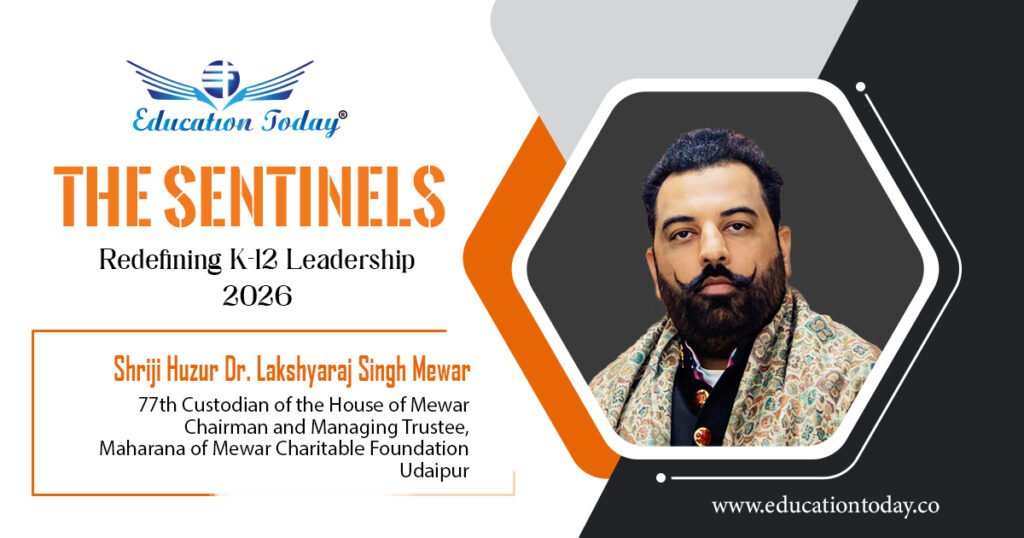
In the contemporary era, where the rapid acceleration of technology often threatens to eclipse the foundational values of human civilization, the role of an educator has transcended the mere dissemination of information. It has become a profound act of stewardship, a sacred duty to anchor the volatile energy of youth in the bedrock of tradition while simultaneously equipping them with the wings of modern innovation. At the vanguard of this philosophical synthesis is Shriji Huzur Dr. Lakshyaraj Singh Mewar of Udaipur. As the 77th Custodian of the House of Mewar and the Chairman and Managing Trustee of the Maharana of Mewar Charitable Foundation, Shriji Huzur serves as a “Guiding Light,” illuminating a path where academic excellence is but one facet of a much larger diamond: the holistic, multifaceted development of the human spirit. EducationToday recognises such leadership as an important force in shaping the future of education.
For Shriji Huzur, leadership in education is not a static position of administrative authority; it is a dynamic, conversational engagement rooted in education leadership in India. He finds profound delight in the “mutual learning experience” that occurs when communicating with young, eager minds. Whether through face-to-face discourse or the intimate medium of written correspondence, he views these interactions as a vital bridge between the historical wisdom of the past and the burgeoning aspirations of the future. In his vision, learning recognises no limits and respects no artificial boundaries; it is a perpetual journey of self-actualisation that involves students, faculty, and management in a collective, tireless pursuit of truth and excellence.
Navigating the “Sea of Expectations”: Confronting the Architecture of Fear
The modern educational landscape is often characterised by what Shriji Huzur describes as a “vast sea of expectations.” In an increasingly competitive globalised world, students aspire to unprecedented heights, teachers strive for institutional prestige, and parents dream of a “Suraksha Kawach”, a protective shield that will guarantee their children’s success, safety, and prosperity. Yet, beneath this drive for achievement lies a pervasive undercurrent of anxiety. The macro environment, fraught with volatility, violence, and confusion, naturally breeds apprehension in the hearts of the youth, who often feel the weight of an uncertain world upon their shoulders.
Shriji Huzur observes that this fear often manifests as a resistance to change, particularly regarding technological disruption. He points specifically to the global discourse surrounding Artificial Intelligence (AI). While many voices propagate fearmongering claims that AI will render human effort obsolete and disrupt livelihoods, Shriji Huzur maintains a stance of reasoned, historical optimism. He asserts that technology is not a spectral force to be feared but a sophisticated tool designed to facilitate growth and human convenience. He encourages a perspective where machines are viewed as extensions of human capability rather than replacements for human essence.
The antidote to this fear, he posits, is not found in the avoidance of challenge, but in the cultivation of “Pragya”, the wisdom to use knowledge responsibly. In the institutions governed by the Maharana of Mewar Charitable Foundation, such as the Maharana Mewar Public School and Maharana Vidya Mandir, the role of the educator is redefined. It is no longer sufficient to merely introduce technology into the classroom; educators must act as moral compasses, guiding students to ensure that digital tools serve curiosity, critical thinking, and creativity rather than supplanting human judgment or ethical values. Students who approach innovation with confidence rather than trepidation are better prepared for a world where wisdom must grow in tandem with information.
The Aesthetic of Resilience: Creativity as the Opposite of Fear
Shriji Huzur often recalls the wisdom of the sages who defined the opposite of fear not as courage in a vacuum, but as peace, happiness, calmness, and the “confidence to face any life or work situation.” This state of equilibrium, he explains, is an architectural feat achieved through the deliberate pursuit of positivity and creativity in learning. True peace comes from the ability to grow without feeling diminished by the success of others, fostering an environment of communal upliftment.
At the Foundation’s institutions, this philosophy is manifested through a rigorous emphasis on:
- The Fine Arts: Music, dance, and arts and crafts serve as essential conduits for emotional expression and the meticulous refinement of the soul.
- Physical Vitality: Sports and adventure activities are designed to instill the thrill of achievement and the resilience required to navigate physical and mental obstacles with composure.
- Cultural Grounding: Ensuring that the student remains an “Indian at Heart”, deeply aware of the rich, diverse tapestry of their heritage while being a citizen of the world, reflecting the essence of the traditional values in education.
Over the past two decades, Shriji Huzur has witnessed a remarkable metamorphosis within these academic communities. There is a palpable shift toward “fearlessness”, a proactive confidence that allows students, faculty, and management to address internal and external challenges with poise rather than panic, strengthening true resilience in students. This, he argues, is the true measure of educational success. It is not the absence of obstacles that defines a great institution, but the quality, speed, and integrity of the response to those obstacles. This transformation proves that when a culture of continuous learning is established, success becomes a natural byproduct of human activity nurtured by overwhelming positivity.
Epic Inspirations: Drawing Strength from the House of Mewar
As a scion of a dynasty defined by its unyielding spirit and historical resilience, Shriji Huzur draws immense inspiration from the epic literature of India and the historical legacy of his forefathers. He notes that the Mahabharata and the Ramayana are essentially narratives of overcoming life-threatening challenges through focus, discipline, and the relentless drive to do good. These ancient truths are mirrored in the real-life sagas of Maharana Kumbha, Maharana Sangha, and Maharana Pratap, whose lives were testaments to the power of the human will.
The lives of these legendary figures serve as a masterclass in confronting adversity with hope and positivity. They faced innumerable hardships and systemic threats, yet their narratives are not ones of defeat or despair, but of endurance and the refusal to succumb to the “volatility and chaos” of their respective times. Shriji Huzur encourages the youth to view these historical icons not as distant, mythologised figures of the past, but as living, breathing examples of how to construct a “mental Suraksha Kawach” through character, integrity, and unshakeable resolve. Their examples demonstrate that challenges are not stop signs, but invitations to grow stronger and more focused on one’s ultimate purpose, a core reflection of the Indian education system.
Resolve for 2026: The New Himalaya of Growth
Looking ahead to the year 2026, Shriji Huzur advocates for a collective resolution to remain positive, creative, and innovative, shaping truly future-ready students. He envisions a generation of peace-loving and confident Indians who are ready to share their unique values and profound knowledge with a global audience. This vision of transformation is poignantly captured in the evocative lines he frequently recalls, which serve as a clarion call for change:
हो गई है पीर पर्वत सी पिघलनी चाहिए, इस हिमालय से कोई गंगा निकलनी चाहिए। आज यह दीवार, परदों की तरह हिलने लगी, शर्त लेकिन थी कि ये बुनियाद हिलनी चाहिए।
These words serve as a powerful metaphor for the educational revolution Shriji Huzur leads. The “mountain of pain” (fear, stagnation, and doubt) must finally melt; a new Ganges of innovation and clarity must flow from the peaks of our collective potential. The “walls” of tradition are not being destroyed, but they are being made to “shiver like curtains”, becoming flexible, translucent, and responsive to the winds of change, provided that the “foundation” (our core values and ethics) remains absolutely unshakable and grounded in truth.
Conclusion: Education as a Continuous Journey
In the final estimation, Shriji Huzur Dr. Lakshyaraj Singh Mewar believes that the ultimate responsibility of education is to prepare young minds not merely for examinations, certifications, or careers, but for the profound complexities and wonders of life itself through a deeply rooted values-based education approach. While the future remains inherently uncertain and fraught with new challenges, a student nurtured in an environment of peace, creativity, and resilience is equipped to walk any path with dignity and purpose, embodying true holistic learning.
Education, therefore, must remain a “continuous journey of growth” for the institution, the educator, and the student alike within the framework of a strong Indian education system. By confronting fear with creativity and volatility with unyielding positivity, we ensure that the next generation does not merely inherit a world of uncertainty, but possesses the inherent wisdom, courage, and compassion to define a more promising future for all. As we move forward, let us embrace this journey of growth, ensuring that every activity we undertake is a step toward a more enlightened and confident world.
Lakshyaraj Singh Mewar is known for his leadership, heritage-driven perspective, and efforts to promote education, innovation, and social development.
His vision focuses on empowering young minds through purposeful learning, innovation, leadership, and values rooted in heritage.
Heritage provides a foundation of cultural values and identity while encouraging learners to embrace innovation and prepare for the future.
Innovation can help create future-ready learning environments that encourage creativity, critical thinking, adaptability, and leadership.
His leadership perspective connects education with values, purpose, innovation, and opportunities for young people to contribute meaningfully to society.