Table of Contents
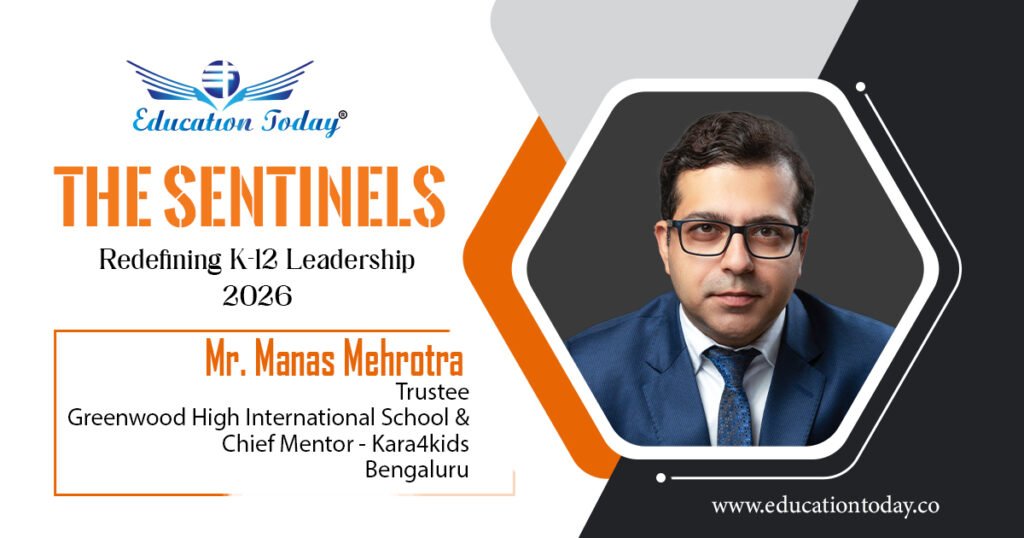
In the contemporary global discourse on pedagogical evolution, the traditional binary between technological advancement and humanistic values is being systematically dismantled. As educational systems grapple with the dual pressures of digital acceleration and a renewed focus on socio-emotional intelligence, the role of the school leader has shifted from administrative overseer to visionary architect. At the centre of this transformation stands Mr. Manas Mehrotra, an educator whose professional trajectory serves as a profound meditation on the necessity of balance in human-centric education. His leadership in the K–12 sector is defined by a sophisticated understanding of how institutions must adapt to a volatile future while remaining anchored in the perennial purpose of schooling: the cultivation of ethical, independent, and intellectually agile individuals, shaping benchmarks in education leadership in India.
Navigating the Crucible: Resilience in a Post-Pandemic Landscape
The last decade has functioned as a crucible for global education, testing the structural and philosophical resilience of institutions worldwide. For Mr. Manas Mehrotra, the COVID-19 pandemic represented a watershed moment, a period of forced metamorphosis that fundamentally altered the relationship between the physical classroom and the digital interface. The rapid transition to remote learning was not merely a logistical challenge; it was a psychological shift that demanded unprecedented levels of creativity and empathy from educators, accelerating the adoption of digital learning.
During this period, Mr. Mehrotra observed a significant democratic expansion of the educational ecosystem. Parents transitioned from passive stakeholders to active co-facilitators of learning, and digital platforms evolved from auxiliary tools into primary theatres of engagement. However, as the initial crisis subsided, his leadership turned toward the more complex task of “blended integration.” Rather than returning to a static status quo, he championed a model where digital collaboration enhances, rather than replaces, the intimacy of the traditional classroom. This period of reflection allowed schools to strengthen their digital infrastructure while reinforcing the vital necessity of human connection, a balance that Mr. Mehrotra posits as the cornerstone of modern institutional health and long-term academic sustainability rooted in holistic learning.
A Philosophy of Depth: The Transition to Concept-Driven Pedagogy
Central to Mr. Manas Mehrotra’s educational philosophy is the conviction that the value of an education is no longer measured by the quantity of information a student can retain, but by the quality of the concepts they can synthesise. In an era of informational ubiquity, the “banking model” of education, where facts are simply deposited into passive recipients, is fundamentally obsolete. Mr. Mehrotra advocates for a “concept-driven” approach, strongly influenced by modern pedagogy, where the focus shifts from the what of learning to the why and the how.
This shift necessitates a move away from rote memorisation toward inquiry-based exploration. Under his guidance, the modern classroom is reimagined as an interactive hub where students are encouraged to interrogate knowledge, draw interdisciplinary parallels, and apply theoretical frameworks to real-world complexities, strengthening student development. By fostering this intellectual curiosity, Mr. Mehrotra ensures that students are not merely preparing for examinations but are developing the cognitive muscles required for lifelong learning.
The Digital Sentinel: Technology as a Guided Resource
In the current epoch, defined by the meteoric rise of artificial intelligence and machine learning, Mr. Manas Mehrotra maintains a stance of “Guided Innovation.” He acknowledges that technology has redefined access to knowledge, yet he remains vigilant regarding its ethical and developmental implications, particularly for young learners whose cognitive self-regulation is still in its nascent stages.
For Mr. Mehrotra, technology is neither a panacea nor a peril; its efficacy is entirely contingent upon the quality of the mentorship that accompanies its use. He views machine learning tools as potent diagnostic resources that can help educators identify learning gaps and personalise instruction with surgical precision. However, he insists that these tools must remain subservient to the human relationship.
- Empathetic Instruction: Digital interfaces cannot replicate the intuitive understanding of a teacher who senses a student’s frustration or subtle shift in confidence.
- Ethical Discernment: As AI generates vast quantities of content, the role of the educator as a “Digital Sentinel” becomes paramount, teaching students how to evaluate sources and interrogate biases.
- Human-Centric Collaboration: Technology should facilitate deeper human connection, allowing for global perspectives to enter the classroom while maintaining a safe, grounded local community.
This balanced approach reflects the essence of innovation in education, ensuring technology enhances rather than replaces human values.
The Architecture of Mentorship and Reflective Leadership
A school is more than a curriculum; it is a relational ecosystem. Mr. Manas Mehrotra’s approach to leadership prioritises the cultivation of this ecosystem through structured mentorship and reflective practice, deeply rooted in mentorship in education. He rejects the hierarchical “top-down” model of administration, opting instead for a culture of “Collective Accountability.” In this model, leadership is a distributed quality that empowers teachers to be reflective practitioners and facilitators of discovery.
By fostering an environment of open dialogue and mutual trust, Mr. Mehrotra ensures that his institutions are capable of continuous self-correction. When educators are encouraged to reflect on their pedagogical strategies and collaborate across disciplines, the entire institutional fabric is strengthened.
Forging Future-Ready Minds for an Unwritten World
Perhaps the most formidable challenge addressed by Mr. Manas Mehrotra is the task of preparing students for a future that is structurally unpredictable. The rise of automation means that many technical skills have a diminishing shelf-life. Consequently, he emphasises the development of “meta-capabilities”, referred to as future ready skills, essential for adaptability in any evolving ecosystem.
To succeed in a globalised, AI-integrated world, Mr. Mehrotra insists that academic knowledge must be married to:
- Emotional Intelligence: The ability to navigate complex social dynamics and collaborate across cultural boundaries.
- Ethical Reasoning: The capacity to make responsible decisions in a world where the consequences of technology are increasingly vast.
- Resilience and Adaptability: The psychological fortitude to pivot in the face of disruption and find opportunity within uncertainty.
He believes that parents and educators must work in tandem to nurture these qualities, moving the conversation beyond grades and into the realm of values, choices, and consequences. This holistic approach ensures that students are not just competitive on a global stage, but are grounded in a sense of purpose and integrity, reinforcing student development.
Conclusion: The Vision of Balanced Progress
Ultimately, the stewardship of Mr. Manas Mehrotra represents a sophisticated synthesis of tradition and transformation. He understands that while the tools of education may change, the heart of the endeavor remains the same: the empowerment of the human spirit through holistic learning.
In a world characterised by constant flux, his leadership serves as a reminder that the most successful institutions are those that embrace innovation without losing sight of the human connection that gives education its meaning, firmly anchored in human-centric education.
“Under his guidance, schools become more than places of instruction; they become crucibles of character where curiosity, resilience, and integrity are forged. As he continues to navigate the evolving landscape of 21st-century pedagogy shaped by modern pedagogy, Mr. Manas Mehrotra stands as a sentinel for a future that is as promising as it is uncertain – architecting an educational world where every learner has the wisdom, the moral grounding, and the courage to shape their own unwritten destiny through impactful education leadership in India. His progressive approach to learning and leadership continues to inspire conversations featured by platforms such as EducationToday, highlighting the evolving role of educators in shaping future-ready institutions.”
His vision remains a testament to the fact that true academic excellence is always a derivative of human empathy, strengthened through digital learning and sustained by innovation in education.
Mr. Manas Mehrotra is an education leader recognized for promoting human-centric learning, innovation, and excellence in modern education.
Human-centric learning focuses on the individual needs, strengths, and well-being of students, creating engaging and meaningful educational experiences.
He advocates for student-focused learning, innovative teaching methods, leadership development, and holistic growth to prepare learners for future challenges.
It encourages critical thinking, collaboration, creativity, emotional intelligence, and lifelong learning while supporting overall student development.
Educational excellence ensures high-quality teaching, strong academic outcomes, and the development of essential life skills that help students thrive in a rapidly changing world.