Table of Contents
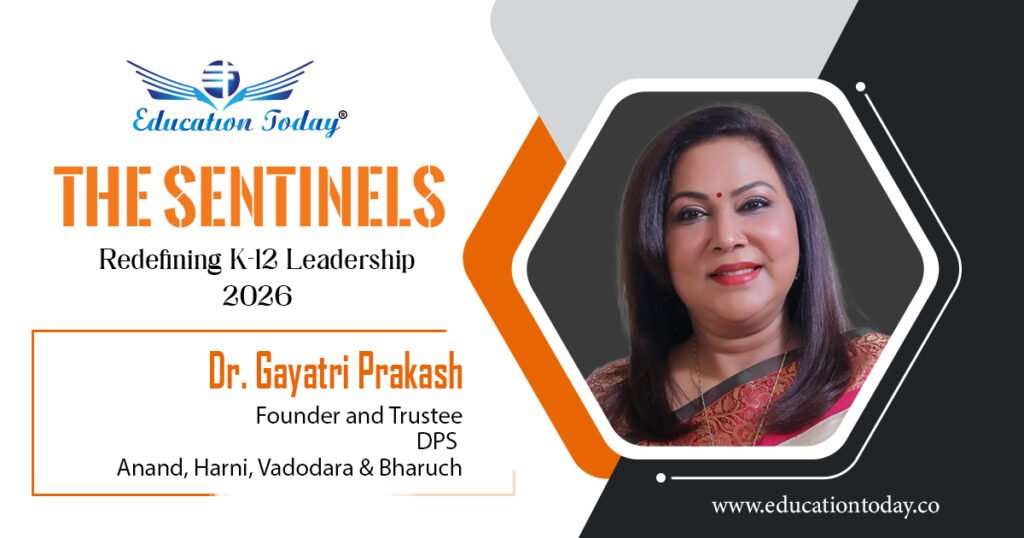
In an era where education is often reduced to measurable outcomes and institutional benchmarks, the deeper purpose of schooling risks being overshadowed by quantifiable success. Yet, there are leaders who continue to challenge this narrow framing, advocating instead for education as a force of profound social transformation. Among them stands Dr. Gayatri Prakash – economist, educationist, and founder- whose work across institutions reflects a steadfast commitment to equity in education, inclusion, and meaningful learning. Her journey is not merely administrative; it is philosophical, rooted in the conviction that education must shape not only intellect, but also character, conscience and courage.
With an MPhil from the University of Delhi and over two decades of engagement in education and social advocacy, Dr. Prakash has consistently bridged the worlds of theory and practice. Through Sakaar Outreach, the organisation she founded, she has worked extensively to advance informal education, vocational training and legal awareness among women in marginalized communities. This commitment to equity extends seamlessly into her work as Founder and Trustee of leading educational institutions, including Delhi Public School Vadodara, Delhi Public School Harni, Delhi Public School Bharuch, Delhi Public School Anand and Avalon World Schools. Across these campuses, her vision is clear: to create environments where learning is not transactional, but transformative.
The School as a Living Ecosystem
For Dr. Prakash, a school is far more than a physical space defined by infrastructure and curriculum. It is a living, dynamic ecosystem, one that must be morally anchored, intellectually vibrant, and socially responsive. In her view, education must move beyond rote memorisation and examination scores, embracing a more expansive understanding of learning.
Under her leadership, classrooms have evolved into spaces of exploration and engagement. Learning extends beyond textbooks into real-world contexts, where students collaborate on projects, participate in fieldwork, engage in debates and contribute to community initiatives. This experiential approach ensures that knowledge is not merely acquired, but applied, bridging the gap between theory and practice through holistic learning.
Such an environment fosters clarity of thought, resilience and self-belief. Students are encouraged to question, to reflect and to develop independent perspectives. In doing so, they become not just learners, but active participants in their own intellectual journeys.
Celebrating Individuality and Holistic Growth
A defining feature of Dr. Prakash’s educational philosophy is her recognition of individual differences. She rejects the notion of a uniform learning pathway, acknowledging instead that each student brings unique strengths, interests and aspirations.
To support this diversity, her institutions offer a wide array of platforms, spanning academics, arts, sports, technology and community service. Co-curricular activities are not treated as supplementary, but as integral to the educational experience. Through these avenues, students discover their passions, develop new skills and build confidence in their abilities.
In this framework, success is redefined. It is not measured solely by academic accolades or competitive achievements, but by the quiet transformation that occurs within each learner. The ability to think independently, to act ethically, and to engage with the world with dignity becomes the true marker of educational success, reflecting student-centered learning.
Rethinking Learning in a Changing World
As the demands of the twenty-first century continue to reshape the educational landscape, Dr. Prakash advocates for a fundamental shift in pedagogical approach. The traditional one-size-fits-all model, she argues, must give way to a more nuanced, learner-centred paradigm.
Her schools exemplify this transition through the integration of adaptive technologies such as AcadAlly, an AI-driven platform designed to personalise learning. By analysing student performance and identifying areas of strength and difficulty, the system provides targeted insights that enable more effective teaching, advancing educational innovation. This forward-looking approach also reflects the kind of meaningful educational transformation highlighted by EducationToday.
Importantly, technology is not positioned as a replacement for educators. Rather, it serves to enhance their role, freeing them from routine tasks such as grading and data management. This allows teachers to focus on what truly matters: mentoring students, designing meaningful learning experiences, and fostering intellectual curiosity.
Diagnostic analytics further support this process, enabling timely intervention and promoting a growth-oriented mindset. Students are encouraged to view challenges not as limitations, but as opportunities for development. Parents, too, are actively engaged through transparent communication, reinforcing the idea that education is a collaborative endeavour.
Navigating the Digital Age with Discernment
In a world increasingly defined by digital connectivity, Dr. Prakash places significant emphasis on the thoughtful and responsible use of technology. She recognises that the question is no longer whether students will engage with digital tools, but how they will do so.
Her approach begins with intentionality. Students are encouraged to reflect on their digital habits, asking critical questions about their usage and its purpose. This shift from passive consumption to conscious engagement fosters a more mindful relationship with technology.
Equally important is the development of digital literacy in schools as a core competency. Students learn to evaluate sources, identify bias and verify information, skills that are essential in an age of misinformation. Fact-checking exercises and analytical discussions cultivate a sense of vigilance and intellectual rigour.
Digital citizenship forms another key component of this framework. Through structured lessons on privacy, plagiarism and online conduct, students are made aware of the ethical dimensions of their digital presence. Creative projects, including blogs, presentations and application development, further reinforce responsible and original use of technology.
In this balanced approach, technology is neither idealised nor rejected. It is humanised, integrated into a broader educational context that prioritises relationships, ethics and lived experience.
Leadership Through Collaboration and Mentorship
For Dr. Prakash, the strength of an educational institution lies not in its policies alone, but in the quality of its relationships. She places mentorship at the heart of her leadership model, fostering a culture of collaboration and shared growth through mentorship in schools.
Experienced educators guide their younger counterparts, creating a continuum of learning that benefits both mentors and mentees. Teachers, in turn, extend this mentorship to students, supporting not only their academic progress but also their personal development.
Reflection serves as a second pillar of this approach. Through peer observations, professional learning communities, and open dialogue, educators engage in continuous self-assessment and improvement. This culture of reflection ensures that teaching practices remain dynamic and responsive.
Leadership, within this framework, is distributed rather than hierarchical. Teachers are empowered to lead initiatives, students take on responsibilities through councils and clubs, and administrators model transparency and accountability. Authority is redefined as stewardship, a means of guiding and supporting rather than controlling, exemplifying visionary leadership.
Preparing Learners for an Unwritten Future
As the future of work and society continues to evolve, Dr. Prakash’s vision for education is both forward-looking and deeply grounded. She emphasises the importance of equipping students with skills that transcend disciplinary boundaries – adaptability, critical thinking, collaboration, and ethical judgment.
Her institutions champion inquiry-led and interdisciplinary learning, encouraging students to explore connections across subjects and apply their knowledge in diverse contexts. Creativity and empathy are cultivated alongside technical proficiency, ensuring a well-rounded educational experience.
Wellbeing, too, is an integral component of this vision. Recognising the pressures faced by students in a competitive world, the schools prioritise emotional resilience and mental health, creating environments where learners feel supported and valued.
Ultimately, Dr. Prakash views education as inseparable from moral development. It is not enough for students to succeed; they must also contribute meaningfully to society. By nurturing curiosity, conscience, and courage, her approach prepares learners to engage with a world that is constantly changing and to shape it with integrity and purpose.
Conclusion: A Vision Rooted in Transformation
In Dr. Gayatri Prakash, one encounters a leader who has consistently redefined the possibilities of education. Her work reflects a deep understanding that schools are not merely institutions, but spaces of transformation, where young minds are shaped, values are instilled, and futures are imagined.
Through her commitment to equity, innovation and holistic development, she has created educational environments that honour both individuality and community. Her vision challenges conventional notions of success, inviting educators to look beyond outcomes and towards impact.
In a time when education is often driven by immediacy and competition, Dr. Prakash’s approach offers a compelling alternative, one that places humanity at the centre of learning. It is a vision that does not merely respond to the future, but seeks to shape it, one learner at a time.
Dr. Gayatri Prakash is an educationist and educational leader associated with school management and initiatives focused on improving learning and social equity.
She is known for her work in education, school management, social initiatives and promoting approaches that support holistic and experiential learning.
Her work reflects an emphasis on holistic education, experiential learning, inclusion and developing learners beyond conventional academic achievement.
She has been involved in school management and educational leadership, including serving as an educationist and Vice Chairperson of the Delhi Public School Vadodara School Managing Committee.
Her educational work highlights experiential and holistic learning, helping students develop academic, social, emotional and practical capabilities for a changing world.