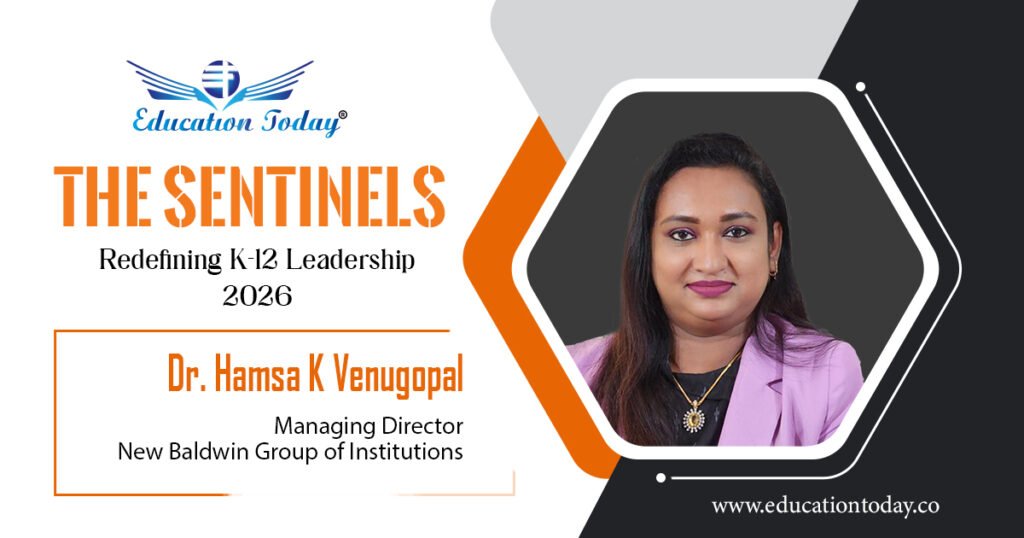
In the contemporary educational epoch, the definition of leadership has undergone a radical metamorphosis. It is no longer sufficient for an academic head to be a mere administrator of curricula; they must be the architects of a dynamic ecosystem where intellectual curiosity intersects with ethical fortitude. At the vanguard of this institutional renaissance is Dr. Hamsa K Venugopal, whose stewardship at the New Baldwin Group of Institutions (New Baldwin Group of Institutions) serves as a definitive blueprint for 21st-century learning shaped by modern pedagogy and education leadership in India.
Armed with a scholarly pedigree that spans the globe, including a Doctorate in Design Thinking from Stanford University, a Doctorate in Curriculum Development from the European International University, Paris, and strategic leadership credentials from IIM Kolkata and Cambridge University, Dr. Hamsa represents a rare synthesis of academic rigour and visionary pragmatism rooted in design thinking in education. Her leadership is not merely a product of her accolades, which include the Best Woman Entrepreneur Award and the Global Education Leadership Achievement Award, but a manifestation of a deeply held conviction: that education is the ultimate vehicle for societal transformation through holistic education.
A Journey of Intentionality: Milestones of Influence
Dr. Hamsa’s professional trajectory is anchored in the belief that every child is entitled to an environment where their latent potential is not just recognised, but systematically nurtured under K12 innovation. Her tenure at NBGI has been defined by a transition from traditional, transactional instruction to a philosophy of influence, profound responsibility, and service. This journey has not been a linear progression but a series of calculated, transformational moments designed to bring NBGI in alignment with emerging global standards and modern pedagogy.
“Under her guidance, the institution has navigated periods of profound systemic change with a steady hand. By strengthening academic frameworks and embedding design thinking into the very fabric of the school’s operations, she has fostered an atmosphere of stability and optimism aligned with design thinking in education. These milestones are not merely statistical; they are visible in the burgeoning confidence of the student body and the professional dexterity of the faculty. Dr. Hamsa views leadership as a relational construct; it is about building collaborative teams where accountability is tempered with empathy, and where mentorship is the primary engine of institutional growth. Her progressive vision for transforming K-12 education has also been recognised through platforms such as EducationToday, which continues to highlight inspiring educational leaders shaping the future of learning.”
The Holistic Pivot: An Evolving Educational Philosophy
The traditional model of K-12 education, often criticised for its narrow focus on rote academic performance and high-stakes testing, has been systematically dismantled at NBGI in favour of a holistic education framework. Dr. Hamsa recognises that modern learners are not passive vessels for the storage of information; they are thinkers, creators, and empathetic problem-solvers navigating a globalised, interconnected landscape shaped by education leadership in India.
This evolution prioritises a four-dimensional growth model:
- Intellectual Vitality: Cultivating critical thinking and the ability to synthesise complex data.
- Emotional Resilience: Equipping students with the self-awareness to navigate failure and the tenacity to persist through challenges.
- Social Fluidity: Developing the communication and collaborative skills necessary for a diverse, global workforce.
- Ethical Anchoring: Ensuring that every academic achievement is underpinned by integrity, humility, and social responsibility.
By adopting student-centric strategies and differentiated instruction, NBGI ensures that pedagogical delivery is tailored to the unique learning profiles of each child. In this environment, classrooms are reconfigured as safe harbours for curiosity. Questions are not merely welcomed; they are the fundamental currency of the learning process. Mistakes are reframed as “iterative prototypes” of thought, removing the stigma of failure and replacing it with the drive for continuous refinement and intellectual grit.
Beyond the Digital Veneer: Cultivating Discerning Thinkers
As we inhabit the mid-point of the 2020s, the saturation of technology in education is ubiquitous. However, Dr. Hamsa advocates for a “digital temperance”, a deliberate and principled integration of technology within digital education in India. While NBGI leverages AI-enhanced learning tools and smart classroom interfaces, these are never viewed as substitutes for human ingenuity or the vital mentor-student relationship.
The core objective is the development of digital literacy complemented by a robust ethical discernment. Students are trained to be interrogators of information, evaluating sources for bias, provenance, and credibility rather than merely consuming content. Dr. Hamsa maintains that true wisdom is forged beyond the screen. Consequently, experiential learning remains the heartbeat of the institution through experiential learning. Whether through project-based initiatives, competitive sports, or community engagement, students are encouraged to engage deeply with the physical world. This ensures that while they are digitally competent, they are not digitally dependent, preserving the essential human capacity for original thought and creative problem-solving. This balance prevents cognitive passivity and ensures that technology serves as a vehicle for innovation rather than a replacement for cognitive effort.
Mentorship as Institutional DNA
A hallmark of Dr. Hamsa’s leadership is the elevation of the educator. She understands that the quality of an educational institution can never exceed the quality of its teachers. At NBGI, leadership is participatory rather than hierarchical. Mentorship is not an occasional intervention but a continuous, systemic process that empowers faculty members to be reflective practitioners.
By promoting an open dialogue between students, parents, and staff, Dr. Hamsa has cultivated a culture of transparency and collective ownership. This participatory model ensures that every stakeholder from the youngest learner to the senior administrator is an active contributor to the institution’s excellence. Her leadership style is one of inspiration rather than instruction; she seeks to ignite the intrinsic motivation within her team, fostering a culture where professional growth is viewed as a prerequisite for student success. This investment in human capital creates a ripple effect, where empowered teachers foster empowered students, creating a sustainable loop of academic and personal achievement that defines the New Baldwin identity.
Architecting the Unwritten Future
The global landscape awaiting today’s graduates is one of unprecedented volatility, uncertainty, and complexity. Many of the careers that will define the 2030s and 2040s do not yet exist, and the challenges of tomorrow require a radical departure from yesterday’s solutions. Dr. Hamsa’s vision is anticipatory, designed to equip students with future ready students capabilities.
At NBGI, students are nurtured as lifelong learners. The curriculum integrates interdisciplinary projects and innovation-driven programmes that bridge the gap between theoretical knowledge and real-world application. However, amidst this drive for innovation, the commitment to enduring human values remains steadfast.
- Accountability: Taking ownership of one’s actions and their broader impact on the community.
- Empathy: The ability to understand and value diverse perspectives in a globalised world.
- Entrepreneurial Acumen: Identifying opportunities for positive change and having the courage to pursue them.
NBGI’s mission transcends the production of accomplished professionals; it seeks to forge compassionate citizens who are as ethically grounded as they are intellectually brilliant. By connecting the classroom to global exigencies, Dr. Hamsa ensures that education remains relevant, impactful, and profoundly humane, integrating digital education in India at its core, preparing students to lead with both heart and mind. This comprehensive approach transforms the school from a traditional learning centre into a vital laboratory for social and personal progress.
Conclusion: A Beacon of Progress
In 2026, the mandate for K–12 leadership is clear: schools must be sites of both preservation and transformation. They must preserve the values that make us human while transforming the skills that make us capable. Through the visionary guidance of Dr. Hamsa K Venugopal, the New Baldwin Group of Institutions has successfully harmonised these traditional values with cutting-edge pedagogical innovation rooted in K12 innovation.
Under her stewardship, NBGI stands not just as a school, but as a laboratory for human potential, a beacon of progress dedicated to shaping minds that will, in turn, shape a more enlightened, ethical, and resilient future for all through holistic education. This enduring commitment to excellence ensures that every student graduates not only with a diploma but with a clear sense of purpose.
Dr. Hamsa K Venugopal is an education leader recognized for integrating innovation with purpose-driven learning to create meaningful educational experiences.
Her philosophy emphasizes innovation, student-centric learning, holistic development, and strong values to prepare learners for the future.
Innovation enhances learning through technology, experiential teaching, critical thinking, and creative problem-solving while keeping students at the center.
Purpose-driven leadership fosters a positive school culture, empowers educators, and inspires students to achieve academic and personal excellence.
Holistic learning develops academic skills, emotional intelligence, creativity, collaboration, and ethical values, enabling students to thrive in a changing world.