Table of Contents
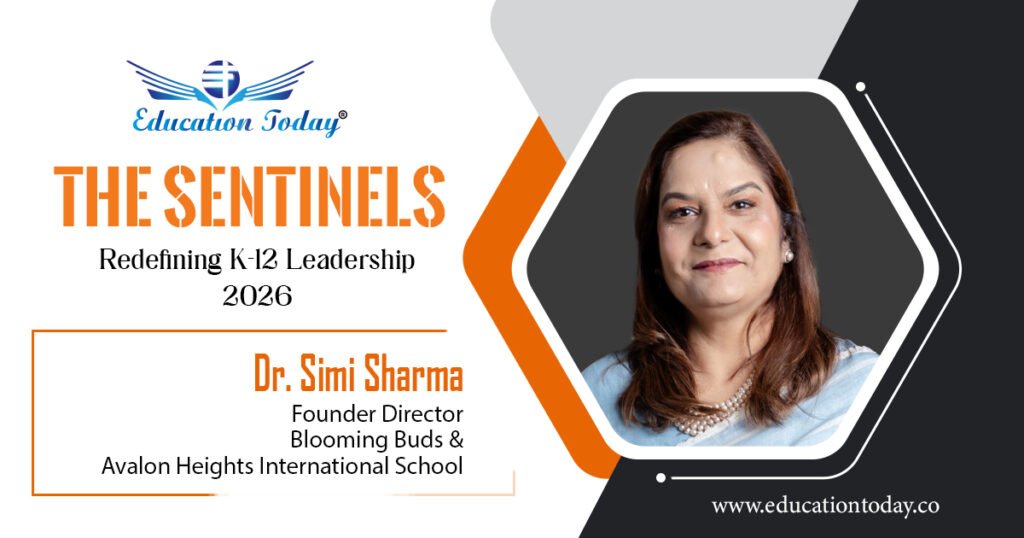
In an era defined by rapid change and increasing complexity, the role of education has never been more critical or more demanding in India. It must do far more than prepare students for examinations; it must equip them to navigate uncertainty, think critically and act with integrity. At the forefront of this evolving educational landscape stands Dr Simi Sharma, Founder Director of Blooming Buds and Avalon Heights International School (Blooming Buds School, Avalon Heights International School), whose work reflects a deeply considered commitment to transformative education and values-driven leadership.
Dr. Sharma’s journey is distinguished not only by institutional success but by a philosophy that harmonises global best practices with enduring Indian values. Her approach is neither rigid nor reactive; rather, it is reflective, adaptive and firmly rooted in the belief that education must remain a humane endeavour of human-centered learning. Through her leadership, schools have become spaces where intellectual development is seamlessly interwoven with personal growth, emotional intelligence and ethical awareness.
Rethinking the Purpose of Education
Central to Dr. Sharma’s educational philosophy is a critical question: what does it truly mean to prepare students for the future? In a world that is constantly shifting, she asserts that knowledge alone is insufficient. The emphasis must instead be placed on cultivating the ability to interpret, question, and apply learning meaningfully, forming the foundation of holistic education.
Her perspective marks a departure from traditional, outcome-driven models of schooling. Rather than focusing exclusively on content delivery, she advocates for an education that prioritises understanding, discernment and adaptability. Students are encouraged to move beyond passive absorption of information and engage actively with ideas, fostering a mindset that is both inquisitive and reflective.
This shift is particularly significant in a time when information is abundant, but wisdom is often scarce. By nurturing curiosity and encouraging thoughtful engagement, Dr. Sharma’s approach seeks to develop learners who are not only informed but also discerning and self-aware.
From Teaching to Learning: A Paradigm Shift
Dr. Sharma’s work underscores an important transition in contemporary education: the movement from teaching as instruction to learning as a dynamic, participatory process grounded in modern pedagogy. In her view, the role of educators is not to provide ready-made answers but to create environments where students can explore, question, and construct their own understanding.
This philosophy finds expression in classrooms that prioritise dialogue over monologue. Learning is not a one-way transmission but an evolving conversation, where students are active participants in their own intellectual journeys. Such an approach fosters deeper engagement, enabling learners to develop critical thinking skills and a genuine appreciation for knowledge.
Equally important is the recognition that each student’s learning trajectory is unique. By acknowledging diverse abilities and perspectives, the educational process becomes more inclusive and responsive, allowing every learner to realise their potential.
Technology with Thoughtfulness
In an age where digital tools have become integral to education, Dr. Sharma offers a nuanced perspective on the role of technology. While acknowledging its transformative potential, she cautions against uncritical adoption. Technology, in her view, should enhance learning rather than dominate it.
She advocates for a balanced approach that integrates digital resources with human interaction, reflection, and critical inquiry. Students are guided not only in how to use technology but also in how to evaluate information, distinguish between meaningful and superficial engagement, and develop responsible digital habits.
This emphasis on discernment is particularly relevant in a world characterised by information overload. By teaching students to pause, reflect and question, Dr. Sharma ensures that technology becomes a tool for empowerment rather than distraction.
Cultivating Discernment and Inner Discipline
A recurring theme in Dr. Sharma’s philosophy is the importance of discernment, the ability to make thoughtful, informed choices. In her view, true education lies not in speed or efficiency but in the capacity to pause, reflect, and respond with intention.
This perspective challenges the prevailing culture of immediacy, where rapid responses are often valued over considered judgement. Instead, she emphasises the development of inner discipline, encouraging students to engage deeply with ideas and to approach learning with patience and purpose.
Such an approach not only enhances intellectual growth but also contributes to emotional and ethical development. By fostering self-awareness and reflective thinking, students are better equipped to navigate complexity and make decisions that are both informed and responsible.
Leadership as Stewardship
Dr. Sharma’s understanding of leadership extends beyond authority and administration. For her, leadership is fundamentally about stewardship – creating environments where individuals can thrive and contribute meaningfully.
This ethos is reflected in the culture of the institutions she leads, where collaboration, trust, and mutual respect are central. Teachers, students and parents are seen as partners in the educational journey, each playing a vital role in shaping a supportive and dynamic learning community.
By redefining leadership in this way, Dr. Sharma not only empowers those within her institutions but also models a more inclusive and humane approach to organisational development.
Preparing for an Unwritten Future
The future, as Dr. Sharma frequently observes, is not a fixed destination but an evolving landscape requiring future-ready students. Preparing students for such a future requires more than academic proficiency; it demands adaptability, resilience and a willingness to embrace uncertainty.
Her approach to education reflects this understanding. Experiential learning, collaborative projects and interdisciplinary exploration are integral to the curriculum, providing students with opportunities to apply their knowledge in real-world contexts. These experiences foster not only intellectual growth but also practical skills and a sense of responsibility.
Importantly, Dr. Sharma emphasises that not all problems have immediate or straightforward solutions. By encouraging students to engage with ambiguity and complexity, she prepares them to navigate the challenges of a rapidly changing world with confidence and clarity.
Beyond Screens: Human-Centred Learning
While technology continues to reshape education, Dr. Sharma remains steadfast in her belief that the most meaningful aspects of learning are inherently human. Listening, empathy, dialogue and reflection are not merely supplementary elements; they are central to the educational experience.
Her emphasis on human-centred learning serves as a counterbalance to the increasing digitisation of classrooms. By prioritising relationships and interactions, she ensures that education remains grounded in values that transcend technological trends.
This approach is particularly significant in fostering a sense of belonging and community, qualities that are essential for both personal well-being and academic success.
A Legacy of Impact and Influence
Dr. Sharma’s contributions extend beyond the institutions she has founded and led. As a global speaker, she has engaged with educators, leaders and professionals across continents, sharing insights that challenge conventional thinking and inspire innovation. Her perspectives on educational transformation also align with the wider conversations featured by EducationToday, particularly around leadership, innovation and the evolving purpose of schooling.
Her work reflects a commitment to continuous learning and improvement, both at an individual and institutional level. By remaining open to new ideas while staying rooted in core values, she exemplifies the balance that is essential for sustainable progress in education.
Conclusion: Education as a Transformative Force
In reflecting on Dr. Simi Sharma’s vision, one is reminded that education, at its best, is a transformative force shaped by value-based learning. It shapes not only what students know but who they become, how they think, how they relate to others and how they engage with the world.
Through her work, Dr. Sharma has demonstrated that meaningful education requires more than systems and structures; it demands a commitment to humanity, purpose and growth. Her approach challenges educators to look beyond immediate outcomes and consider the broader impact of their work.
In a time when education is often driven by speed and scale, her philosophy offers a compelling alternative, one that values depth over breadth, reflection over reaction and purpose over performance. It is an approach that not only prepares students for the future but empowers them to shape it with wisdom, integrity and compassion, truly embodying future-ready students.
Dr. Simi Sharma is associated with educational leadership, learning innovation, and efforts focused on creating meaningful and future-oriented learning experiences.
Her educational vision emphasizes purposeful learning, innovation, leadership development, and preparing students with skills for a changing world.
Strong educational leadership can support better learning environments, encourage innovation, motivate educators, and help students achieve their potential.
Innovation encourages creativity, critical thinking, collaboration, technology awareness, and problem-solving, helping learners become more adaptable.
Educators can combine academic knowledge with life skills, experiential learning, technology, collaboration, creativity, and opportunities for independent thinking.