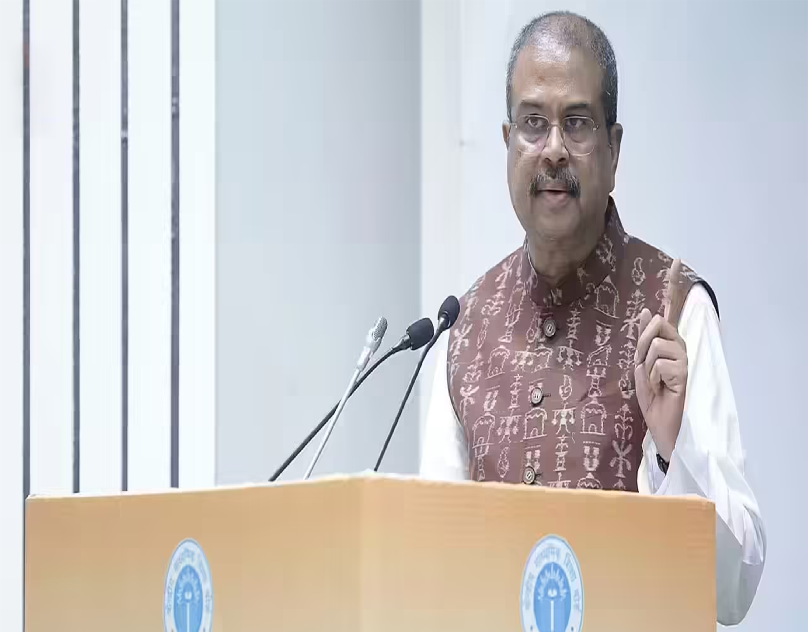
Dharmendra Pradhan Launches CBSE CT & AI Curriculum For Classes 3–8
Dharmendra Pradhan Launches CBSE CT & AI Curriculum For Classes 3 To 8 Students
In a landmark move signalling a decisive shift in India’s educational priorities, Union Education Minister Dharmendra Pradhan has formally launched a new curriculum on Computational Thinking (CT) and Artificial Intelligence (AI) for students of Classes 3 to 8 under the Central Board of Secondary Education (CBSE). Introduced at the very outset of the 2026–27 academic session, the initiative reflects a broader national commitment to embedding future-ready competencies within the school system.
Unveiled at Vigyan Bhawan in New Delhi in the presence of senior policymakers, educationists, and institutional leaders, the curriculum marks a significant milestone in India’s journey towards integrating emerging technologies into foundational education.
A Transformative Step in School Education
At its core, the newly introduced CT & AI curriculum represents more than a mere academic update; it is a philosophical reorientation of how learning is conceived in contemporary India. Described by the minister as a “transformative step towards future-ready learning,” the initiative aims to introduce structured AI education into the school ecosystem at scale.
By bringing computational thinking and artificial intelligence into classrooms as early as Class 3, the policy underscores the urgency of equipping students with skills that extend far beyond traditional academic domains. The emphasis is not simply on technological literacy, but on cultivating analytical thinking, creativity and problem-solving abilities from an early age.
Bridging the Gap Between Education and Technology
The introduction of AI and computational thinking at the elementary and middle school levels reflects a growing recognition that the demands of the 21st-century workforce require a fundamentally different skill set. The curriculum has been carefully designed to bridge the long-standing gap between conventional pedagogy and contemporary technological realities.
Developed in collaboration with the National Council of Educational Research and Training (NCERT), the programme integrates structured modules, teacher handbooks, and clearly defined assessment frameworks. These resources aim to ensure that both educators and learners can navigate the subject with clarity and confidence.
In practical terms, the curriculum introduces students to key elements of computational thinking, such as logical reasoning, pattern recognition, and structured problem-solving, while gradually familiarising them with the principles and applications of artificial intelligence.
A Structured and Age-Appropriate Approach
One of the most notable aspects of the initiative is its emphasis on age-appropriate learning. Rather than overwhelming young learners with complex technical concepts, the curriculum adopts a phased and carefully calibrated approach.
For students in Classes 3 to 5, computational thinking is integrated through interactive, activity-based methods, including puzzles, storytelling and games. This ensures that foundational concepts are introduced in a manner that is both engaging and accessible.
As students progress to Classes 6 to 8, the curriculum gradually introduces foundational AI concepts, enabling learners to build on their earlier exposure. This progression ensures continuity and depth, allowing students to develop a coherent understanding of both computational logic and emerging technologies.
‘AI for Education’ and ‘AI in Education’
A defining feature of the initiative is its dual conceptual framework: “AI for Education” and “AI in Education.” These guiding principles encapsulate the broader vision underpinning the curriculum.
“AI for Education” focuses on leveraging artificial intelligence to enhance learning outcomes, improve pedagogical methods, and personalise educational experiences. Conversely, “AI in Education” emphasises the importance of teaching AI as a subject in its own right, equipping students with the knowledge and skills required to engage with and shape technological advancements.
Together, these approaches aim to foster what the minister described as “augmented learning”, a model that blends human creativity with technological capability to create richer and more dynamic educational experiences.
Alignment with National Education Policy 2020
The rollout of the CT & AI curriculum is closely aligned with the vision articulated in the National Education Policy (NEP) 2020 and the National Curriculum Framework for School Education (NCF-SE) 2023. These policy frameworks emphasise the need to move beyond rote learning towards a more holistic, competency-based model of education.
By embedding AI and computational thinking within the curriculum, CBSE is effectively operationalising these policy objectives. The initiative promotes interdisciplinary learning, encouraging students to draw connections between technology, mathematics, science, and even the humanities.
Such integration not only enhances conceptual understanding but also prepares students to navigate complex, real-world challenges with confidence and adaptability.
Empowering Students as Creators, Not Consumers
A recurring theme in the discourse surrounding the new curriculum is the aspiration to transform students from passive consumers of technology into active creators and innovators.
Education policymakers have increasingly recognised that mere familiarity with digital tools is insufficient in a rapidly evolving technological landscape. Instead, students must be equipped with the skills to design, innovate and critically evaluate technological systems.
By introducing AI education at an early stage, the curriculum seeks to cultivate precisely these capabilities. It encourages students to engage with technology not as an external utility, but as a medium for creativity, problem-solving and societal impact.
Teacher Preparedness and Institutional Support
The successful implementation of such an ambitious curriculum hinges not only on its design but also on educators' preparedness. Recognising this, the initiative includes comprehensive teacher handbooks and structured training resources.
These materials are intended to equip teachers with the knowledge and pedagogical strategies required to effectively deliver the curriculum. By providing clear guidance and support, CBSE aims to ensure that educators are not merely facilitators but active contributors to the learning process.
Furthermore, the availability of digital resources and platforms such as DIKSHA is expected to enhance accessibility and scalability, enabling schools across the country to adopt the curriculum seamlessly.
A Phased and Inclusive Rollout
The implementation of the CT & AI curriculum is designed to be phased, ensuring a smooth transition for schools and students alike. Initially, the focus will be on building strong foundations in computational thinking, with more advanced AI concepts introduced progressively in higher classes.
Importantly, efforts are also underway to make the curriculum accessible in regional languages, thereby broadening its reach and inclusivity. This reflects a commitment to ensuring that the benefits of technological education are not confined to a limited demographic but are available to learners across diverse linguistic and socio-economic backgrounds.
Implications for the Future of Education
The introduction of AI and computational thinking into the school curriculum represents a significant inflection point in India’s educational trajectory. It signals a shift from a knowledge-centric model to a skills-oriented paradigm, one that prioritises adaptability, innovation, and critical thinking.
As global economies become increasingly driven by technology, the ability to understand and engage with AI is likely to become as fundamental as literacy and numeracy. By embedding these competencies within the school system, India is positioning its students to thrive in an increasingly complex and interconnected world.
Conclusion
The launch of the CBSE CT & AI curriculum for Classes 3 to 8 is both timely and transformative. It reflects a forward-looking vision that recognises the centrality of technology in shaping the future of education and employment.
By introducing structured AI education at an early stage, the initiative not only enhances digital literacy but also nurtures a generation of thinkers, innovators and responsible digital citizens.
As the curriculum begins to take root across schools in the 2026–27 academic session, its true impact will unfold over time. Yet, even at this early stage, it stands as a compelling example of how education systems can evolve to meet the demands of a rapidly changing world - thoughtfully, inclusively and with a firm eye on the future.


