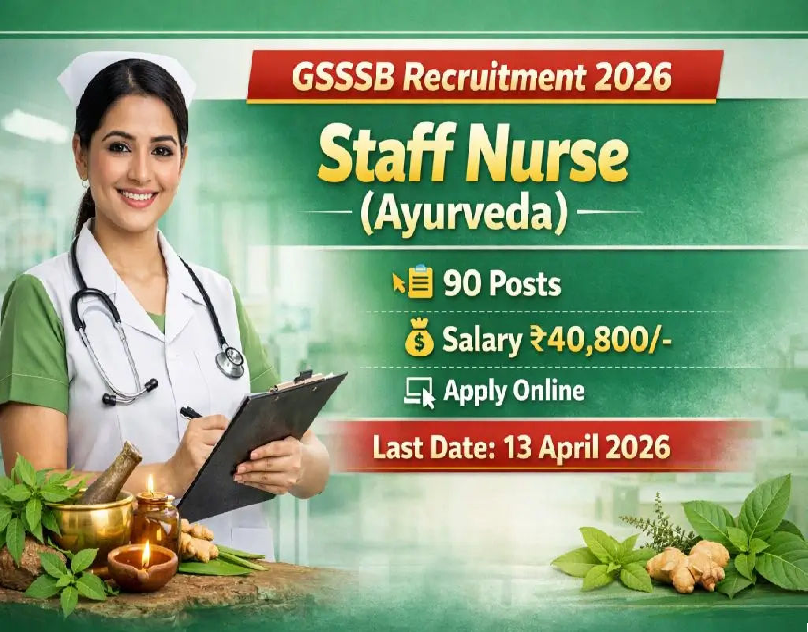
GSSSB Staff Nurse (Ayurveda) Recruitment 2026: Apply by April 13
GSSSB Staff Nurse (Ayurveda) Recruitment 2026: A Significant Opportunity in India’s Evolving Public Healthcare Landscape
In a noteworthy development within India’s public sector employment ecosystem, the Gujarat Subordinate Service Selection Board (GSSSB) has announced the Staff Nurse (Ayurveda) Recruitment 2026, with the application window now extended until 13 April 2026. This extension offers a crucial opportunity for eligible candidates aspiring to build a career in the government healthcare system, particularly within the expanding domain of Ayurveda.
While at first glance the announcement may appear to be a routine recruitment update, a closer examination reveals its broader implications, touching upon healthcare delivery, inclusive employment policies, and the growing institutional recognition of traditional medicine systems.
Understanding the Recruitment: Scope and Significance
The GSSSB recruitment drive aims to fill vacancies for the post of Staff Nurse (Ayurveda), Class-3, under Gujarat’s public health framework. The positions fall within the Directorate of AYUSH (Ayurveda, Yoga, Unani, Siddha and Homoeopathy), reflecting the government’s sustained commitment to strengthening alternative systems of medicine alongside conventional healthcare.
Although the number of vacancies is relatively modest, reported to be around 10 posts, the importance of this recruitment lies not in its scale but in its strategic focus. It represents a targeted effort to address specialised healthcare needs while also supporting the integration of Ayurveda into mainstream public health services.
Moreover, the recruitment has been conducted as part of a special drive, often aimed at addressing backlog vacancies and ensuring inclusivity in government employment.
Extended Deadline: A Window of Opportunity
The extension of the application deadline to 13 April 2026 is perhaps the most immediate and impactful aspect of this announcement. In a competitive and often time-sensitive recruitment environment, such extensions can prove decisive for many candidates.
Students and job seekers frequently face logistical challenges, ranging from documentation delays to overlapping academic commitments. By offering additional time, the board has demonstrated administrative flexibility that aligns with a more candidate-centric approach.
Importantly, this extension should not be misconstrued as an invitation to procrastinate. Rather, it provides applicants with the opportunity to complete their submissions with greater accuracy and preparedness.
Eligibility Criteria: Balancing Professional Rigour with Accessibility
The eligibility framework for the Staff Nurse (Ayurveda) position reflects a careful balance between professional standards and accessibility.
Educational Qualifications
Candidates are required to possess a Diploma or degree in Ayurvedic Nursing from a recognised institution. Additionally, registration with the relevant state board, specifically the Gujarat Board of Ayurvedic and Unani Systems of Medicine, is mandatory.
This requirement ensures that applicants possess both theoretical knowledge and practical competence in Ayurveda-based healthcare practices.
Additional Requirements
Applicants must also demonstrate:
- Basic knowledge of computer applications
- Proficiency in Gujarati or Hindi
- Compliance with general civil service norms, including nationality requirements
Such criteria reflect the evolving expectations of modern healthcare roles, where digital literacy and effective communication are increasingly indispensable.
Age Limit
The prescribed age range is 18 to 45 years, with applicable relaxations for reserved categories, particularly Persons with Disabilities (PwD).
This relatively broad age bracket enhances accessibility, allowing a diverse pool of candidates to participate in the recruitment process.
Vacancy Structure: Inclusivity at the Core
One of the defining features of this recruitment drive is its focus on inclusivity. The vacancies are structured as part of a special recruitment initiative for PwD candidates, with category-wise distribution across disability groups.
This approach underscores the government’s commitment to equitable employment practices, ensuring that opportunities within the public sector are accessible to individuals from diverse backgrounds and abilities.
In an era where inclusivity is increasingly recognised as a cornerstone of institutional integrity, such initiatives serve as important benchmarks for other recruitment bodies.
Selection Process: Merit, Competence and Transparency
The selection process for the GSSSB Staff Nurse (Ayurveda) recruitment is designed to be both rigorous and transparent.
Written Examination
Candidates will undergo a single-stage competitive written examination, typically comprising objective-type questions. The exam is divided into two sections:
- General aptitude, reasoning, and current affairs
- Subject-specific knowledge in Ayurvedic nursing
The inclusion of both general and specialised components ensures a holistic assessment of candidates’ capabilities.
Document Verification
Shortlisted candidates will subsequently be required to undergo document verification, where their eligibility credentials are thoroughly scrutinised.
This two-tier process reflects a broader trend in government recruitment, prioritising both merit-based selection and procedural integrity.
Salary and Career Prospects: Stability with Growth
The position offers a structured salary framework, beginning with a fixed remuneration during the initial years, followed by integration into the standard government pay scale.
Beyond financial stability, the role provides:
- Long-term job security
- Opportunities for professional growth within the public healthcare system
- Exposure to diverse clinical environments
For candidates seeking a meaningful and stable career, the position represents a compelling proposition.
Ayurveda in Public Healthcare: A Growing Paradigm
The recruitment must also be viewed within the larger context of Ayurveda’s resurgence in India’s healthcare ecosystem.
In recent years, there has been a renewed emphasis on integrating traditional medicine systems into public health strategies. This shift is driven by several factors:
- Increasing demand for holistic and preventive healthcare
- Recognition of Ayurveda’s relevance in lifestyle-related disorders
- Government initiatives aimed at promoting AYUSH systems
By recruiting trained Ayurvedic nurses, the GSSSB is contributing to this broader vision, ensuring that traditional healthcare practices are supported by qualified professionals.
Application Process: Navigating the Digital Interface
The application process is conducted entirely online, reflecting the digitisation of government recruitment systems.
Candidates are required to:
- Register on the official portal
- Complete the application form with accurate personal and academic details
- Upload necessary documents
- Pay the application fee through digital payment modes
While the process is streamlined, it demands careful attention to detail. Errors in documentation or incomplete submissions can result in disqualification, irrespective of eligibility.
Challenges and Considerations
Despite its many strengths, the recruitment process is not without challenges.
Limited Vacancies
With a relatively small number of positions available, competition is expected to be intense. Candidates must therefore approach preparation with diligence and strategic focus.
Specialised Qualification Requirements
The requirement of an Ayurvedic nursing qualification may limit the applicant pool, particularly in regions where such courses are less prevalent.
Awareness and Accessibility
Ensuring that eligible candidates, especially those in remote areas, are aware of the opportunity remains a critical challenge. Digital outreach and information dissemination will play a key role in addressing this gap.
For Aspirants: Strategic Preparation
For candidates intending to apply, the extended deadline offers valuable time to refine their approach.
Key recommendations include:
- Thorough review of the official notification
- Systematic preparation for both general and subject-specific exam sections
- Verification of eligibility criteria and documentation
- Timely completion of the application process
Success in such competitive examinations often hinges not only on knowledge but also on discipline and attention to detail.
Conclusion: A Step Towards Inclusive and Holistic Healthcare
The GSSSB Staff Nurse (Ayurveda) Recruitment 2026 is more than a routine employment notification; it is a reflection of evolving priorities within India’s public sector.
By combining inclusivity, professional rigour, and a focus on traditional healthcare systems, the recruitment embodies a forward-looking approach to both employment and public health.
The extension of the application deadline until 13 April 2026 further reinforces this commitment, ensuring that no deserving candidate is left behind due to procedural constraints.
For aspirants, the message is clear: this is not merely an opportunity to secure a government job but a chance to contribute meaningfully to a healthcare system that increasingly embraces diversity, tradition and innovation in equal measure.


