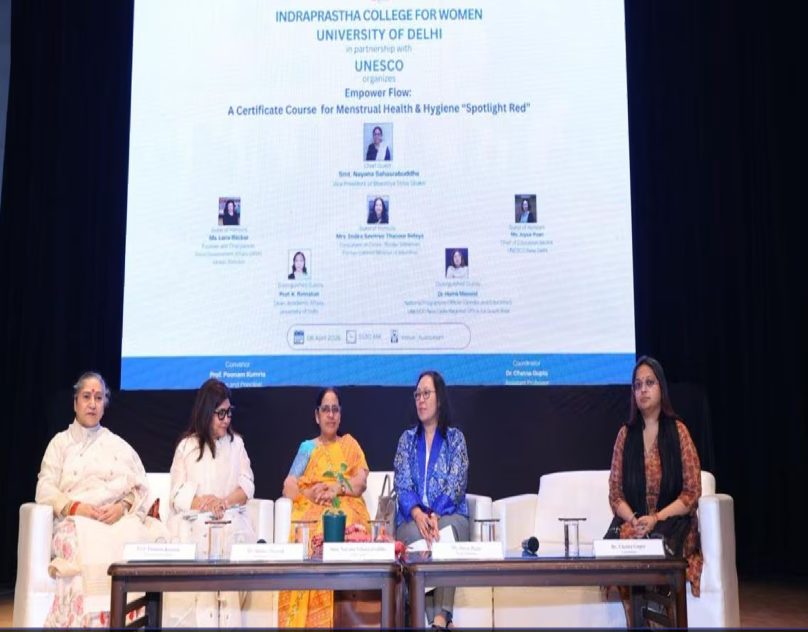
IPCW, UNESCO Launch Menstrual Health Course at Delhi University
IPCW–UNESCO Initiative Marks a Transformative Leap in Menstrual Health Education at Delhi University
In a significant stride towards embedding gender-sensitive discourse in mainstream academia, Indraprastha College for Women (IPCW), a constituent college of the University of Delhi, has unveiled a pioneering certificate programme on menstrual health and hygiene. Developed in collaboration with the UNESCO Regional Office for South Asia, the initiative, titled “Empower Flow: A Certificate Course for Menstrual Health & Hygiene – Spotlight Red”- represents a progressive reimagining of health education within Indian higher education institutions.
The launch of this programme not only underscores the evolving priorities of academic institutions in addressing public health and social equity but also signals a broader cultural shift towards normalising conversations around menstruation, a subject long encumbered by stigma, silence and misinformation.
A Landmark Step in Academic Innovation
At its core, the new certificate course is designed to integrate menstrual health into formal learning structures, thereby moving beyond fragmented awareness campaigns and episodic workshops. By situating the subject within a structured academic framework, IPCW has effectively positioned menstrual health as an area worthy of scholarly attention, policy dialogue and sustained educational engagement.
According to institutional representatives, the programme has been designed to address persistent gaps in awareness and foster a more informed and empathetic understanding of menstrual health. The curriculum blends multiple disciplinary perspectives, including health education, gender studies and social awareness, thereby enabling students to examine the issue through both scientific and socio-cultural lenses.
This multidisciplinary approach reflects a growing recognition that menstrual health cannot be treated merely as a biological concern; rather, it is deeply intertwined with education, gender equality, dignity and access to resources.
Collaboration with UNESCO: A Global Perspective
The partnership with UNESCO lends the initiative an international dimension, aligning it with global frameworks that advocate for gender equity and inclusive education. UNESCO’s involvement reinforces the importance of menstrual health as a public education issue and situates the programme within broader Sustainable Development Goals, particularly those related to quality education, gender equality and health and well-being. By collaborating with an organisation of UNESCO’s stature, IPCW has ensured that the course is not only locally relevant but also globally informed, drawing upon international best practices in health education and gender-sensitive pedagogy.
Addressing Stigma Through Structured Learning
One of the most compelling aspects of the programme is its explicit commitment to dismantling the stigma surrounding menstruation. For decades, menstruation has remained a subject cloaked in cultural taboos and social discomfort, often resulting in misinformation, restricted mobility for young women, and disrupted educational experiences.
The course seeks to confront these challenges head-on by equipping students with accurate knowledge, critical awareness, and the confidence to engage in open dialogue. It is designed to nurture leadership skills among participants, enabling them to act as informed advocates for menstrual equity within their communities.
Faculty members involved in the programme have emphasised that inadequate menstrual awareness continues to affect the academic participation of young women across India. In many cases, insufficient access to sanitary products, infrastructure, and supportive discourse leads to absenteeism and diminished educational outcomes.
By embedding these concerns into academic study, IPCW aims to foster a generation of students who are not only aware of these issues but are also equipped to address them meaningfully.
Voices from the Inaugural Event
The launch event brought together a diverse group of distinguished guests, academics, and international representatives. Among the prominent attendees was Smt. Nayana Sahasrabuddhe, Vice President of Bharatiya Stree Shakti, served as the Chief Guest. She emphasised the importance of open dialogue, noting that menstruation must be recognised as a natural biological process rather than a source of shame or exclusion.
Ms. Joyce Poan, Chief of Education Sector at UNESCO New Delhi, highlighted the significance of integrating menstrual health into educational systems, describing it as a vital component of public awareness and gender equity. Similarly, Dr. Huma Masood of UNESCO underscored the need for institutional frameworks that embed menstrual health within broader policy structures.
Principal Prof. Poonam Kumria, who led the programme, articulated the institution’s commitment to addressing educational inequalities stemming from a lack of awareness and inadequate infrastructure. She noted that empowering students with knowledge is essential for creating a more inclusive academic environment.
Expanding Beyond the Classroom
While the programme has been launched within IPCW, its vision extends far beyond the college campus. According to organisers, there are plans to expand outreach initiatives across other colleges and community spaces, thereby amplifying its impact at a national scale.
This expansion reflects an understanding that menstrual health education must not remain restricted to elite academic environments but should instead be integrated into wider public discourse. By doing so, the initiative aims to foster inclusive awareness and dismantle systemic barriers that perpetuate misinformation and silence.
Reframing Menstrual Health in Indian Education
The introduction of this certificate course represents a broader evolution in India’s educational landscape. Increasingly, institutions are recognising the importance of addressing real-world issues through academic programmes that extend beyond traditional disciplinary boundaries.
Menstrual health, in particular, has emerged as a critical area of focus within gender studies and public health education. The IPCW–UNESCO collaboration thus reflects a timely response to a long-standing gap in formal education systems, where such topics have often been marginalised or overlooked.
By creating a dedicated academic space for menstrual health, IPCW has taken a decisive step towards normalising conversations essential to building equitable societies. The initiative not only empowers students with knowledge but also challenges entrenched cultural norms that have historically limited open discussion.


