Jamia Millia Islamia (JMI) Admissions 2026–27: A Pivotal Moment in Academic Expansion
In a decisive move reflective of India’s evolving higher education landscape, Jamia Millia Islamia (JMI) has formally inaugurated its admission process for the 2026–27 academic session, unveiling a remarkable expansion of its academic portfolio with the introduction of 30 new programmes. The announcement marks a significant milestone for one of India’s foremost central universities, a step that not only broadens academic opportunities, but also underscores the institution’s commitment to accessibility, interdisciplinary learning and global engagement.
Esteemed for its rich legacy, vibrant campus life and emphasis on inclusive scholarship, JMI’s latest admission cycle encapsulates both continuity and innovation: stabilising tuition fees while diversifying curricular offerings across disciplines such as humanities, engineering, science, law, architecture and vocational studies.
In this detailed exploration, we examine the salient aspects of the 2026 admissions process, the nature of the newly introduced courses, structural adaptations to admission modalities, and the broader implications for students and academic aspirants alike.
A Strategic Prospectus Launch and the Admission Opening
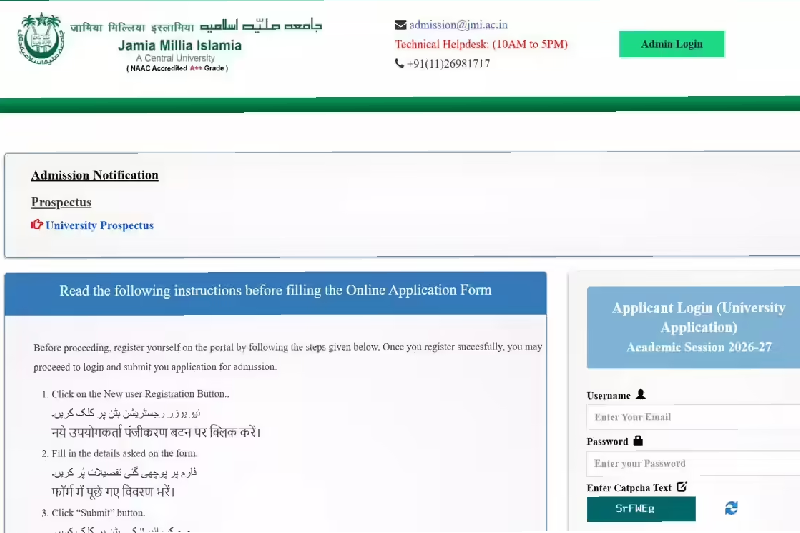
On 20 February 2026, Jamia Millia Islamia released its official 150-page admission prospectus for the academic year 2026–27 and commenced online applications through its dedicated admissions portal. The prospectus, meticulously crafted to guide prospective applicants, contains comprehensive information regarding eligibility criteria, entrance test requirements, course structures, fee details and key timelines.
This year’s admissions process distinguishes itself not just by its scale but by its strategic alignment with the National Education Policy (NEP) 2020, which seeks to transform Indian higher education through enhanced flexibility, interdisciplinary learning and multiple pathways for student progression. JMI’s adoption of the Multiple Entry Mode for the Four-Year Undergraduate Programme (FYUP) is emblematic of this vision, enabling students to embark on a modular learning journey that recognises diverse educational trajectories.
30 New Programmes: A Panorama of Possibilities
At the heart of JMI’s 2026 admissions narrative is the addition of 30 new academic programmes across a spectrum of disciplines, a testament to the university’s responsiveness to evolving academic and professional landscapes. These programmes span undergraduate, postgraduate, diploma and advanced diploma levels, offering students an array of pathways to pursue specialised interests and emerging fields of study.
Among the newly introduced offerings are:
- Language and Cultural Studies: BA (Hons) in Japanese Studies, German Studies, Uzbek Language, Literature & Culture.
- Management and Humanities: BA (Hons) in Human Resource Management; MA in Social Work, HRM and Sociology.
- Sciences and Technology: MSc (Biosciences), MSc (Biotechnology), MSc (Botany), MSc (Renewable Energy), MSc (Biophysics), MTech (Material Science & Technology).
- Engineering: BTech in Robotics & Artificial Intelligence; BTech Civil Engineering (Construction Technology); Evening BE programmes in Civil, Electrical and Mechanical Engineering.
- Law and Related Areas: LLM in Criminal Law, Corporate Law and Personal Law; PG Diploma in Computational Design & Artificial Intelligence in Architecture.
- Vocational and Applied Programmes: Advanced Diploma in Child Guidance & Counselling; BVoc in Molecular Diagnostics; Diploma in Leather Goods & Footwear Technology; Certificate programmes in Painting, Calligraphy and specialised skills.
This curated expansion reflects JMI’s strong intent to be both forward-looking and inclusive, fostering traditional academic rigour alongside professional and industry-oriented competencies.
Fees and Equity: No Hike, But Greater Access
A striking feature of this admission cycle is the university’s decision to maintain the existing fee structure across all programmes for the 2026-27 session, even as it adds new courses. In an era when escalating educational costs often constrain student choices, this commitment to fee stability is both rare and commendable.
Moreover, JMI has adopted a region-wise differential fee structure for foreign students, and significantly reduced fees for international scholars under both general and supernumerary seat categories. This approach is designed to enhance the internationalisation of higher education at JMI, inviting a more diverse cohort of learners from SAARC, West Asian, African and Latin American regions.
Structured Admissions: Categories and Pathways
To streamline the application process and accommodate the diversity of its offerings, JMI has categorised admissions into four distinct streams:
- General University Programmes: Courses that fall under JMI’s own entrance or eligibility criteria.
- CUET-Based Programmes: Courses admitting students on the basis of scores from the Common University Entrance Test (CUET) UG and PG.
- BTech and BArch Programmes: Technical and architectural streams with admissions aligned to respective qualifying tests like JEE Main and NATA.
- Multiple Entry NEP Programmes: Pathways under the Four-Year Undergraduate Programme (FYUP) that allow for entry and exit at defined stages, in keeping with NEP principles.
This layered application structure honours the multiplicity of student backgrounds and exam preferences, affording greater flexibility while maintaining academic integrity and rigour.
Exam Centres Expanded, Accessibility Enhanced
In a tangible effort to expand accessibility, JMI has increased its network of entrance examination centres from eight to eleven, adding Jaipur, Dehradun and Kishanganj to the existing roster of test venues that includes cities such as Delhi, Lucknow, Guwahati, Patna, Kolkata, Srinagar, Calicut and Bhopal. This geographically wider footprint is intended to alleviate travel burdens for aspirants and ensure broader representation from diverse regions.
Such infrastructural augmentation also demonstrates JMI’s responsiveness to the realities of student mobility and regional participation, factors that bear significantly on educational equity and opportunity.
Bridging National Standards and Institutional Autonomy
One of the most striking dimensions of this admissions cycle is JMI’s commitment to harmonising national educational priorities with its own institutional ethos. By aligning with the NEP 2020’s multiple entry and exit framework, the university not only complies with contemporary policy prescriptions, but also reimagines the student experience in ways that promote autonomy, flexibility and lifelong learning.
This alignment is not merely procedural; it holds substantive implications for students, enabling them to tailor their academic journeys according to emerging interests, career goals and life circumstances, a transformation that realises the spirit of a more dynamic, adaptive higher education system.
What Prospective Students Should Know
Aspiring applicants considering JMI for 2026-27 must be attentive to several key procedural and strategic considerations:
- Application Timeline: The JMI admission portal opened on 20 February 2026, with registration scheduled to remain active until 25 March 2026 for most programmes, and up to 10 days after respective national test result declarations for CUET, JEE Main, NEET and related screens.
- Eligibility and Requirements: Each programme specifies detailed eligibility criteria within the admission prospectus. Prospective students are encouraged to consult the document in full to ensure compliance with academic and procedural prerequisites.
- Strategic Choices: Given the breadth of options from classical arts to cutting-edge technology and interdisciplinary studies, applicants should align their choices with long-term academic and career aspirations, ensuring that they leverage both emerging opportunities and academic rigour.
A Broader Educational Tapestry
In the context of India’s vibrant education ecosystem, JMI’s expanded offerings represent more than a mere incremental increase in course numbers. They signify a reaffirmation of the university’s mission to democratise knowledge, integrate tradition with innovation, and sustain a learning environment that resonates with both national priorities and global academic standards.
The absence of a fee hike, the adoption of multiple entry pathways, the introduction of strategically relevant programmes, and the expansion of test centres collectively reflect a nuanced understanding of contemporary educational demands and a determination to meet them without sacrificing accessibility or quality.
Conclusion
As Jamia Millia Islamia embarks on its 2026–27 admissions journey, the university stands at the intersection of heritage and innovation. Its enlarged academic canvas offers prospective students a rare combination of deep tradition, interdisciplinary breadth and adaptive frameworks aligned with modern policies. For students, educators and stakeholders in higher education alike, JMI’s latest initiatives invite careful attention not simply as a procedural update, but as a significant marker in the trajectory of Indian university education. With an eye to inclusivity, relevance and academic depth, the 2026 admissions season at JMI promises to be both transformative and emblematic of broader shifts shaping higher education in the 21st century.