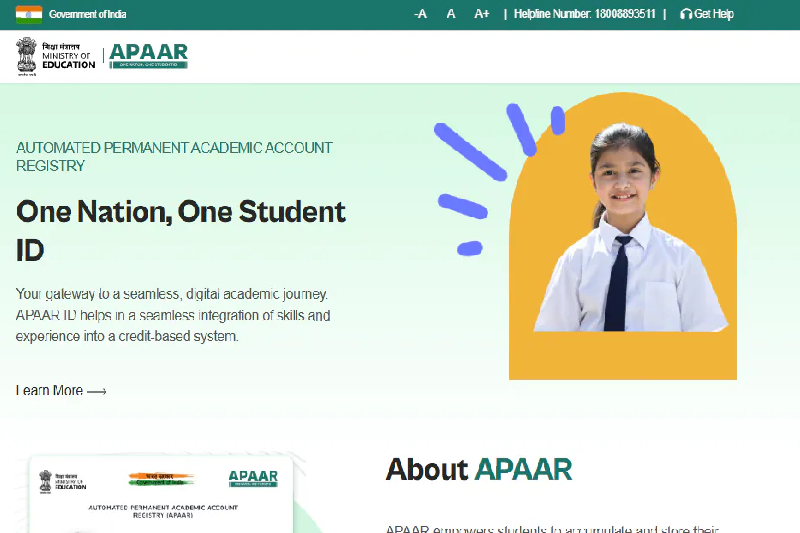
Mandatory APAAR ID for CBSE Board Exams 2026: A Digital Leap in India’s Education System
In a significant stride towards digitising educational administration, the Central Board of Secondary Education (CBSE) has announced a major procedural overhaul: beginning with the 2026 board examinations, students must possess an APAAR ID to be eligible to appear for their examinations. This directive, part of a broader agenda to modernise India’s school examination framework, underscores a broader shift within the country’s education policy, one that embraces digital infrastructure as the backbone of academic administration and record-keeping.
The announcement marks a watershed moment in the evolution of India’s school education system.
What is the APAAR ID and Why Now?
At its core, the APAAR ID: an acronym for the Automated Permanent Academic Account Registry is a 12-digit, lifelong academic identity designed to consolidate records across a student’s educational journey. Conceived under the aegis of the Government of India’s National Education Policy (NEP) 2020 and dovetailing with the One Nation, One Student ID initiative, the APAAR ID is envisioned as a cornerstone of India’s digital education architecture.
Unlike traditional identifiers, which are static and limited to individual examinations or institutions, the APAAR ID offers a persistent and unified digital reference. This enables seamless tracking of academic data from school enrolment and board exam results to higher education admissions and professional credential verification, all anchored in a single digital identity. It is a mechanism that reflects global trends in leveraging digital identity systems to enhance transparency, reduce duplication, and mitigate credential fraud.
The Board’s Rationale: Efficiency, Accuracy and Academic Continuity
CBSE’s ruling body has placed considerable emphasis on the operational and systemic benefits of APAAR. By making it compulsory for students to link their academic records to this unique ID, the board aims to:
- Eliminate duplication and inconsistencies in student records that arise from manual or non-standardised data entry
- Streamline the submission of the List of Candidates (LoC), the official roster of students authorised to sit for board examinations
- Facilitate inter-institution mobility for learners who transfer across regions, syllabi or boards
- Provide a reliable digital framework for future functions such as admissions, scholarships and credential verification
By interlinking APAAR IDs with the submission of registration and LoC details, CBSE intends to ensure that every student’s academic footprint is secure, authentic and accessible throughout their scholastic trajectory.
The New Mandatory Requirement
Under the revised directive, students in Classes 9 to 12 must possess a valid APAAR ID to complete their board exam registrations and, ultimately, receive their admit cards and sit for the examinations. Although APAAR IDs were previously encouraged as part of the board’s digital initiative, the 2026 cycle represents the first time they are being enforced as an eligibility criterion.
This requirement will apply across CBSE-affiliated schools within India, covering both Class 10 and Class 12 board candidates and is intended to be embedded in the official registration process. Schools are expected to generate APAAR IDs for their students ahead of registration deadlines, ensuring compliance before the List of Candidates is finalised.
How APAAR IDs Are Created
The process for generating an APAAR ID hinges on the DigiLocker platform, India’s government-approved digital repository for storing official documents. Students (or schools on their behalf) register through DigiLocker, which links to the student’s Aadhaar (the national unique identity) and verifies their credentials before issuing the APAAR ID. Parental consent is generally required as part of this process for minors.
Once created, the APAAR ID becomes a persistent reference point for all future academic submissions, from board exam entries to migration certificates and beyond.
Implementation Challenges and Flexibility
While the policy’s intent is clear, the transition to a mandatory APAAR ID has not been entirely seamless. Several schools have reported challenges during the rollout phase, particularly in generating APAAR IDs due to data mismatches between school records and Aadhaar details, spelling inconsistencies, and delayed parental consent.
In response, CBSE introduced temporary mechanisms to allow schools to submit the List of Candidates even when a student’s APAAR ID is unavailable. In such cases, schools can use designated entries - “REFUSED” if parents decline consent, or “NOGEN” if technical or administrative hurdles prevent ID generation. These provisions are designed to prevent students from being unfairly excluded from board exams due to operational barriers.
Nevertheless, the board has reiterated that this accommodation is transitional, intended to ensure continuity for the 2026 examination cycle and that in future APAAR IDs will be strictly required without exception.
Broader Policy and Educational Implications
The compulsory adoption of APAAR IDs holds implications that extend well beyond this year’s exams:
1. Standardisation of Academic Records
By anchoring academic data to a single, digital identifier, CBSE is promoting a standardized model of record-keeping that could simplify administrative processes, reduce bureaucratic friction and support nationwide educational oversight.
2. Enhanced Digital Integration
The APAAR initiative is a linchpin of India’s broader digital education strategy, dovetailing with platforms such as DigiLocker and the Academic Bank of Credits. Together, these systems lay the groundwork for a comprehensive digital academic repository that can serve students throughout their educational and professional lives.
3. Facilitating Mobility and Global Recognition
A digital academic identity can be especially beneficial for students who relocate across states or pursue international study, as it simplifies the verification of past academic achievements without reliance on cumbersome physical paperwork.
4. Policy Alignments with NEP 2020
The initiative aligns with the spirit of the National Education Policy 2020, which emphasises flexibility, transparency, and the harnessing of digital infrastructure to improve educational delivery and outcomes nationwide.
Concerns and Cautions
Despite its potential benefits, the APAAR mandate has also prompted discussion on certain concerns, particularly around data privacy, digital accessibility and inclusion. Critics argue that tying essential academic functions to digital identifiers may inadvertently disadvantage students with limited access to digital tools or those facing challenges in generating their IDs due to documentation discrepancies. While CBSE has instituted interim flexibilities, addressing structural digital divides remains a priority for stakeholders across the educational ecosystem.
What Students, Parents and Schools Should Know
To navigate this transition successfully, students, parents and educational institutions must be proactive:
- Early APAAR Registration: Students should ensure their APAAR IDs are generated well ahead of registration deadlines to avoid last-minute complications.
- Accurate Data Submission: Schools must carefully verify all student information including names and birth dates to prevent mismatches during ID creation.
- Parental Consent: Parents are encouraged to provide consent for APAAR ID generation promptly, as this is often a key requirement in the process.
- Stay Informed: Stakeholders should rely on official CBSE communications and digital platforms rather than social media or unverified sources for accurate updates.
Conclusion: A New Era in Academic Administration
The move to make APAAR IDs mandatory for CBSE board exams 2026 represents more than a procedural tweak; it is a bold step into a future where digital identity underpins academic credibility, continuity and accessibility. While the transition is not without its challenges, the long-term benefits, including streamlined record-keeping, reduced administrative burden, and a more connected educational ecosystem are compelling. As India’s largest school board embraces this digital transformation, it sets a precedent for how educational systems can evolve to meet the demands of a data-driven age, provided that implementation remains inclusive, transparent and attuned to the needs of all students.