JEE Advanced 2026 Applications Open for Foreign & OCI/PIO Candidates
JEE Advanced 2026 Application Window Opens for Foreign and OCI/PIO Candidates: A Comprehensive Guide to Eligibility, Process, and Key Dates
The opening of the JEE Advanced 2026 application window for foreign nationals and OCI/PIO (F) candidates marks a crucial development in India’s highly competitive engineering admissions landscape. Conducted by the Indian Institute of Technology (IIT) Roorkee, the Joint Entrance Examination (Advanced) remains one of the most rigorous academic assessments in the country, serving as the primary gateway to the prestigious Indian Institutes of Technology (IITs) and other leading institutions.
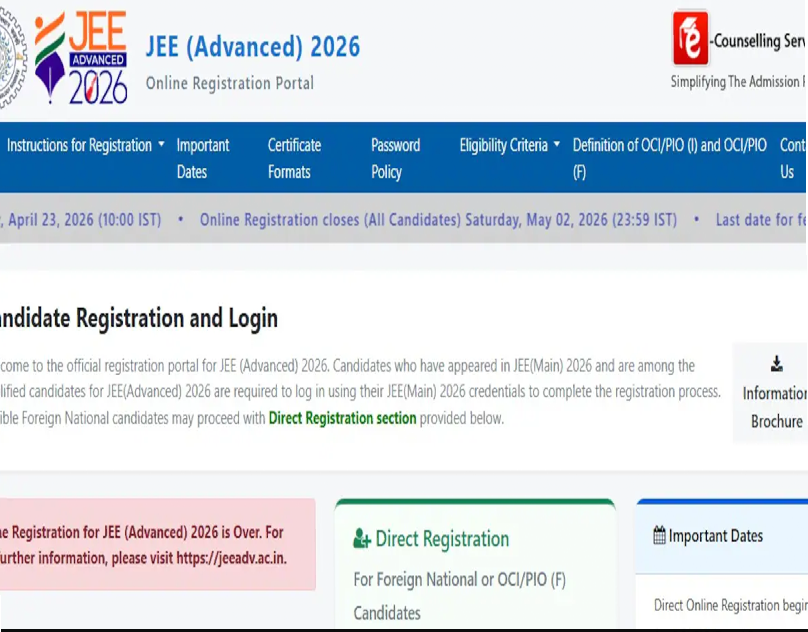
With registrations commencing on April 6, 2026, this early application window is designed to accommodate international aspirants and overseas Indian candidates, ensuring a streamlined and inclusive admission process.
A Distinct Pathway for Global Aspirants
The JEE Advanced examination has long been synonymous with academic excellence and intellectual rigour. While traditionally associated with Indian candidates progressing through the JEE Main route, the provision for foreign nationals and OCI/PIO (F) candidates introduces a parallel pathway, one that broadens access to India’s premier engineering institutions.
Unlike Indian applicants, eligible foreign and OCI/PIO (F) candidates are not required to qualify through JEE Main. Instead, they can apply directly for JEE Advanced, provided they meet the prescribed eligibility criteria.
This distinction is particularly significant, as it reduces procedural barriers and allows international candidates to participate more efficiently in the admissions process. It also reflects India’s growing emphasis on global academic integration and the internationalisation of its higher education ecosystem.
Key Dates and Application Timeline
The application window for foreign nationals and OCI/PIO (F) candidates will remain open until May 2, 2026. This provides applicants with a defined timeframe to complete the registration process, upload necessary documents, and submit the required fee.
The examination is scheduled for May 17, 2026, in a computer-based format at designated centres.
This structured timeline underscores the importance of timely preparation and adherence to deadlines. Given the competitive nature of the examination, even minor delays or errors in the application process could have significant consequences.
Understanding Eligibility and Candidate Categories
A nuanced understanding of eligibility criteria is essential for prospective applicants, particularly those belonging to the OCI/PIO category. The classification of such candidates is determined by the date of issuance of their OCI/PIO cards, resulting in distinct categories with differing eligibility criteria.
Candidates holding OCI/PIO cards issued after March 4, 2021, are considered equivalent to foreign nationals and must apply under the OCI/PIO (F) category. Conversely, those with earlier documentation may choose to apply either as foreign nationals or as candidates at par with Indian nationals, depending on their preferences and eligibility.
It is also important to note that foreign and OCI/PIO (F) candidates compete for supernumerary seats, which are in addition to the regular intake and are capped at a specified percentage of the total seats in each IIT.
This framework ensures that international participation does not affect the existing seat matrix for domestic candidates, while still promoting diversity within IIT campuses.
Application Process: A Digital-First Approach
The application process for JEE Advanced 2026 is entirely online, reflecting the broader digitisation of examination systems in India. Candidates are required to visit the official website and complete a series of steps, including registration, form submission, and document upload.
Essential documents include a recent photograph, signature, proof of identity, and a birth certificate. Additionally, foreign candidates must provide proof of citizenship, while OCI/PIO applicants must upload relevant cards and supporting documents.
The emphasis on precise document specifications, such as file formats and size limits, highlights the need for careful attention to detail. Any discrepancies or incomplete submissions may result in rejection, underscoring the importance of accuracy at every stage.
The Significance of JEE Advanced
To appreciate the weight of this opportunity, it is necessary to consider the stature of JEE Advanced within India’s academic framework. The examination is widely regarded as one of the most challenging in the country, assessing candidates in Physics, Chemistry and Mathematics through a rigorous, dynamic question format.
Each year, only a small fraction of aspirants secure admission to the IITs, making the examination both highly selective and deeply aspirational. For international candidates, participation in JEE Advanced represents not only access to world-class education but also entry into a globally recognised academic network.
Preparation and Strategic Considerations
For foreign and OCI/PIO (F) candidates, the preparation strategy may differ from that of domestic aspirants, particularly due to variations in academic curricula and examination formats.
A thorough understanding of the JEE Advanced syllabus, rooted in senior secondary-level Physics, Chemistry, and Mathematics, is essential. Candidates must also familiarise themselves with the examination pattern, which typically includes two compulsory papers, each designed to test conceptual clarity and analytical reasoning.
Time management, problem-solving speed, and adaptability to diverse question types are critical skills for success. Given the limited number of attempts permitted, a well-structured preparation plan becomes indispensable.
Opportunities Beyond Admission
Admission to an IIT extends far beyond academic instruction. These institutions are renowned for their research output, innovation ecosystems, and global collaborations. Students benefit from exposure to cutting-edge technologies, interdisciplinary learning and a vibrant campus environment.
For international candidates, this experience is further enriched by cultural exchange and the opportunity to engage with a diverse student body. The inclusion of foreign nationals within IITs reflects a broader vision of global academic integration, positioning India as an emerging hub for higher education.
The Importance of Diligence and Verification
As with any high-stakes examination, the application process demands meticulous attention. Candidates are strongly advised to verify all details before submission, ensuring that personal information, academic records and uploaded documents are accurate and consistent.
Retaining a copy of the submitted application is equally important, as it serves as a reference for future stages of the process. In the event of discrepancies, candidates may be required to provide clarifications or additional documentation.
Regularly monitoring the official website for updates is also essential, as important announcements regarding admit cards, examination centres and post-exam procedures will be communicated through official channels.
A Step Towards Global Academic Integration
The opening of the JEE Advanced 2026 application window for foreign nationals and OCI/PIO (F) candidates is more than a procedural announcement; it reflects India’s evolving educational landscape. By facilitating international participation, the IIT system continues to expand its global footprint, fostering collaboration and intellectual exchange.
For aspirants, this represents a unique opportunity to access one of the world’s most respected engineering education systems. However, it also demands a high degree of commitment, preparation, and precision.
As the application window progresses towards its closing date, prospective candidates would do well to approach the process with both diligence and foresight. In doing so, they not only enhance their chances of success but also position themselves at the threshold of an academic journey defined by excellence, innovation and global relevance.


