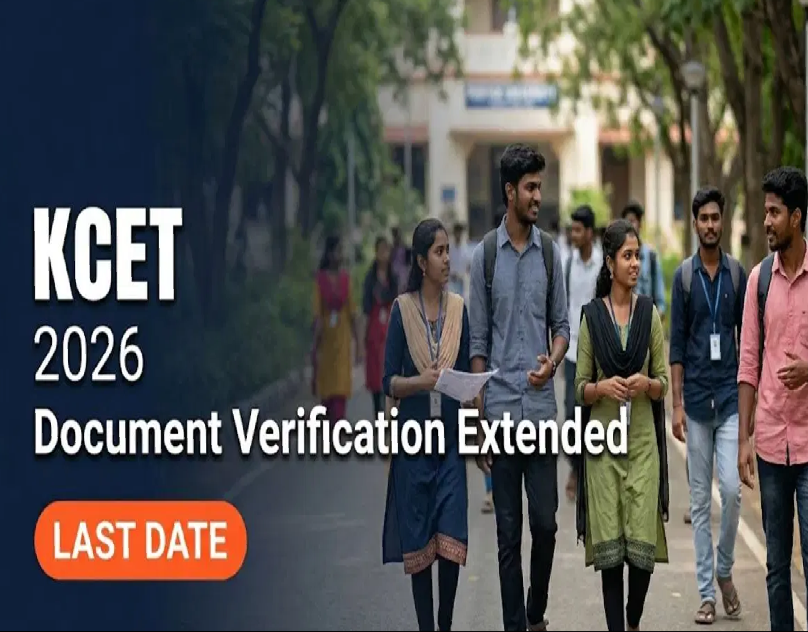
KCET 2026 Document Verification Deadline Extended by KEA
KCET 2026: KEA Extends Document Verification Deadline Amid Growing Pressure on Admission Timelines
The Karnataka Examinations Authority (KEA) has extended the deadline for KCET 2026 document verification, offering relief to thousands of candidates participating in the state’s highly competitive undergraduate admissions process. The extension comes at a crucial juncture for students seeking admission into professional courses such as engineering, pharmacy, agriculture, veterinary sciences and allied disciplines across Karnataka.
Although deadline extensions are not uncommon within large-scale examination systems, the decision reflects the increasing administrative complexity surrounding modern admission processes. For candidates navigating multiple layers of eligibility verification, category claims, and counselling requirements, document verification is not a mere procedural formality. It is one of the most decisive stages in determining admission eligibility.
The Karnataka Common Entrance Test, officially referred to as UGCET, remains among India’s most significant state-level entrance examinations. Conducted by KEA, the examination functions as the gateway to undergraduate professional education across a wide network of government, aided and private institutions within Karnataka. Every year, lakhs of students compete through the examination for a limited number of seats across high-demand academic streams.
In this context, even relatively small administrative announcements, such as extensions to verification deadlines, carry considerable significance for students and families alike.
Why Document Verification Matters So Deeply
Within the broader architecture of the KCET admission system, document verification occupies a uniquely sensitive position. Unlike the written examination itself, which primarily measures academic performance, the verification process determines whether candidates’ claims regarding eligibility, reservation, domicile, category status and educational qualifications are valid and acceptable under state regulations.
In practical terms, this stage establishes whether candidates can participate fully in counselling and seat allotment processes.
The verification process typically requires students to produce original academic certificates, identity documents, category certificates, income records, rural quota claims, Kannada medium certificates, or other eligibility-related records, depending on the reservation or admission category under which they are applying.
Any discrepancy, whether minor or substantial, can affect a candidate’s ranking eligibility, reservation benefits, or even overall participation in counselling rounds.
This explains why the extension announced by KEA has generated considerable attention among aspirants. For many candidates, particularly those from rural regions or those studying under national boards such as CBSE and CISCE, assembling and validating the required documentation often involves coordination across schools, district offices, digital portals and local authorities. Administrative delays are therefore not unusual.
The Extended Timeline and Immediate Implications
According to reports, KEA has now extended the document verification deadline until May 21, 2026, providing candidates with additional time to complete pending formalities.
The extension applies to candidates participating in the verification process for KCET 2026 admissions, including those claiming eligibility under various clauses and reservation categories. KEA is expected to continue verification procedures at designated centres across Karnataka during the revised schedule.
While the additional window may appear limited in duration, it offers meaningful relief for candidates struggling with incomplete documentation, scheduling issues, or technical difficulties linked to online systems.
Importantly, the extension also reflects the increasing logistical demands placed upon state examination authorities. Modern admission ecosystems now involve digital registration systems, Aadhaar-linked verification, automated academic record integration, reservation authentication, and real-time database validation. While these systems improve efficiency in principle, they also create new forms of procedural vulnerability.
When large numbers of students simultaneously attempt to upload records, book verification slots, or update eligibility information, even minor technical disruptions can create cascading administrative pressure.
The Expanding Complexity of Admission Systems
The KCET process today is considerably more sophisticated than it was even a decade ago. Earlier admission cycles relied heavily on manual verification structures and institution-level coordination. Contemporary systems, by contrast, increasingly integrate digital authentication, centralised counselling and automated academic data retrieval.
KEA itself has recently introduced several measures aimed at streamlining verification and reducing discrepancies. In a related development earlier this week, the authority instructed students from CBSE, CISCE and other non-Karnataka boards to update their Class 12 marks through DigiLocker to facilitate accurate rank generation and eligibility assessment.
Such initiatives reflect a broader administrative effort to reduce errors within the counselling ecosystem. Yet they also reveal how dependent admission systems have become on seamless digital coordination between examination boards, government databases and student-facing portals.
For candidates unfamiliar with these processes or lacking reliable digital access, the complexity can become overwhelming.
The extension, therefore functions not merely as an administrative adjustment but also as an implicit acknowledgement of the procedural pressures candidates currently face.
The Emotional Weight Behind Admission Formalities
Discussions around document verification often focus heavily on deadlines and procedures while overlooking the psychological dimension experienced by students.
For many aspirants, KCET represents years of preparation, academic aspiration, and family expectation. The examination itself is already emotionally demanding. However, the period following the exam frequently proves equally stressful because admission outcomes depend not only on scores but also on flawless completion of multiple administrative stages.
Students are expected to monitor schedules, upload records correctly, attend verification sessions, validate reservation claims and remain attentive to counselling updates, often within compressed timelines.
In highly competitive environments, the fear of procedural disqualification can become as intense as examination anxiety itself.
This is particularly true for first-generation college aspirants and students from smaller towns who may not possess extensive familiarity with bureaucratic admission systems. For them, a missed document, an incorrect upload, or an overlooked certificate can feel catastrophic.
The extension announced by KEA, therefore, carries emotional significance beyond its technical implications. It offers students additional time to correct errors, gather pending records and navigate the process with slightly reduced pressure.
Reservation Claims and Verification Sensitivities
One reason document verification remains so rigorous within KCET admissions is the wide range of reservation categories and eligibility clauses recognised under Karnataka’s educational framework.
Candidates may apply under rural quotas, Kannada medium reservations, Hyderabad-Karnataka provisions, defence categories, ex-servicemen categories, agricultural family backgrounds, NCC quotas, sports categories and several caste-based reservations. Each category requires supporting documentary evidence.
Verification authorities must therefore ensure not only that documents are authentic but also that they comply precisely with prescribed formats and issuing authorities. Even technically valid certificates can face rejection if procedural requirements are not met correctly.
This often creates confusion among candidates, particularly when district-level documentation practices differ or when local authorities issue certificates in inconsistent formats.
Extensions in verification timelines partly help mitigate these issues by giving students additional opportunities to secure corrected or updated records.
Karnataka’s Competitive Higher Education Landscape
The significance of KCET itself cannot be separated from Karnataka’s broader educational reputation. The state remains one of India’s most important centres for technical and professional education, particularly in engineering and technology.
Cities such as Bengaluru, Mysuru, Mangaluru and Hubballi host major engineering institutions, medical colleges, research centres and technology-linked educational ecosystems that attract students from across the country. As a result, KCET admissions carry substantial academic and professional weight.
For many candidates, securing admission through KCET is viewed not merely as entry into a degree programme but as access to Karnataka’s larger technological and industrial ecosystem. This partly explains the extraordinary attention paid to every stage of the process, from examinations and rankings to counselling and verification.
Competition remains intense because opportunities associated with strong engineering and professional institutions continue to shape long-term career trajectories.
Technology, Accessibility, and Administrative Balance
The extension also raises broader questions regarding how educational authorities balance technological modernisation with accessibility.
Digital systems undoubtedly improve efficiency, transparency and data management. Online counselling, automated rankings, and centralised portals have significantly streamlined admissions compared to older manual systems. Yet technological dependence also creates new barriers.
Students facing unstable internet access, limited digital literacy, document scanning difficulties, or overloaded portals often encounter challenges that remain invisible within policy-level discussions. Administrative reforms succeed only when technical infrastructure and user accessibility evolve simultaneously.
The recent extension suggests that KEA recognises at least some of these operational realities.
Importantly, such flexibility can help preserve institutional credibility. Rigid adherence to deadlines despite widespread procedural difficulties often generates distrust among students and parents. Extensions, when implemented responsibly, can strengthen perceptions of fairness and administrative responsiveness.
What Candidates Should Do Now
With the revised deadline now in place, candidates should use the additional time strategically rather than assuming further extensions will necessarily follow.
Students are advised to carefully review the complete list of required documents relevant to their category claims and eligibility clauses before attending verification sessions. Original certificates, photocopies, identity proofs, educational records, reservation documents and any supporting claim certificates should be organised systematically in advance.
Candidates should also monitor the official KEA portal regularly for updated instructions, slot schedules and counselling notifications.
Most importantly, students should avoid relying solely on unofficial social media rumours regarding deadlines or procedural changes. Admission cycles often generate misinformation, particularly during periods of administrative revision.
Understanding the Changing Dynamics of India’s Admission Systems
The KCET 2026 document verification extension may appear administrative on the surface, but it reflects larger transformations within India’s higher education ecosystem.
Admission processes today are no longer confined to examination halls and result declarations. They involve intricate systems of digital validation, procedural accountability, reservation authentication and real-time data coordination.
At the same time, students increasingly expect transparency, flexibility and institutional responsiveness from educational authorities. The challenge for examination bodies lies in managing both efficiency and empathy simultaneously.
KEA’s decision to extend the verification deadline illustrates this balancing act. It acknowledges that admission systems must remain rigorous without becoming unnecessarily exclusionary.
For thousands of aspirants across Karnataka and beyond, that additional time may ultimately make the difference between procedural disruption and a smooth transition into higher education.