Punjab Government Schools Achieve 100% Class 12 Pass Rate
Punjab’s Government Schools Register Remarkable Turnaround as 416 Institutions Achieved 100% Class 12 Pass Rate
Punjab’s public education system witnessed a significant moment of academic affirmation after 416 government schools across the state recorded a perfect 100% pass rate in the Punjab School Education Board (PSEB) Class 12 examinations. The achievement, announced alongside the 2026 board results, was widely viewed as a reflection of the state’s ongoing education reforms and the growing academic competitiveness of government-run institutions.
The development marked a notable shift in public perception surrounding state-funded schools, which for years had grappled with infrastructural gaps, uneven academic outcomes, and declining confidence among sections of society. The latest results, however, indicated a changing narrative, one centred on educational recovery, institutional accountability and the strengthening of foundational learning across Punjab.
A Significant Milestone for Public Education
The Punjab School Education Board Class 12 examinations for 2026 saw participation from nearly 2.65 lakh students, of whom approximately 2.42 lakh successfully cleared the examination. The overall pass percentage stood at 91.46%, reflecting a strong statewide academic performance.
Amid these broader results, the performance of government schools emerged as one of the most widely discussed aspects of the examination cycle. The fact that 416 state-run schools secured a flawless pass percentage represented not merely a statistical accomplishment, but also a symbolic validation of the reforms introduced in Punjab’s education sector over recent years.
Educational observers noted that such outcomes would have been difficult to imagine a decade ago, when government schools across many parts of India were frequently associated with poor infrastructure, teacher shortages and low academic morale. Punjab’s latest results, therefore, stood out as evidence that sustained policy interventions, when implemented consistently, can substantially alter institutional performance.
Education Reforms and the ‘Sikhya Kranti’ Push
The state government linked the improved outcomes to its broader educational reform initiative, often referred to as “Sikhya Kranti”. The programme reportedly focused on strengthening school infrastructure, modernising classrooms, improving teacher training, and introducing targeted academic interventions aimed at raising learning standards.
In recent years, government schools across Punjab witnessed increased investment in digital classrooms, upgraded laboratories, sports facilities and student-centric learning programmes. Officials argued that these measures gradually contributed to rebuilding confidence in the public education system.
The latest Class 12 results appeared to reinforce this claim. Beyond the perfect pass rates recorded in hundreds of schools, another notable indicator emerged from the merit list itself: 122 of the 275 merit-holders belonged to government schools.
This representation carried particular significance because merit lists have traditionally been dominated by private institutions with greater financial and academic resources. The increasing presence of government school students among top performers suggested a narrowing gap between public and private educational outcomes.
Girls Continued to Outperform Boys
One of the defining features of the Punjab Class 12 results remained the exceptional performance of female students. Girls once again surpassed boys in overall pass percentage as well as merit representation, continuing a trend that has become increasingly prominent in recent years.
According to the official figures, girls recorded a pass percentage of 94.73%, while boys registered 88.52%. The margin highlighted not only academic consistency among female students but also broader social changes taking place within the state’s educational landscape.
Observers noted that the sustained rise in girls’ academic achievement reflected growing awareness regarding the importance of female education, coupled with improved institutional support and access to learning opportunities. In many districts, girls from rural and economically modest backgrounds emerged among the highest achievers, reinforcing the transformative role education continues to play in social mobility.
Punjab Chief Minister Bhagwant Mann publicly acknowledged the contribution of female students, describing their success as a sign of genuine empowerment and social progress.
Toppers from Humble Backgrounds Inspire Wider Attention
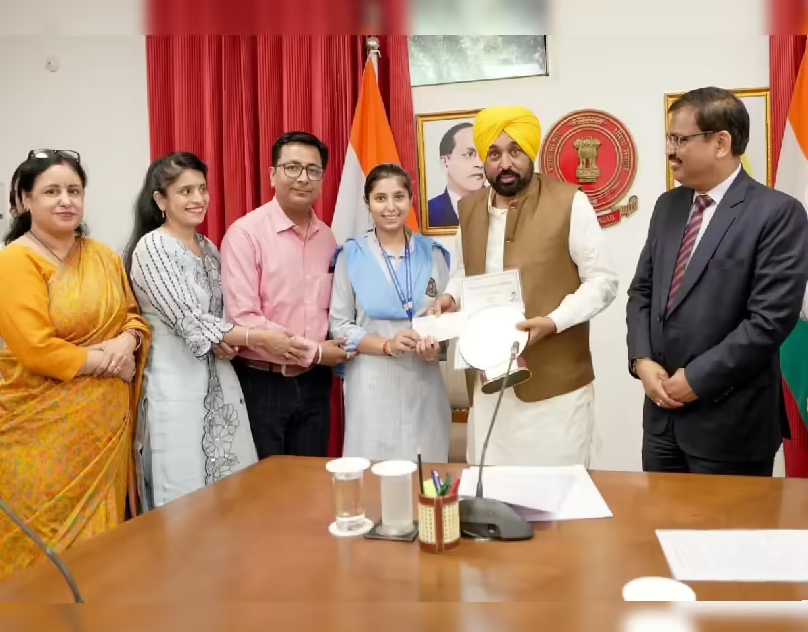
Among the most celebrated stories emerging from the results were those of three students who secured a perfect score of 500 out of 500 marks in the examination. The toppers: Supneet Kaur from Mansa, along with Suhani Chauhan and Divyanshi from Ludhiana, were felicitated by the Chief Minister in recognition of their academic excellence.
Each student received a cash award of ₹50,000 from the state government. Officials noted that all three students belonged to modest backgrounds and had balanced academics with achievements in sports and extracurricular activities.
Their stories resonated widely because they reflected a broader shift in educational aspiration within Punjab. Rather than elite urban institutions alone producing top performers, students from ordinary families and government schools increasingly emerged as symbols of academic excellence.
During the felicitation ceremony, the Chief Minister remarked that the toppers represented the spirit of perseverance and discipline, adding that the government would continue supporting talented students in achieving their future ambitions.
District-Wise Performance Reflected Competitive Academic Culture
The results also revealed interesting district-level trends. Amritsar recorded the highest district-wise pass percentage at 96%, while Patiala produced the largest number of merit-holders, with 59 students securing positions in the merit list.
These figures highlighted the increasingly competitive academic environment across Punjab, where districts are not only focusing on pass percentages but also on producing high-performing students capable of excelling at the state level.
Education analysts suggested that such competition between districts could positively influence institutional accountability and encourage schools to adopt more effective academic practices.
Changing Perceptions of Government Schools
Perhaps the most enduring significance of the 2026 results lay in their impact on public perception. For many years, private schools had been widely viewed as the preferred avenue for quality education, while government schools often struggled against stereotypes of inefficiency and underperformance.
The latest outcomes, however, challenged several of those assumptions. The performance of government schools in both pass percentages and merit representation indicated that state-funded institutions are gradually reclaiming credibility within the education ecosystem.
Parents and educators alike increasingly acknowledged that improved infrastructure alone was not responsible for the transformation. Teacher commitment, institutional monitoring, student mentorship programmes and administrative reforms all appeared to contribute to the changing academic environment.
The results also underscored the importance of long-term educational investment. Sustainable improvements in school education rarely emerge through isolated interventions; rather, they require continuous policy focus, resource allocation and institutional support over extended periods.
Broader Implications for Indian School Education
Punjab’s results may also hold wider relevance for educational policy discussions across India. At a time when several states continue to grapple with disparities between public and private schooling, Punjab’s experience offered an example of how targeted reforms can strengthen government institutions.
The performance of girls, rural students, and government school candidates further highlighted the potential of inclusive educational policies to reshape outcomes at scale. Experts noted that the success of public education systems ultimately plays a critical role in ensuring equitable access to opportunity, particularly for students from economically disadvantaged backgrounds.
As education increasingly becomes central to employment, social mobility and economic development, the strengthening of government schools assumes even greater national importance.
Closing Perspective
The Punjab School Education Board Class 12 results for 2026 represented far more than an annual academic announcement. The achievement of 416 government schools securing a 100% pass rate reflected a deeper institutional transformation taking place within the state’s education sector.
Combined with the strong performance of female students, the growing presence of government school candidates in merit lists and the emergence of toppers from modest backgrounds, the results pointed towards a broader narrative of educational resurgence.
While challenges within public education undoubtedly remain, Punjab’s latest outcomes suggested that consistent reforms, improved infrastructure and sustained academic support can gradually redefine the trajectory of government schooling. In doing so, they also reaffirmed a simple but enduring truth: meaningful educational progress is ultimately measured not only by statistics, but by the opportunities created for students across every section of society.