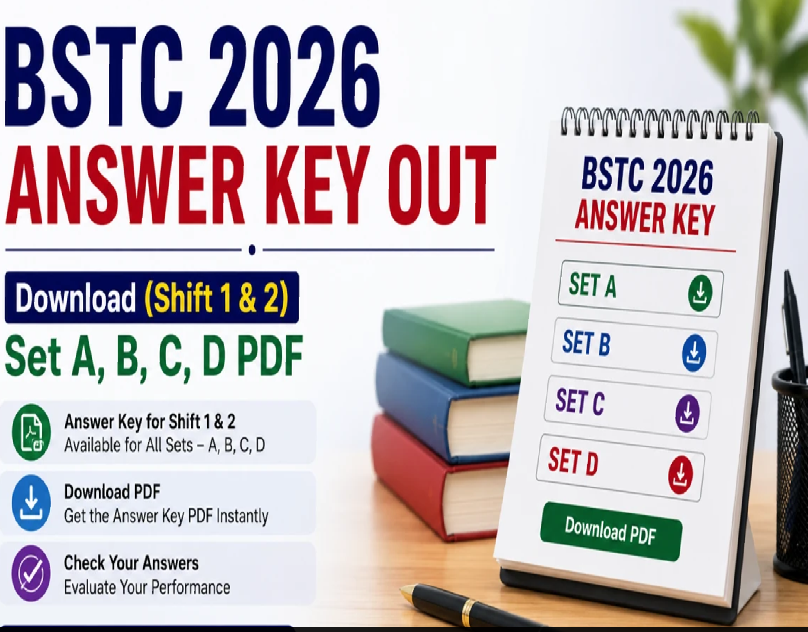
Rajasthan BSTC 2026 Answer Key Released by VMOU Kota
Rajasthan BSTC 2026 Answer Key: Transparency, Evaluation and the Road to Teacher Education
The release of the official answer key for Rajasthan BSTC 2026 marks a pivotal moment in the state’s teacher education admission process. Conducted by Vardhman Mahaveer Open University (VMOU), Kota, the Pre Diploma in Elementary Education (Pre DElEd) examination serves as the gateway for aspiring primary school teachers across Rajasthan. With the publication of the answer key and corresponding shift-wise question papers, candidates are now positioned at a crucial stage, one that bridges examination performance and eventual admission outcomes.
Unlike the finality associated with result declarations, the answer key introduces a phase of reflection and verification. It empowers candidates to engage actively with their performance, transforming what might otherwise be a passive waiting period into an informed and participatory process.
The Function and Significance of the Answer Key
At its core, the answer key is a mechanism of transparency. By making the correct responses publicly available, the examination authority enables candidates to cross-check their answers and estimate probable scores. This process not only demystifies evaluation but also fosters trust in the system.
For an examination such as BSTC, where competition is considerable and outcomes carry significant implications for professional trajectories, this transparency is especially valuable. Candidates can assess their standing with a degree of precision, allowing them to anticipate potential outcomes and plan accordingly.
The inclusion of shift-wise question papers further enhances this clarity. Given that the examination is conducted across multiple sessions, variations in question sets are inevitable. Providing access to each shift’s paper ensures that candidates evaluate their responses against the correct reference, minimising confusion and potential discrepancies.
A Window for Accountability: The Objection Process
Perhaps the most critical aspect of the answer key release is the provision for raising objections. Examination authorities typically allow candidates to challenge specific answers within a defined timeframe, submitting evidence or justification in support of their claims.
This mechanism introduces an element of accountability into the evaluation process. It acknowledges the possibility of error, however minimal and creates a structured pathway for correction. For candidates, it represents an opportunity to ensure that their performance is assessed fairly and accurately.
However, this process demands both precision and restraint. Objections must be grounded in credible sources and articulated clearly. Frivolous or speculative challenges not only burden the system but also detract from its intended purpose. Candidates are therefore advised to approach this stage with careful consideration, focusing only on substantiated discrepancies.
Understanding the Examination Context
The Rajasthan BSTC examination occupies a distinctive place within the state’s educational framework. As an entrance test for the Pre DElEd programme, it serves as the first formal step towards a career in elementary education. The significance of this pathway cannot be overstated. Primary education forms the foundation of the learning continuum, shaping cognitive, social and emotional development in formative years.
Consequently, the selection process for teacher training programmes assumes a broader societal importance. It is not merely about identifying candidates with academic aptitude but about selecting individuals who will eventually play a pivotal role in shaping future generations.
The BSTC examination typically assesses a combination of general awareness, mental ability, teaching aptitude, and language proficiency. This multidimensional approach reflects the diverse competencies required in the teaching profession. The release of the answer key, therefore, offers candidates insight not only into their scores but also into their strengths and areas for improvement across these domains.
Digital Access and Administrative Efficiency
The availability of the answer key and question papers through the official online portal reflects the increasing digitisation of examination processes. Candidates can access, download, and review the documents with relative ease, eliminating the delays and logistical challenges that once characterised such procedures.
This shift towards digital administration has significantly enhanced efficiency, but it also places a degree of responsibility on candidates. Navigating online portals, ensuring timely downloads and adhering to submission deadlines are now integral aspects of the examination process.
Moreover, the digital format ensures that information is standardised and widely accessible, reducing the scope for misinformation. In an environment where unofficial sources often circulate unverified content, the importance of relying on official communications cannot be overstated.
The Emotional Landscape of Post-Examination Phases
While the release of the answer key is primarily a procedural development, it also carries an emotional dimension. For many candidates, it marks the first tangible indication of how their performance may translate into outcomes. This can evoke a range of responses: confidence, anxiety, relief, or uncertainty.
Managing these emotions is an often-overlooked aspect of the examination journey. Candidates who approach the answer key with a balanced perspective, recognising both its utility and its limitations, are better positioned to navigate this phase constructively.
It is important to remember that estimated scores, while indicative, are not definitive. Variations may arise during the final evaluation, particularly if objections lead to revisions in the answer key. Maintaining a measured outlook can therefore help mitigate unnecessary stress.
From Answer Key to Result: Anticipating the Next Stage
The release of the answer key sets in motion the final stages of the admission process. Once objections are reviewed and necessary corrections made, the final answer key is published, followed by the declaration of results.
For candidates, this interim period is an opportunity to prepare for subsequent steps, including counselling and document verification. Understanding the procedural requirements in advance can facilitate a smoother transition once results are announced.
In competitive examinations, preparedness extends beyond academic performance. Familiarity with admission processes, timelines and documentation requirements can significantly influence outcomes. Candidates who adopt a proactive approach are often better equipped to navigate these complexities.
A Broader Reflection on Merit and Opportunity
The BSTC examination, like many competitive tests in India, operates within a framework that seeks to balance merit and access. The use of standardised testing provides a common platform for evaluation, but it also raises broader questions about equity and inclusivity.
Access to quality preparation resources, educational background and socio-economic factors all play a role in shaping candidate performance. While the examination itself may be uniform, the conditions under which candidates prepare are far from equal.
The answer key, in this context, serves as a small but meaningful step towards fairness. By allowing candidates to verify and, if necessary, challenge the evaluation process, it reinforces the principle that merit must be both demonstrable and justly assessed.
The Role of Teacher Education in a Changing Landscape
Beyond the immediate concerns of scores and admissions lies a larger narrative: the role of teacher education in shaping the future of schooling. Programmes such as Pre DElEd are instrumental in preparing educators who will operate at the foundational level of the education system.
In an era characterised by rapid technological change and evolving pedagogical approaches, the expectations placed on teachers are expanding. They are required not only to impart knowledge but also to foster critical thinking, adaptability and emotional intelligence.
The selection of candidates for such programmes, therefore, carries long-term implications. Examinations like BSTC must continue to evolve, ensuring that they identify individuals with both aptitude and potential for growth.
Closing Observations
The release of the Rajasthan BSTC 2026 answer key represents more than a routine administrative step. It is a moment of transition, one that invites candidates to engage critically with their performance while preparing for the next phase of the admission process.
For aspirants, the task is twofold: to use the answer key as a tool for evaluation and to approach the subsequent stages with clarity and preparedness. For the examination authority, it is an opportunity to reinforce transparency and trust within the system.
As the process moves towards final results and admissions, what remains evident is the enduring significance of such examinations within India’s educational landscape. They are not merely gateways to programmes but instruments through which aspirations are channelled and opportunities realised.
In this interplay between effort and evaluation, between ambition and outcome, the answer key stands as a modest yet essential milestone, one that brings candidates a step closer to their goal of becoming educators and, in time, contributors to the broader fabric of learning and development.