UCEED and CEED 2027 Exam Date Announced by IIT Bombay
UCEED and CEED 2027: IIT Bombay Signals the Next Chapter in India’s Expanding Design Education Landscape
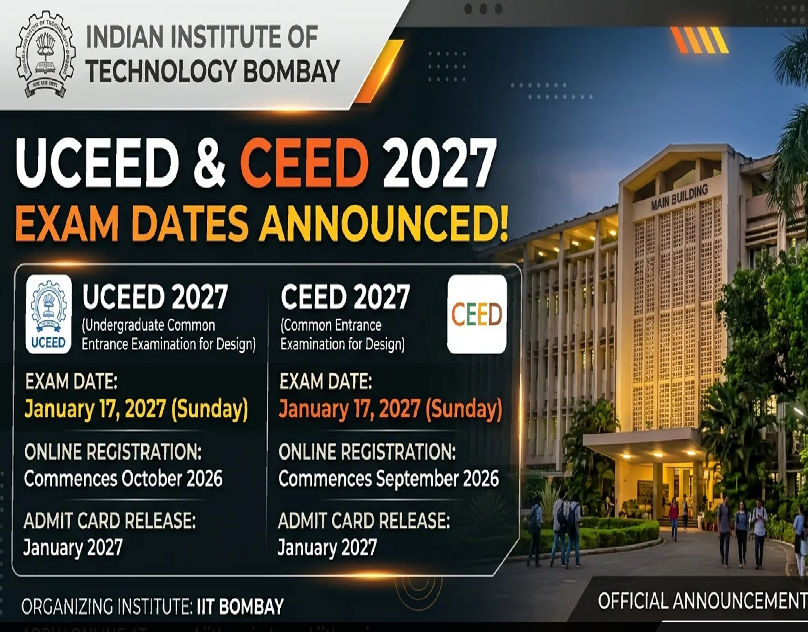
The announcement by the Indian Institute of Technology Bombay regarding the examination dates for Undergraduate Common Entrance Examination for Design 2027 and Common Entrance Examination for Design 2027 has once again drawn national attention towards the evolving significance of design education in India. Scheduled to be conducted on January 17, 2027, both examinations will take place in a single shift across centres nationwide, reaffirming IIT Bombay’s role as the principal coordinating institution for some of the country’s most prestigious design entrance tests.
While the announcement itself is procedural, its implications are considerably broader. UCEED and CEED are no longer niche examinations known only within specialised creative circles. Over the past decade, they have emerged as highly competitive national gateways for students aspiring to enter the expanding domains of industrial design, interaction design, visual communication, animation, product innovation and human-centred systems thinking.
The release of the examination schedule effectively marks the beginning of another intensive preparation cycle for thousands of aspirants seeking admission to some of India’s foremost design institutions.
The Growing Prestige of Design Education in India
The increasing prominence of UCEED and CEED reflects a larger transformation in societal attitudes towards design as a profession. Once perceived as peripheral to mainstream academic and career pathways, design education has steadily gained legitimacy within India’s educational ecosystem.
This shift has been driven by multiple factors. The digital economy has expanded the demand for user experience designers, interface specialists, visual communicators, and strategic design thinkers. Simultaneously, industries ranging from healthcare and mobility to education and consumer technology have begun recognising design not merely as aesthetic enhancement but as a framework for problem-solving and innovation.
Institutions such as IIT Bombay, through their design programmes, have played a crucial role in shaping this transition. The Industrial Design Centre (IDC) at IIT Bombay, in particular, has acquired a reputation for combining technological understanding with creative inquiry, thereby producing graduates equipped to navigate interdisciplinary challenges.
Consequently, examinations like UCEED and CEED now attract candidates from remarkably diverse backgrounds: students of science, commerce, humanities, architecture, engineering and fine arts alike.
Understanding UCEED and CEED
Although frequently mentioned together, UCEED and CEED serve distinct academic purposes.
UCEED is conducted for admission to Bachelor of Design (BDes) programmes offered by participating institutions, including IIT Bombay, IIT Delhi, IIT Guwahati, IIT Hyderabad, IIT Roorkee and IIITDM Jabalpur. It primarily caters to students completing secondary education who wish to pursue undergraduate studies in design.
CEED, by contrast, is intended for postgraduate admissions, particularly Master of Design (MDes) programmes across IITs and other participating institutes. It attracts graduates from a broad range of disciplines, many of whom seek to integrate design thinking into technical, managerial, or creative careers.
Despite these differences, both examinations share a common objective: identifying candidates with originality, analytical thinking, visual sensitivity and problem-solving ability.
Beyond Conventional Testing
One of the defining characteristics of UCEED and CEED is their departure from conventional entrance examination models. Unlike assessments that prioritise rote memorisation or repetitive procedural accuracy, these examinations attempt to evaluate creativity, observation, design aptitude and conceptual reasoning.
According to the examination structure released by IIT Bombay, UCEED 2027 will comprise two sections: Part A and Part B. Part A includes Numerical Answer Type (NAT), Multiple Select Questions (MSQ) and Multiple Choice Questions (MCQ), collectively carrying 200 marks. Part B focuses on sketching and design aptitude, carrying 100 marks.
Similarly, CEED 2027 will also be divided into two parts. Part A evaluates aptitude through objective-format questions, while Part B assesses creativity, sketching, visual sensitivity, form sensitivity and problem identification.
This structure reflects a deliberate attempt to balance analytical precision with imaginative thinking. The examinations recognise that effective designers must not only generate ideas but also understand systems, users and practical constraints.
Preparation in a Highly Competitive Environment
As awareness surrounding these examinations grows, so too does competition. Aspirants today prepare through a combination of coaching institutes, online platforms, portfolio development exercises and independent creative practice.
Interestingly, discussions within student communities increasingly reveal that preparation for design examinations differs fundamentally from preparation for traditional engineering or medical entrance tests. Online forums and candidate discussions frequently emphasise observation skills, portfolio thinking, visual storytelling and conceptual clarity over formulaic memorisation.
For many aspirants, this represents both liberation and uncertainty. Unlike examinations with narrowly predictable patterns, design entrance tests reward originality and interpretive thinking. Consequently, candidates must cultivate habits of curiosity, engaging with architecture, typography, cinema, product design, sustainability, visual culture and everyday human behaviour. This broader intellectual engagement often becomes the defining feature of successful preparation.
The Expanding Influence of IIT Design Programmes
The growing interest in UCEED and CEED is inseparable from the increasing visibility of IIT design programmes themselves. Traditionally associated with engineering and technological research, IITs have gradually broadened their academic identity to include design innovation as a core interdisciplinary field.
This evolution reflects global trends. Around the world, leading universities increasingly integrate design thinking into technological development, entrepreneurship, urban planning and digital systems. India’s IITs are similarly recognising that future innovation will depend not only on technical competence but also on human-centred problem-solving.
The integration of design into IIT ecosystems has therefore expanded the credibility and appeal of these programmes. Students are drawn not merely by institutional prestige but by the possibility of working at the intersection of creativity and technology.
Furthermore, graduates from these programmes increasingly find opportunities across sectors, including product development, interaction design, animation, strategic consulting, mobility systems, gaming, healthcare innovation and public policy.
The Importance of Eligibility and Timing
Although detailed registration schedules and eligibility criteria for the 2027 cycle are expected to be released later in the year, IIT Bombay has indicated that official notifications will likely be issued around October 2026.
This interim period becomes particularly important for aspirants. Many students underestimate the importance of eligibility conditions, especially age criteria and qualifying examination timelines. Discussions across online communities frequently reveal confusion regarding attempt limits and board examination eligibility.
Such misunderstandings can have serious consequences. Candidates are therefore advised to review official information bulletins carefully once released and avoid relying exclusively on informal interpretations circulating online.
Equally important is the recognition that preparation for these examinations cannot be compressed into a short timeframe. Developing visual sensitivity, sketching fluency and design reasoning typically requires sustained practice rather than last-minute revision.
A Reflection of India’s Educational Transition
The growing institutional importance of UCEED and CEED also reflects broader shifts within Indian education itself. Increasingly, students are seeking careers that combine creativity with impact, rather than adhering rigidly to traditional professional hierarchies.
This transition is significant. It indicates a gradual movement away from overly narrow definitions of academic success and towards a more plural understanding of talent and professional contribution.
At the same time, the rise of design education introduces new responsibilities for institutions. As competition intensifies, examinations must continue evolving to ensure fairness, accessibility and meaningful assessment of aptitude rather than superficial coaching-driven performance.
The challenge lies in preserving creativity within a highly competitive ecosystem, a balance that remains delicate but essential.
Looking Ahead
The announcement of the January 17, 2027, examination date may appear distant at present, yet for serious aspirants, preparation has already begun. The months ahead will likely witness an intensification of portfolio-building exercises, sketching practice, aptitude development and conceptual exploration.
For many candidates, these examinations represent more than admission tests. They symbolise entry into disciplines that shape how people interact with technology, environments, products and systems. In an increasingly complex world, such disciplines are acquiring unprecedented relevance.
As IIT Bombay prepares to release detailed notifications later this year, one thing remains evident: UCEED and CEED are no longer peripheral academic pathways. They have become central to India’s expanding vision of innovation, one where creativity, empathy and analytical intelligence converge to address the challenges of the future.