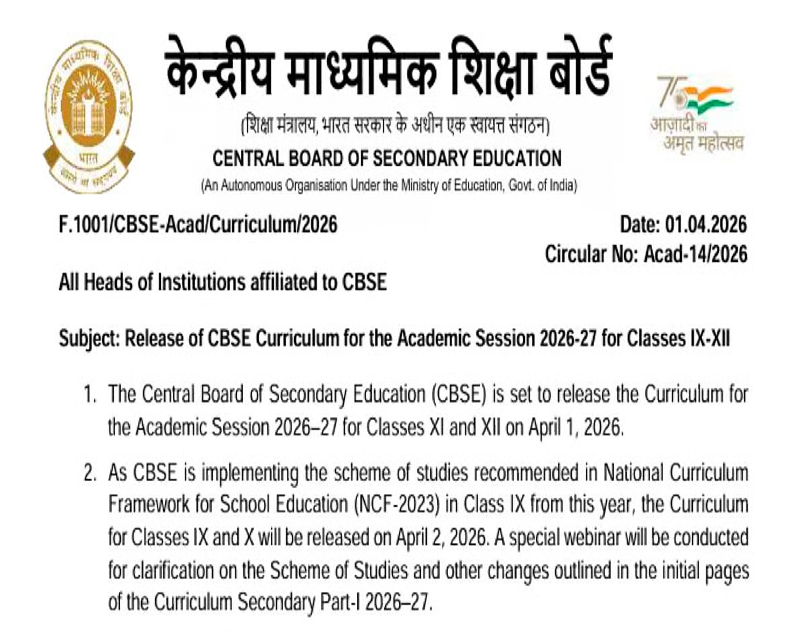
CBSE to release new curriculum for Classes 9–12 today; webinar scheduled at 3 PM for details
CBSE Curriculum 2026-27: Board To Release New Syllabus For Classes 9-12 Today, Webinar At 3 PM
In a significant development for India’s school education landscape, the Central Board of Secondary Education (CBSE) is set to unveil its revised curriculum for Classes 9 to 12 for the 2026–27 academic session. The announcement, scheduled for today, will be accompanied by a live webinar at 3 PM to familiarise educators, school leaders and academic stakeholders with the changes introduced in the updated framework.
This rollout marks yet another step in CBSE’s ongoing efforts to modernise the curriculum in alignment with evolving pedagogical priorities and national education reforms. With increasing emphasis on competency-based learning and holistic development, the new syllabus is expected to redefine classroom practices across affiliated schools.
A Timely Curriculum Overhaul
The release of the updated curriculum comes at a time when India’s education system is undergoing a paradigm shift. Over the past few years, policy interventions such as the National Education Policy (NEP) 2020 have called for a transition away from rote memorisation towards conceptual understanding, critical thinking, and application-based learning.
CBSE’s revised syllabus for Classes 9 to 12 is widely anticipated to reflect these priorities. By restructuring academic content and refining assessment strategies, the board aims to create a more meaningful and engaging learning experience for students.
The timing of the announcement, just ahead of the new academic session, ensures that schools have sufficient clarity and direction as they prepare for implementation.
Webinar at 3 PM: Bridging Information Gaps
A central feature of the rollout is the 3 PM webinar, which will serve as an official platform to explain the changes introduced to the curriculum.
Such webinars have increasingly become a key communication tool for CBSE, enabling direct engagement with stakeholders across the country. During the session, the board is expected to outline:
- The revised scheme of studies
- Updates in subject content
- Changes in assessment patterns
- Implementation guidelines for schools
This interactive format not only ensures clarity but also allows educators to raise queries and seek clarification in real time. For teachers and school administrators, the webinar represents an essential opportunity to align their instructional strategies with the updated curriculum.
Focus on Competency-Based Learning
One of the most defining features of recent CBSE reforms has been the shift towards competency-based education. The upcoming curriculum is expected to deepen this approach by prioritising skills such as analytical reasoning, problem-solving, and conceptual clarity.
Rather than emphasising memorisation, the revised syllabus is likely to encourage students to engage with content more meaningfully, through application, interpretation and critical evaluation. This aligns closely with global educational trends, where the ability to think independently is valued as highly as the acquisition of knowledge.
Such a transition also has implications for assessment practices. Examinations may increasingly incorporate case-based questions, real-world scenarios, and interdisciplinary problem sets, thereby testing students’ understanding rather than their recall abilities.
Structural Changes in Curriculum Framework
The new curriculum is expected to bring refinements to the overall structure of subjects offered in Classes 9 to 12. CBSE has already released portions of the Secondary Curriculum (Part II) for Classes 11 and 12, detailing subject groupings such as languages, academic electives and internal assessment components.
The forthcoming release is likely to complement this by introducing updated guidelines for Classes 9 and 10, thereby completing the academic framework for the entire secondary and senior secondary spectrum.
This structured approach ensures continuity across grades, enabling students to build knowledge progressively while maintaining coherence in subject design.
Alignment with NEP 2020 and NCF
The revised CBSE curriculum is not an isolated initiative but part of a broader alignment with national policy frameworks, particularly the NEP 2020 and the National Curriculum Framework (NCF).
These frameworks advocate for:
- Multidisciplinary learning
- Flexibility in subject choices
- Integration of skills and vocational education
- Reduced content load with increased conceptual depth
By embedding these principles into the curriculum, CBSE aims to create a more flexible and inclusive education system, one that caters to diverse learner needs and aspirations.
Implications for Students
For students, the updated curriculum represents both an opportunity and a challenge. On the one hand, it promises a more engaging and relevant learning experience, with greater emphasis on understanding and application.
On the other hand, it requires a shift in study habits. Students will need to move beyond memorisation and develop skills such as critical thinking, analysis and problem-solving.
In the long run, however, this approach is likely to prove beneficial. As higher education institutions and employers increasingly value these competencies, students educated under such a system may find themselves better prepared for future academic and professional pursuits.
What It Means for Teachers
Teachers will play a pivotal role in translating the revised curriculum into effective classroom practice. The shift towards competency-based learning necessitates changes not only in what is taught, but also in how it is taught.
Educators may need to adopt more interactive and student-centric teaching methods, including:
- Project-based learning
- Inquiry-driven discussions
- Collaborative activities
- Real-world problem-solving exercises
The webinar scheduled by CBSE is expected to provide valuable guidance in this regard, helping teachers navigate the transition with confidence.
Strengthening Assessment Practices
Another key area of focus in the revised curriculum is assessment. CBSE has been gradually reforming its examination system to better reflect students’ actual understanding and skills.
The updated syllabus is likely to further strengthen this approach by introducing:
- Competency-based questions
- Application-oriented assessments
- Greater weightage to internal evaluation
Such changes aim to reduce exam-related stress while ensuring that assessments remain rigorous and meaningful.
A Continuation of Ongoing Reforms
The forthcoming curriculum release should be viewed as part of a broader continuum of reforms within CBSE. In recent years, the board has introduced several initiatives aimed at modernising education, including changes to exam patterns, increased use of technology, and the integration of emerging disciplines.
The updated curriculum for 2026–27 builds on these efforts, reflecting a sustained commitment to improving educational quality and relevance.
The Road Ahead
While the announcement marks an important milestone, the real impact of the revised curriculum will depend on its implementation. Schools will need to adapt quickly to ensure that teaching practices, assessment methods and learning resources align with the new framework.
Continuous support from CBSE, through training programmes, webinars and resource materials, will be crucial in facilitating this transition.
Conclusion
The release of the CBSE curriculum for 2026–27 represents a significant step forward in India’s educational journey. By emphasising competency-based learning, structural clarity, and alignment with national policies, the revised syllabus seeks to create a more dynamic and future-ready academic environment.
As the details unfold during the 3 PM webinar, educators and students alike will gain a clearer understanding of what lies ahead. Yet, even at this stage, the direction is unmistakable: a shift towards an education system that values understanding over memorisation, skills over repetition and learning over mere instruction.