MeitY Warns CISCE Students About Fake DigiLocker Portal Stealing Aadhaar, OTP and Personal Data
MeitY Warns of Fake DigiLocker Portal Targeting CISCE Students: A Wake-Up Call for Cyber Awareness
As India’s education ecosystem becomes increasingly digitised, convenience and accessibility have transformed how students access examination records, certificates and academic services. Platforms such as DigiLocker have simplified documentation processes, enabling millions of learners to securely retrieve marksheets and credentials with remarkable ease. Yet this rapid digital transition has also created fertile ground for cybercriminals seeking to exploit trust, urgency and technological unfamiliarity.
The recent warning issued by the Ministry of Electronics and Information Technology (MeitY), in collaboration with DigiLocker, regarding a fraudulent website impersonating DigiLocker and the Council for the Indian School Certificate Examinations (CISCE), is therefore more than a routine cyber advisory. It is a stark reminder that educational spaces, once perceived as relatively insulated from cybercrime, are now becoming prime targets for digital deception.
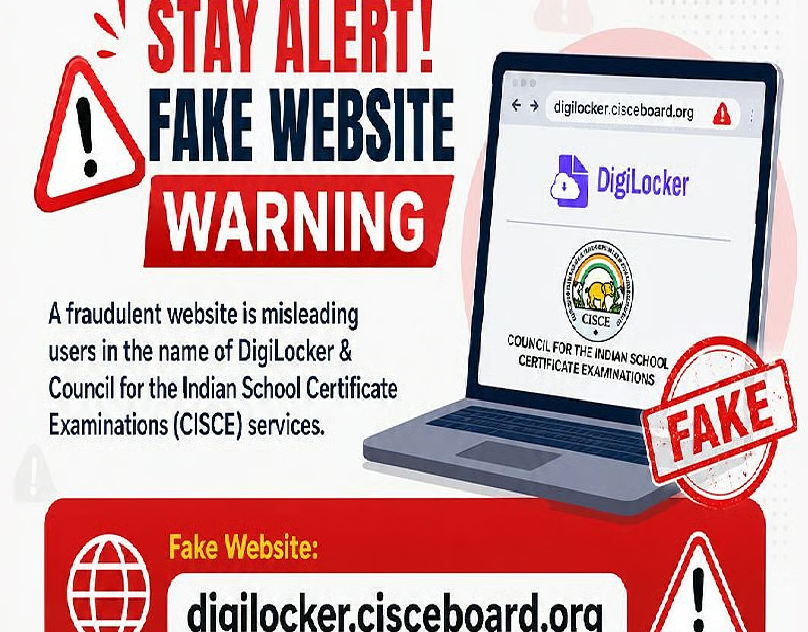
The fake portal, reportedly operating under the misleading domain “digilocker.cisceboard.org”, was designed to imitate legitimate academic and government-linked services. Authorities warned that the site could potentially collect sensitive information from unsuspecting users, including Aadhaar numbers, OTPs, passwords, banking details and uploaded documents.
What makes this incident particularly concerning is not merely the existence of a fraudulent website, but the demographic it appears to target: students and parents during a period of heightened academic activity, when examination results and digital certificates are being accessed in large numbers.
The Psychology Behind Educational Cyber Fraud
Cybercrime has evolved considerably over the past decade. Fraudsters no longer rely solely on crude phishing emails or obvious scams. Modern digital fraud increasingly depends on psychological manipulation, exploiting anxiety, urgency and institutional trust.
Students awaiting marksheets or certificates are especially vulnerable because academic outcomes often carry emotional weight and time sensitivity. A platform appearing to offer immediate access to results or official records can easily bypass suspicion, particularly if it resembles a familiar government interface.
This is precisely why fraudulent portals mimicking educational institutions have become increasingly sophisticated. They frequently incorporate official-looking logos, formal language and domain names designed to appear authentic at first glance.
The fake CISCE-DigiLocker portal reportedly mirrored the appearance of legitimate academic service platforms, thereby creating an illusion of institutional credibility.
In many cases, victims do not even realise they have been compromised until personal data has already been harvested and misused.
Why Aadhaar and OTP Fraud Is So Dangerous
The advisory issued by MeitY and DigiLocker repeatedly stressed one central message: users must never share Aadhaar details, OTPs, passwords or payment-related information on suspicious websites.
This warning is significant because such information forms the backbone of India’s digital identity infrastructure.
Aadhaar-linked data, when combined with OTP authentication, can potentially grant fraudsters access to financial accounts, government-linked services and sensitive personal records. Cybercriminals often exploit these credentials to initiate identity theft, financial fraud or unauthorised account access.
Students and parents may incorrectly assume that educational websites are inherently safe spaces requiring fewer precautions than banking platforms. In reality, educational portals increasingly intersect with identity verification systems, payment gateways and cloud-based storage networks.
Consequently, even a seemingly harmless action, such as entering a mobile number or uploading a document on a fraudulent portal, can carry substantial cybersecurity risks.
The Expanding Digitalisation of Indian Education
The incident also reflects a larger transformation underway across India’s education sector.
Over recent years, academic administration has undergone accelerated digitisation. Examination boards, universities and schools now rely extensively on online platforms for admissions, result dissemination, certificate verification and document storage.
Initiatives such as DigiLocker have undoubtedly modernised bureaucratic processes and reduced dependency on physical documentation. Students can now retrieve official records within minutes, eliminating delays and administrative inefficiencies. However, digital convenience often advances faster than digital literacy.
A substantial proportion of students and parents still possess limited awareness regarding cyber hygiene, phishing techniques and website verification practices. This knowledge gap creates vulnerabilities that malicious actors readily exploit.
The CISCE-DigiLocker fraud alert, therefore, exposes a critical reality: digital infrastructure alone is insufficient unless accompanied by widespread cybersecurity education.
The Need for Cyber Literacy in Schools
One of the most striking lessons emerging from this episode is the urgent need to integrate cyber literacy into mainstream education.
For years, conversations surrounding education reform have focused on coding, artificial intelligence and technological innovation. While these areas are undeniably important, basic digital safety remains comparatively neglected within school curricula.
Yet cybersecurity today is not a niche technical concern reserved for IT professionals. It is a fundamental civic skill.
Students should be taught how to identify suspicious URLs, recognise phishing attempts, understand HTTPS security indicators and evaluate the authenticity of digital communication. They must also learn that legitimate government platforms rarely demand sensitive information through unsolicited links or suspicious interfaces.
The safety guidelines issued by authorities in response to the fake DigiLocker portal were notably straightforward: verify URLs carefully, avoid clicking unknown links, use only official websites and never share confidential credentials unnecessarily.
These may appear to be simple precautions, yet their importance cannot be overstated in an era where digital fraud is becoming increasingly persuasive.
Institutional Trust and Public Responsibility
The rapid expansion of online governance has fundamentally altered how citizens interact with institutions. Educational boards, ministries and government agencies now operate extensively through digital ecosystems.
This creates immense opportunities for efficiency, but it also amplifies the consequences of misinformation and impersonation.
When fraudulent websites mimic official institutions, they do more than steal data; they erode public trust in digital governance itself.
Maintaining that trust requires a collaborative effort between government agencies, educational institutions, technology platforms and citizens. Authorities must continue issuing timely advisories, strengthening cybersecurity infrastructure and ensuring that official portals remain clearly identifiable and accessible.
Simultaneously, schools and colleges must treat cyber awareness as an essential aspect of student welfare rather than an optional technological concern.
Parents, too, play a crucial role. Many cyber fraud incidents succeed because adults unfamiliar with evolving digital threats inadvertently trust misleading links shared through messaging platforms or social media. The responsibility of vigilance, therefore, extends across generations.
Beyond Technology: Building a Culture of Digital Caution
The broader significance of the CISCE-DigiLocker fraud alert lies in what it reveals about contemporary society. As public life migrates online, the distinction between physical and digital safety continues to blur. A generation raised on smartphones and cloud-based services may appear technologically fluent, yet familiarity with digital tools does not automatically translate into cybersecurity awareness.
This Distinction Matters Enormously
Digital literacy is no longer simply about accessing information or navigating applications. It increasingly involves discernment, scepticism and responsible online behaviour.
India’s ambitious digital transformation agenda will ultimately succeed not only through technological innovation but also through cultivating citizens capable of navigating digital ecosystems safely and intelligently.
The fake DigiLocker portal incident may appear relatively isolated, yet it embodies a much larger challenge confronting modern education systems worldwide: preparing young people not merely to participate in digital environments, but to protect themselves within them.
In that sense, the warning issued by MeitY and DigiLocker is not just a cyber alert. It is an educational moment, one that underscores the pressing need to make digital vigilance as fundamental to learning as literacy itself.