Centre Expands Open Schooling via NIOS to Achieve 100% School Enrolment by 2030
Reaching Every Child: How Open Schooling Through NIOS Is Redefining India’s Enrolment Ambitions
India’s educational aspirations have long been anchored in the principle of inclusivity, an enduring commitment to ensure that every child, regardless of circumstance, has access to meaningful learning. In a renewed push towards this vision, the Centre has intensified efforts to strengthen open schooling through the National Institute of Open Schooling (NIOS), with the ambitious objective of achieving 100 per cent enrolment from pre-primary to secondary level by 2030.
This initiative, spearheaded by the Department of School Education and Literacy under the Ministry of Education, is not merely a policy intervention but a profound recalibration of how education is conceptualised, delivered, and accessed across the country. At its core lies a simple yet transformative idea: that education must adapt to the learner, rather than compel the learner to conform to rigid institutional structures.
The Imperative of Universal Enrolment
The pursuit of universal enrolment is central to India’s broader developmental agenda, particularly within the framework of the National Education Policy (NEP). Achieving a 100 per cent Gross Enrolment Ratio (GER) is not simply a statistical milestone; it represents a moral and socio-economic imperative.
Despite significant progress over the past decades, a considerable number of children remain outside the formal schooling system. Economic hardship, geographic isolation, social constraints, and academic setbacks often compel students to discontinue their education prematurely. Recognising these realities, the government’s renewed emphasis on open schooling reflects a pragmatic and inclusive approach.
A nationwide drive is set to identify and enrol out-of-school and dropout children, ensuring that no learner remains beyond the reach of education. This effort seeks not only to bring children back into the system but also to reimagine the pathways through which they can continue their educational journeys.
Understanding the Role of the National Institute of Open Schooling
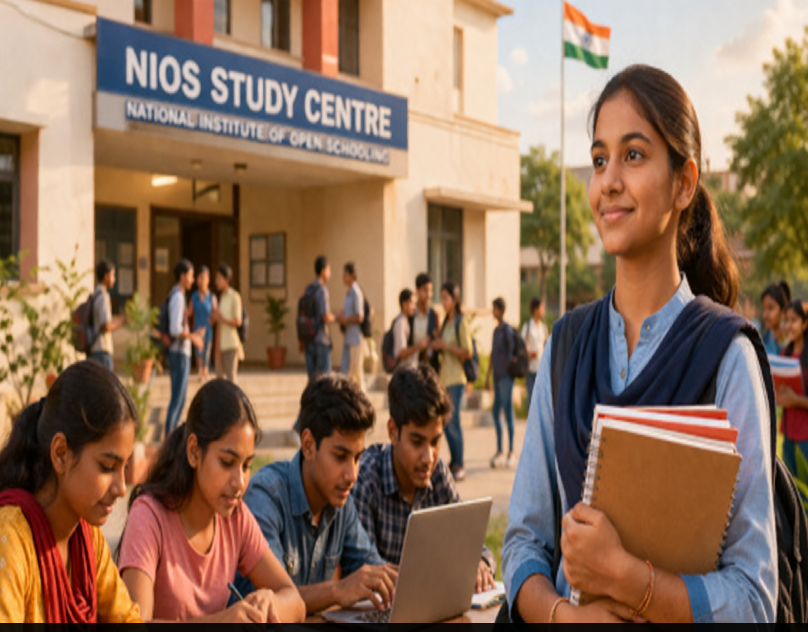
At the heart of this initiative stands the National Institute of Open Schooling, an autonomous body under the Ministry of Education and the largest open schooling system in the world.
NIOS has, over the years, emerged as a vital alternative to conventional schooling. Its open and distance learning model is designed to accommodate learners who, for a variety of reasons, are unable to participate in mainstream education. Whether due to economic responsibilities, migration, health concerns, or social barriers, these learners find in NIOS a system that is both flexible and inclusive.
The institution offers a wide array of programmes at the secondary and senior secondary levels, alongside vocational and skill-based courses aligned with employability. Crucially, its certifications are recognised on par with other national and state education boards, ensuring that students do not face systemic disadvantages upon re-entering academic or professional pathways.
Flexibility as a Pedagogical Strength
One of the defining characteristics of open schooling is its inherent flexibility. Unlike traditional systems bound by fixed schedules and uniform curricula, NIOS allows learners to tailor their educational experience according to their individual circumstances.
Students benefit from flexible admission timelines, multiple opportunities to appear for examinations, and the innovative On-Demand Examination System. These features are particularly significant for those who may have previously struggled within rigid academic frameworks.
Such adaptability is not merely a logistical convenience; it represents a fundamental shift in educational philosophy. By acknowledging the diverse realities of learners, open schooling affirms that education need not be a linear or uniform journey.
Building a Scalable and Inclusive Infrastructure
The scale of India’s educational challenge necessitates solutions that are both expansive and efficient. In this regard, NIOS provides a robust and scalable platform. With more than ten thousand study and examination centres across the country, it possesses the infrastructural reach required to accommodate large numbers of learners.
The government’s strategy involves further strengthening this network, ensuring that open schooling becomes accessible even in the most remote and underserved regions. By working in close collaboration with states and Union Territories, the initiative seeks to establish a cohesive and well-coordinated system that can respond effectively to local needs.
In doing so, the programme also emphasises standardisation and quality enhancement, recognising that access must be accompanied by meaningful learning outcomes.
Addressing the Challenge of Dropouts
Perhaps the most compelling dimension of this initiative lies in its focus on re-engaging dropout students. For many young individuals, leaving school is not a matter of choice but a consequence of complex socio-economic realities.
Open schooling offers a second chance, an opportunity to re-enter the educational system without stigma or disadvantage. It provides a pathway for those who may have previously felt excluded, enabling them to regain confidence and pursue their aspirations.
The planned nationwide identification drive will play a crucial role in this process, ensuring that out-of-school children are not merely counted but actively supported in their return to education.
Equity, Access, and Social Justice
Beyond its immediate educational objectives, the expansion of open schooling carries profound implications for social equity. By targeting marginalised, economically disadvantaged, and geographically isolated populations, the initiative seeks to bridge longstanding disparities in access to education.
Open schooling is particularly beneficial for groups such as migrant children, those in rural and tribal areas, and learners with special needs. Its inclusive design ensures that education becomes a right realised in practice, rather than an aspiration constrained by circumstance.
In this context, the initiative aligns closely with broader national goals of equity and social justice, reinforcing the principle that education must serve as a levelling force within society.
Strengthening the Educational Ecosystem
The emphasis on open schooling also signals a broader transformation within India’s educational ecosystem. Rather than viewing alternative systems as peripheral, the government is positioning them as integral components of the national framework.
This shift reflects a recognition that traditional schooling, while essential, cannot single-handedly address the diverse and evolving needs of the population. By integrating open schooling into mainstream policy, the initiative fosters a more resilient and adaptable system.
Furthermore, the focus on quality, standardisation, and institutional collaboration ensures that open schooling does not remain a secondary option but emerges as a credible and respected pathway.
The Road to 2030: Opportunities and Challenges
While the vision of achieving 100 per cent enrolment by 2030 is both ambitious and commendable, its realisation will depend on effective implementation and sustained commitment.
One of the primary challenges lies in ensuring awareness and acceptance of open schooling among communities. Despite its advantages, misconceptions regarding its credibility and value may persist. Addressing these perceptions will require targeted outreach and advocacy.
Additionally, maintaining consistent quality across a vast and decentralised network of centres will be crucial. Robust monitoring mechanisms, teacher training, and technological integration will play a vital role in this regard.
There is also the question of learner support. Flexibility, while empowering, can also pose challenges for students who require structured guidance. Ensuring adequate academic and emotional support systems will be essential to prevent attrition within open schooling programmes.
A Transformative Vision for Education
Ultimately, the Centre’s push to expand open schooling through NIOS represents a transformative moment in India’s educational journey. It reflects a shift from exclusivity to inclusivity, from rigidity to adaptability, and from uniformity to diversity.
By recognising that learning can take multiple forms and pathways, the initiative redefines the very meaning of education. It acknowledges that the true measure of an educational system lies not in its ability to serve the few, but in its capacity to reach and empower the many.
Conclusion
The ambition to achieve universal enrolment by 2030 is as much about vision as it is about execution. Through the strengthening of open schooling via the National Institute of Open Schooling, India is taking a decisive step towards realising this goal.
In doing so, it is not merely expanding access to education; it is reimagining the structures through which education is delivered. If implemented with diligence and foresight, this initiative has the potential to transform countless lives, bringing learners back into the fold, restoring aspirations, and laying the foundation for a more equitable and enlightened society.
In the final analysis, the success of this endeavour will be measured not only by enrollment statistics, but by the stories of resilience, opportunity, and empowerment that it enables, stories that reaffirm the enduring promise of education as a force for collective progress.